When Maserati was controlled by Ferrari
For eight years, from 1997 to 2005, Maserati and Ferrari were one and the same, and the V8s from Maranello drove the Trident models.

Maserati could come back under Ferrari's control. The rumour is gaining momentum following statements made by Stellantis management during the presentation of the financial results for the first half of the year. Of the Group's 14 brands, the Trident is one of those suffering most, with sales plummeting from 15,300 units in the first half of 2023 to 6,500 in 2024.
Revenues and profits have fallen and group finance director Natalie Knight has said that"there may be an assessment in the future as to where the best location for Maserati is". One clarification, however: Stellantis is focused on "creating as much value as possible for the brand."
A brand that, unlike Ferrari, has changed hands several times. As early as the 1930s, it experienced economic problems and, from 1997 to 2005, it was controlled by the 'rival' company in Maranello which, in its 85-year history, has been run by very few men: after Enzo Ferrari, there was Montezemolo, then Marchionne, and now Benedetto Vigna.
So many changes of hands
Maserati began its history not in Modena, where management moved in 1939, but in Bologna in 1914, where it was founded by Alfieri Maserati. However, between one iconic model and the next, there were almost constant financial problems which, on the death of the founder (in 1937), brought the company into the hands of the Modenese entrepreneur Adolfo Orsi.
The first road cars and numerous successes in competition followed, but in the long term they were not enough and in 1968 Citroën arrived, only to give way to Alejandro de Tomaso in 1975.
Fiat bought the company in 1993 and the following year saw the launch of Marcello Gandini's Quattroporte IV. However, in 1997, the Italian company sold 50% of Maserati to Ferrari (then part of the Fiat Group) and, two years later, the Prancing Horse took full control.

Maserati Biturbo (1984)
The Ferrari chapter
Under Ferrari control, the new Maserati factory and the 3200 GT with a Shamal-derived 3.2-litre twin-turbo V8 engine saw the light of day, representing the last link with the De Tomaso era. However, the Trident needed a proper relaunch to return to the pinnacle of elegance and performance, elements enshrined in its DNA.
But it wasn't an easy birth. In Maranello, some doubted the possibility of reintroducing the model, also given the lack of success of the previous generation. After a long gestation period in Maranello, the green light was given to the project, entrusting the design not to Marcello Gandini, but to Pininfarina, the historic 'pencil' linked to Ferrari.
Maserati Quattroporte, fourth generation
Maserati Quattroporte, fifth generation
It made its debut in 2003, a year after the Maserati Coupé and Spyder, with which it shares Ferrari's V8 engine. With a length of almost 5 metres, the new Quattroporte born in collaboration with Maranello proved to be a success, with around 24,000 units produced in nine years.
The Trident's V8 engines owe much of their DNA to Ferrari. First naturally aspirated, then supercharged, they have endured to this day, giving way to the 3.8 Biturbo that powers the Ghibli Trofeo and Quattroporte Trofeo.
Read also:
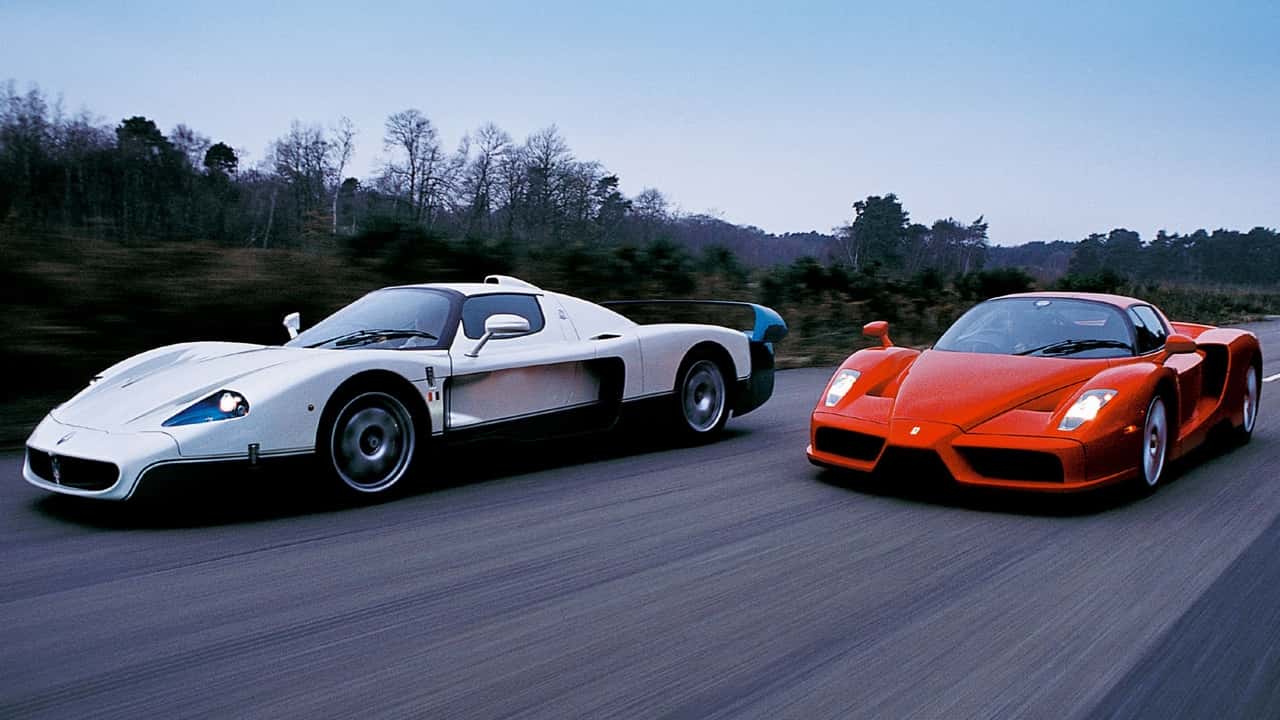
Still under the wing of Ferrari, Maserati returned to motorsport with the legendary Maserati MC12 of 2004, a fascinating road and track racing car based on the Ferrari Enzo and capable of winning numerous victories in the FIA GT World Championship.
Back to Fiat
The Maserati-Ferrari link was severed in 2005, when ownership reverted to the Fiat Group. That same year, Sergio Marchionne took over as head of Fiat Auto (Fiat Group Automobiles from 2007 to 2014 and FCA Italy from 2014 to 2023).
2003 Maserati Spyder, the 4.2-litre V8 engine
In 2010, Fiat announced the expansion of the brand. In 2013 it unveiled the new Quattroporte and Ghibli, and the following year Maserati sold more than seven times as many cars as it had five years earlier. The Trident is launched and Marchionne has a very specific plan in mind: to create a new luxury cluster made up of Maserati and Alfa Romeo, with the Giorgio platform at its centre, driven by the new Giulia. In 2019, the Modena innovation laboratory is born and everything seems to be going well.
Maserati Ghibli Ultima
Maserati MC20
In 2021 - around three years after Marchionne's death - Stellantis is born and Maserati can count on the strength of a solid Group with international reach. However, things do not go according to plan. There was talk of introducing electric models, which would gradually replace combustion engine versions. So the Folgore family was born, starting with the GranTurismo and then the GranCabrio, completed by the Levante, a mid-size SUV based on the Giorgio platform. The MC20s also arrive, sporty coupes (and cabrios) that inaugurate the new V6 christened Nettuno.
Maserati Neptune
Production of the Quattroporte, Ghibli and Levante has ended, but for the new flagship, we're now talking 2027, while for mid-size vehicles and SUVs, the horizon could be even further away.
Why are we still talking about Ferrari today?
Maserati is forecast to sell less than 12,000 units this year, which represents a double-digit negative margin. Most worryingly, there are no new products in sight until 2027.
Ferrari might be the best company to run Maserati given its excellent results since it was floated on Wall Street in 2015 (in 2023, it generated revenues of almost €6 billion with 13,663 units sold).
Maranello produces some of the most incredible engines in the world and electrification is certainly nothing new, with hybrid powertrains in the SF90 and the 296 GTB and GTS. In fact, electric motors are planned for 2025. Conversely, Maranello could exploit Maserati to generate greater volumes without undermining its exclusivity.
Ferrari 296 GTB
As we said, there's nothing official at the moment and it's all rumour. However, Tavares' comments on the profitability of Stellantis' brands are more than a hint.
RECOMMENDED FOR YOU
Ferrari CZ26 One-Off Turns SF90 Into A Radical Two-Box Supercar
Why Every New Car Seems To Have A Giant Screen Now
Ferrari Files 'LC67' Trademark. Is Another Special Model Coming?
Your Car Has a Hidden Mechanical Key. Here's Why It's There
Hot Wheels’ Ferrari F40 RLC Drop Lands August 18 With Tight Limits
Woman Leaves Dodge Charger Parked Outside. Then Her Airbags Deploy For No Reason: ‘Never Seen This Happen Before’
The Ferrari Of SUVs Is Changing. New Purosangue Version Spied