Citroën Traction Avant (1934-1957): French progress
The legendary saloon was a pioneer of front-wheel drive 90 years ago


A French legend turns 90: the Citroën Traction Avant. Built from 1934 to 1957 (the Second World War intervened) and with a name that says it all: "Traction Avant" means nothing other than front-wheel drive.
Citroën did not invent this. There were already corresponding models in the USA from 1929 and in Germany from 1931. However, the last vehicle developed under the direction of André Citroën made front-wheel drive acceptable.
Gallery: Citroën Traction Avant (1934-1957)



At the beginning of the 1930s, engineer André Lefèbvre and designer Flaminio Bertoni developed a well thought-out shape with a one-piece cabin structure and balanced weight distribution, which was primarily achieved by the significantly lower centre of gravity, the wide track, the long wheelbase and the installation of the transmission in front of the engine and front axle.
The Traction Avant is also known for its outstanding road-holding and excellent comfort. The floating engine reduces the transmission of vibrations into the vehicle interior. The rigid rear axle, which is guided on two trailing arms with torsion bar springs, also contributes significantly to a high level of ride comfort.
Citroën Traction Avant (1934-1957)
90 years ago, other innovations such as hydraulic brakes, independent front suspension and the rack-and-pinion steering first installed in 1936 caused just as much of a stir. Well thought-out details were equally well received. The windscreen of the Traction Avant can be opened slightly at the bottom to ventilate the interior in warmer outside temperatures. In winter, a blind can be fitted in front of the radiator grille to allow the engine to reach its operating temperature more quickly.
The "floating" four-cylinder engine had overhead valves operated by centrifugally cast rocker arms and were easily removable and therefore easy-to-maintain cylinder liners. The initially 32 PS engine with a displacement of 1,303 cc is equipped with a three-speed gearbox and has a fuel consumption of 9 l/100 km.
The upper mid-range model was advertised at the time with the slogan "La Traction Avant dompte la force centrifuge" - "The Traction Avant tames centrifugal forces".
Citroën 11 CV advertisement
Citroën 11 CV advertisement
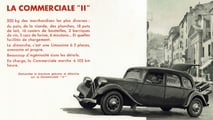
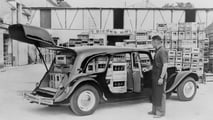
The first Type 7A presented in 1934 was replaced within a few months by the more powerful Type 7B and 7C; the Type 7S ("Sport") was further developed into the 11A and 11B. These later became known colloquially as the "7 CV" and "11 CV", named after their French tax classes (Chevaux fiscaux: tax horsepower). The 11 CV produced 56 PS from a displacement of 1.9 litres. As an alternative to the classic saloon (as a smaller "Légère" model alongside the "Normale"), the Cabriolet, Commerciale, Familiale and Faux Cabriolet (Coupé) were also produced. Lengths: 4.45 to 4.96 metres.
In addition to the legendary eight-cylinder prototypes from 1934 (22 CV), which were never produced in series and whose whereabouts are a myth, the 15-Six ("15 CV") with a 2.9-litre in-line six-cylinder engine and around 78 PS, produced from 1938 onwards, became synonymous with comfortable travelling. The technical highlight in 1954 was the 15-Six H model with hydro-pneumatically suspended rear axle, the predecessor of the legendary DS.
Citroën Traction Avant
Citroën Traction Avant
Due to its outstanding driving characteristics, the Traction Avant is also popularly known as the "gangster saloon". With its low centre of gravity, wide track and long wheelbase, legend has it that it is the ideal getaway vehicle - which it also proves in many contemporary films and crime thrillers.
In a self-experiment a few years ago in an 11 CV, the gears can be sorted amazingly well and the controls are quickly learnt. In general, you are amazed at how easy the Traction Avant is to drive. In addition, there is plenty of space inside and, even today, excellent road-holding. The four-cylinder engine produces 60 PS, so the Citroën can easily be trusted to cover longer distances.
Citroën yesterday and today:
The brand produced a total of 759,123 Citroën Traction Avant vehicles between 1934 and 1957. Between 1934 and 1935, the "Front" model, the German version of the Traction Avant, was produced at the Cologne-Poll plant.
RECOMMENDED FOR YOU
Rare Mazda 767B Engulfed In Flames At Laguna Seca
Polestar Wants Answers After Being Banned In The US
1958 Ferrari Reappears With A Shocking $5 Million Estimate
Ferrari Wants To Turn Taillights Into Active Aero
This Lovely Mercedes 190 Evo II Restomod Packs 765 Horsepower
I Watched A Hydrogen Car Hit 406 MPH. The Implications Go Far Beyond Speed
The Reborn Citroën 2CV Will 'Make Mobility Accessible To All'