'Woulda Been Good to Know:' Couple Buys RAV4 Thinking It’s Big Enough for Their Family of 4. Then They Have a ‘Rude Awakening’
"You are in for a rude awakening."
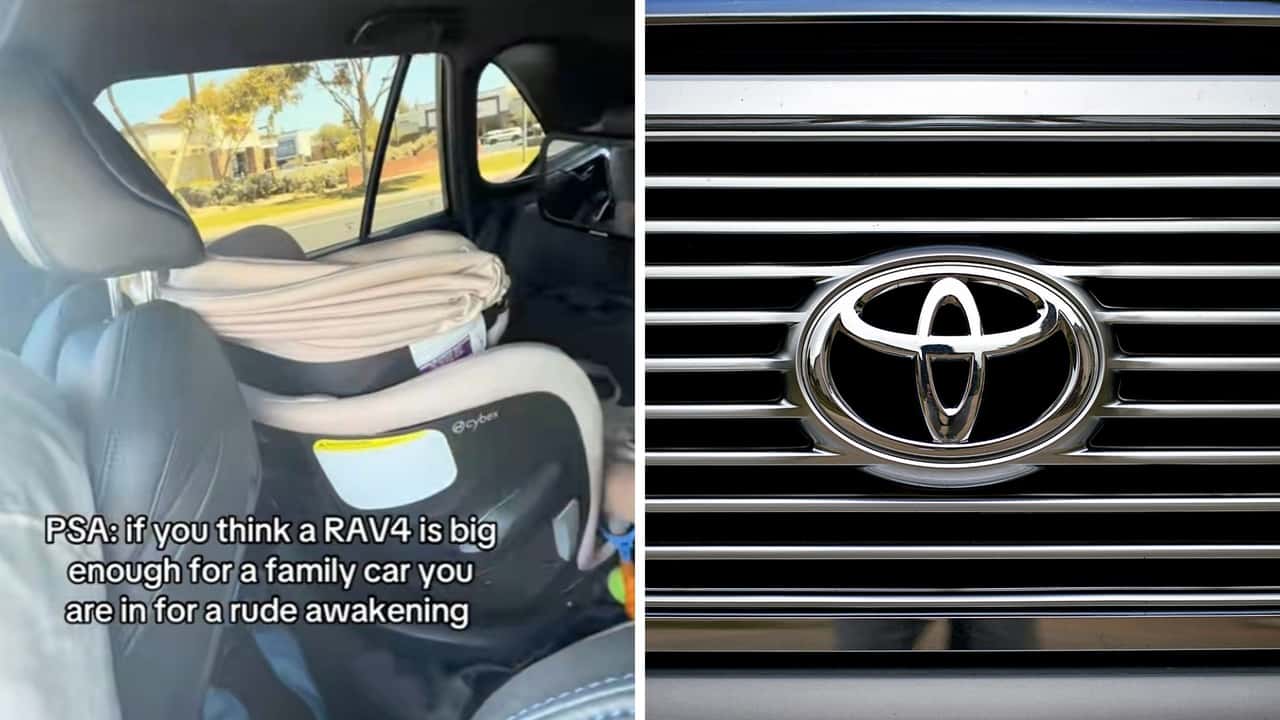

The Toyota RAV4 is high up on the list as a family car, but it may not be nearly as practical as you’d think.
Mom cars get a bad rep for being oversized or boring, but the truth is, size and space really matter when you’re hauling kids, strollers, groceries, and everything else that comes with family life.
While the RAV4 checks a lot of boxes—good gas mileage, reliability, and plenty of safety features—it falls short in one area that makes a huge difference for parents: backseat space.

Are RAV4s Good for the Whole Family?
In a viral video with more than 3.5 million views, Brit and Austin (@brittandaustin) share what it's really like to use a RAV4 as a family car.
While the RAV4 looks like it would be a great size for a family (it is one of the most popular compact SUVs on the market), the couple points out one major drawback: car seat fit.
In the TikTok, Austin is sitting in the passenger side seat with his legs pushed into the dashboard. He clearly looks uncomfortable.
“PSA: if you think a RAV4 is big enough for a family car, you are in for a rude awakening,” the text overlay on the video reads.
That’s when Brit pans the camera to reveal that their baby’s rear-facing car seat is taking up so much room that Austin is forced to push his seat all the way up to prioritize the baby’s safety.
This is a common complaint among parents who own compact SUVs. On paper, many, like the RAV4, offer solid cargo space and a comfortable ride, but the backseat dimensions simply don’t accommodate bulky car seats as well as one may expect.
“This woulda been good to know,” the caption reads.
Why Should Car Seats Be Rear-Facing?
Rear-facing seats cradle a child’s entire body in the event of a crash, distributing force more evenly and protecting the head, neck, and spine, What to Expect explains.
This is especially important for infants and toddlers, whose bones and connective tissues are still developing. In a forward-facing seat, a crash can throw a child’s head forward violently, placing enormous stress on vulnerable areas. Rear-facing seats dramatically reduce that risk.
Trending Now
Leading organizations—including the American Academy of Pediatrics (AAP), Centers for Disease Control and Prevention (CDC), and National Highway Traffic Safety Administration (NHTSA)—all recommend that children remain rear-facing as long as possible, not just until age two.
There are two main types of rear-facing seats:
- Infant seats: Lightweight and portable, usually with a carrying handle and a base that stays in the car. Most have weight limits of 28–35 pounds and height limits around 30–35 inches. Babies often outgrow these before they’re ready to face forward.
- Convertible seats: Bulkier and meant to stay in the car, but they last much longer. They can be used rear-facing until 40–50 pounds, and then switched for a forward-facing one when your child is big enough.
Parents may worry when a child’s legs look cramped in a rear-facing seat, but experts say bent legs are not unsafe. What matters most is keeping children rear-facing until they hit the seat’s maximum weight or height limits.
Best Family Vehicles
US News & World Report publishes a list of the best family cars. Top picks include the Honda Accord and Accord Hybrid for midsize and hybrid cars, the Hyundai Tucson and Mazda CX-70 for compact and two-row SUVs, and the Kia Telluride and Toyota Highlander Hybrid for three-row vehicles.
For families needing extra space or electric options, the Jeep Wagoneer L and Kia EV9 shine, while the Chrysler Pacifica remains a standout minivan.
All these models feature advanced safety systems, teen driver controls, and car-seat-friendly designs, plus modern comforts like Apple CarPlay, Android Auto, multiple USB ports, and in-car Wi-Fi, because family-friendly doesn’t mean compromising on style, tech, or driving experience.
User Error?
People were, in turns, amused and frustrated by the Brit and Austin’s post. “This is because daddy is supposed to be driving,” a top comment read.
“So many ppl have been arguing with me on a post about ‘big mom cars’ and it’s like YA WE NEED THEM because these rear-facing car seats are massive and there’s no room for our dog and all our [expletive]!” another wrote.
A few suggested that the parents may actually be part of the problem.
“I’m 5’ 10” and my husband is 6’ 5” and we did not have this problem with two rear-facing car seats in our RAV4,” one parent chimed in. “You gotta buy the right car seat for your kid and your vehicle.”
“It is big enough, you just put the large object behind the largest passenger lol,” another offered.
Motor1 reached out to Brit and Austin for comment via TikTok direct message and comment. We’ll update this post if they respond.
More From Motor1
RECOMMENDED FOR YOU

New Jersey Woman Starts Up Toyota RAV4. Then It Rains: ‘Never In My Life Have I Seen This’
Man Gets Intoxalock Breathalyzer After DUI. Then He Tries To Use It In 90-Degree Heat: ‘They Put A Camera In There Too?!?’
Woman Forced To Sell Her Toyota RAV4. Then She Sees It At The Store In Perfectly Good Condition: 'Um...'
Ferrari Wants To Turn Taillights Into Active Aero
Man Sells Grandma's Toyota RAV4 In Pristine Condition. But He Makes A Key Sales Mistake: 'Never Let A Customer Know'
How Much Car Can I Actually Afford? Here's A Simple Way To Figure It Out
Toyota Corolla 60th Anniversary Editions: US Vs Europe