Home
News
Trending
‘My Mechanic Literally Crashed Out:’ Woman Goes to the Mechanic. Now She’s Warning to Do Any Repairs Before Aug. 1
"They already charged $600 for an alternator."
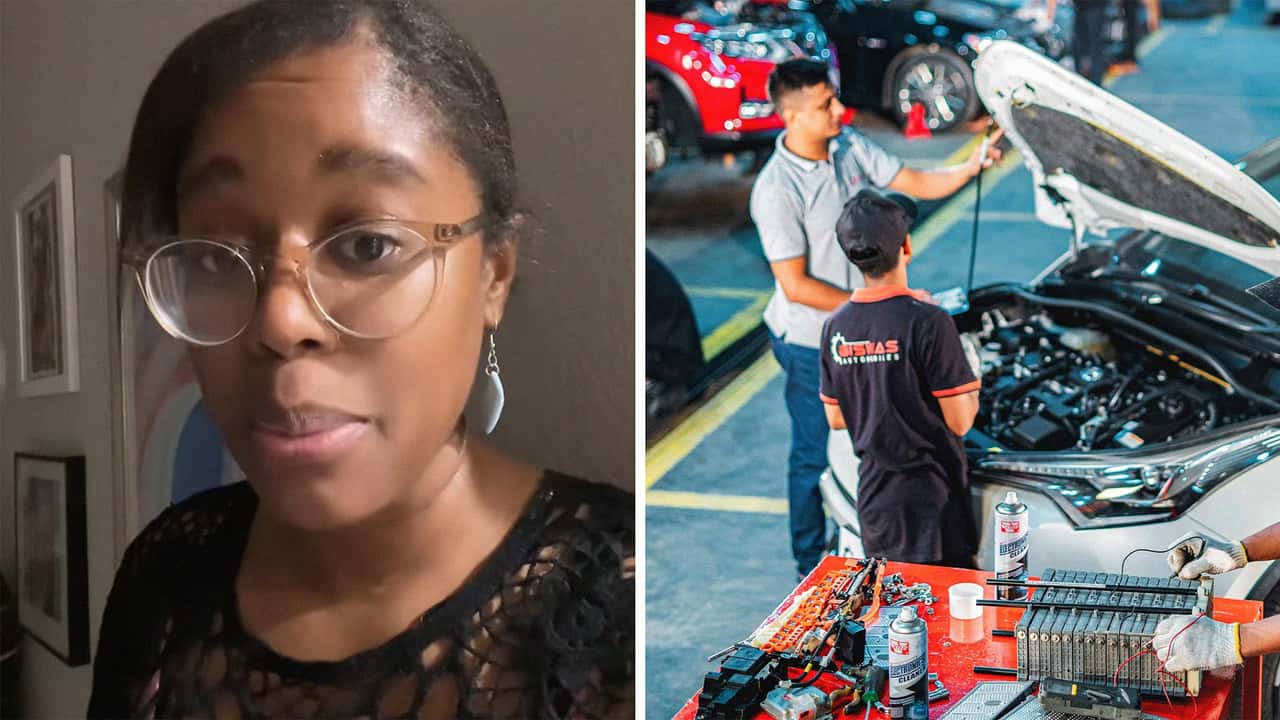
Photo by: starlantzer & Biswas Automobiles BD
Alexandra Samuels 
By: Alexandra Samuels
Jul 26, 2025 at 5:00pm ET
Add Motor1.com as a preferred source in Google
- (https://twitter.com/intent/tweet?url=https%3A%2F%2Fwww.motor1.com%2Fnews%2F766972%2Fcar-parts-price-increase-tariffs%2F&text=%E2%80%98My%20Mechanic%20Literally%20Crashed%20Out%3A%E2%80%99%20Woman%20Goes%20to%20the%20Mechanic.%20Now%20She%E2%80%99s%20Warning%20to%20Do%20Any%20Repairs%20Before%20Aug.%201&via=motor1com)
- copy
Share
Comment
A woman is warning that car repairs could soon get a lot more expensive thanks to new tariffs.
Bri (@starlantzer) says she recently took her car to a repair shop where the mechanic “crashed out” on her over an issue with her brakes. At first, she says she thought he was just having a bad day. Then came the bill. What should have been a $500 to $600 fix, she says, ended up costing more than $1,400.

Get the best news, reviews, columns, and more delivered straight to your inbox, daily.
back
Subscribe For more info, read our Privacy Policy & Terms of Use.
Bri says the mechanic blamed the spike on tariffs—and there’s more coming. Starting Aug. 1, dozens of countries, including top U.S. trading partners, will get hit with a 50% tariff. The price hikes won’t just hit cars. Coffee, electronics, and shoes are all about to get more expensive.
“If you have a car repair that you need to get done and you’re blowing it off, I recommend doing it before August 1,” Bri tells viewers. As of this writing, her TikTok has more than 34,600 views.
Tariffs on Car Parts to Squeeze Auto Repair Shops—And Drivers’ Wallets
Trending Now
 ‘Did You Know?:’ Woman Doesn’t Drive Her Kia for 3 Weeks. Then She Sees What Happened to It
Mark Fields, former Ford CEO, told CNBC that the impact of the president's new trade penalties will depend on how much of an automaker’s equipment is built in the U.S. versus imported. The same goes for repair shops, which often rely on a mix of American-made and foreign-sourced parts.
In 2024, the U.S. brought in $475 billion worth of vehicles, engines, and auto parts, according to CNN, citing data from the Bureau of Economic Analysis. Mexico accounted for $182 billion of that total, while $57 billion came from Canada.
Trump’s tariff order carves out partial exemptions for parts that fall under a trade agreement between the U.S., Canada, and Mexico—but only the portion manufactured in the U.S. will be spared. Tariffs will still apply to parts produced in Canada and Mexico. But those levies won’t take effect until Commerce Secretary Howard Lutnick finalizes a system for calculating and taxing non-U.S. goods.
How fast consumers feel the impact depends on a shop’s inventory. If they’ve got a solid supply of certain parts, prices might hold steady for a bit. But for high-demand items or shops that don’t keep much on hand, costs could climb within days or weeks.
“Many vehicle parts are sourced globally, which would increase repair costs for car owners and reconditioning costs for dealers,” Jessica Caldwell, head of insights at Edmunds, told CNN.
Car Repairs Aren’t the Only Thing Getting More Expensive
NPR reported in April that prices were already climbing due to existing tariffs on aluminum and steel, plus a baseline 10% tariff on most imports—all of which drive up the cost of car parts.
It’s not just the repair bill that could sting, though. Car insurance premiums may rise, too. If insurers are paying more for parts and labor, they’re likely to pass those costs on to drivers.
That applies even if you carry the minimum required coverage, Shannon Martin, an insurance analyst at Bankrate, told NPR.
Still, the increase won’t be instant. Unlike the parts market, insurance rates are slower to move. And with tariffs in flux, experts say it’s tough to predict when or how much premiums will rise.
“Any numbers that people give you are just guesses that can change at any moment,” Martin told NPR. “Everything’s so unpredictable right now.”
In the meantime, the best move for drivers is to stay proactive. Experts recommend finding a reliable mechanic, shopping around for the best repair and insurance rates, and keeping a clean driving record.
Tariffs may be out of your hands, but safe driving isn’t.
Drivers Brace for Impact
Commenters on Bri’s TikTok said they’re starting to feel the effects of rising prices tied to tariffs, especially when it comes to car parts.
“They already charged $600 for an alternator when it used to be $200-$300,” one user wrote.
“I work at an auto parts store, and prices are going up for sure,” said another.
“Can confirm,” a third added. “My parents run an auto shop.”
Meanwhile, a few lucky people said they’re hoping their personal connections can soften the blow.
“I gotta go hug my husband because he used to be a mechanic and fixes all my problems,” one woman wrote.
“Oohh baby, I’m glad my brother is a mechanic,” said another. “Y’all be safe.”
Others, though, vented about how unaffordable things already feel.
“Me with $4 in my bank account,” one TikTok user posted.
“Crying, throwing up, in my Audi rn,” said another.
“I’ve got like $1,700 worth of [expletive] quoted last year, I can’t even think about how much it’ll be now,” added a third.
What do you think?
View
Comments
Via TikTok direct message, Bri told Motor1, "To clarify one thing, this was for: four brakes, pads, and rotors, a battery, and [an] oil change. He specifically mentioned that my car would be influenced due to the fact that it is a Kia and all the parts are from China. He mentioned that the battery went from $170 for the battery to $305. I can confirm that, as I had to buy a battery for my EV in April. The price I had in March was 170 from Kia, and when I went to snag it jumped to $250.”
She added that her mechanic is ASE certified and has 30 years' experience in the automotive industry.
More From Motor1
Porsche Warns Employees The Business Model 'No Longer Works'
GM Took a $1.1 Billion Hit in Profits Thanks to Tariffs
Big Surprise: Stellantis Is Set to Lose Insane Amounts of Money Over Tariffs
Tariffs Are Already Killing New Cars Under $30,000: Study
We want your opinion!
What would you like to see on Motor1.com?
Take our 3 minute survey.
- The Motor1.com Team
Share this Story
- (https://twitter.com/intent/tweet?url=https%3A%2F%2Fwww.motor1.com%2Fnews%2F766972%2Fcar-parts-price-increase-tariffs%2F&text=%E2%80%98My%20Mechanic%20Literally%20Crashed%20Out%3A%E2%80%99%20Woman%20Goes%20to%20the%20Mechanic.%20Now%20She%E2%80%99s%20Warning%20to%20Do%20Any%20Repairs%20Before%20Aug.%201&via=motor1com)
- copy
GO TO COMMENTS
(
)
Got a tip for us? Email: tips@motor1.com
View all comments ( )
Popular
Driven: The Revuelto SV Is All Bull, No BS
Toyota's Next Mid-Engined Coupe Is Going Racing This Weekend
Alfa Romeo Has Had It With Huge Screens
Subaru Teases A New Manual WRX, But Only For Japan
latest articles
- Woman Takes Her Kia For Routine Maintenance. That’ll Be $1,000: ‘On A Kia?!?’ Oct 24 - Trending -
- Ferrari's CEO Praises The Tesla Roadster: 'We Have To Keep Dreaming' Oct 24 - Design -
- Woman Takes Her Car For An Oil Change At Meineke. Then She’s Told It'll Be $800: ‘How Much?!’ Oct 24 - Trending -
- NASCAR's Coolest Stock Cars Were Too Good At Their Jobs Oct 24 - Motor101 -
- Woman Buys RAV4. Then She Realizes This Highly Sought-After Item Is Already Built-In: ‘They Did Not Tell Me This’ Oct 24 - Trending -
- Customer Tries To Do ‘Courtesy Lease Return’ For Mazda. There’s Just One Problem: ‘I’ve Not Seen Something Like That Before’ Oct 24 - Trending -
- Man Buys 2026 Ford Truck. Then The Salesman Gives Him A Sneaky Offer Usually Reserved For People With Bad Credit Oct 23 - Trending -
RECOMMENDED FOR YOU
Woman Takes Her Kia For Routine Maintenance. That’ll Be $1,000: ‘On A Kia?!?’
Ferrari's CEO Praises The Tesla Roadster: 'We Have To Keep Dreaming'
Woman Takes Her Car For An Oil Change At Meineke. Then She’s Told It'll Be $800: ‘How Much?!’
NASCAR's Coolest Stock Cars Were Too Good At Their Jobs
Woman Buys RAV4. Then She Realizes This Highly Sought-After Item Is Already Built-In: ‘They Did Not Tell Me This’
Man Buys 2026 Ford Truck. Then The Salesman Gives Him A Sneaky Offer Usually Reserved For People With Bad Credit
Customer Tries To Do ‘Courtesy Lease Return’ For Mazda. There’s Just One Problem: ‘I’ve Not Seen Something Like That Before’