Nissan Micra K10 (1982-1992): Classic of the future?
Such a small car from the 80s can be a grateful classic car
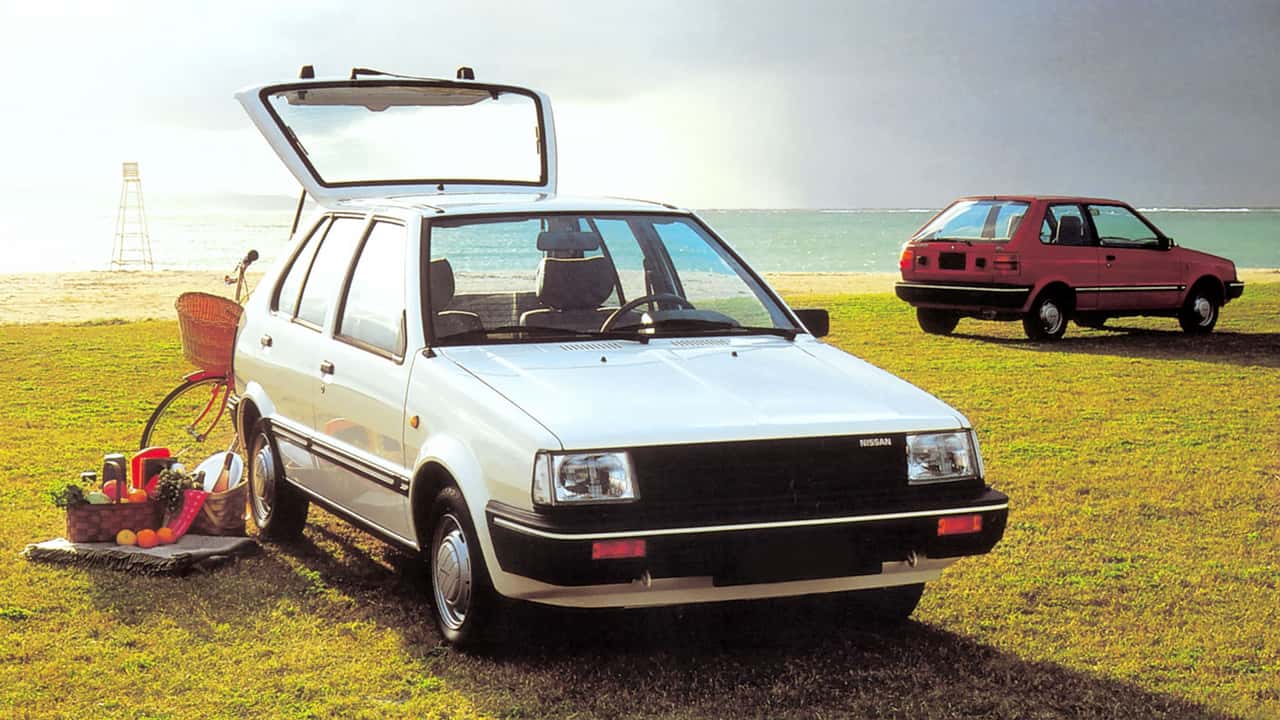

Our valued readers have probably already read the "Do you remember?" series. There we present cars from the past that are now almost forgotten. But what about the models that are still on the road in large numbers? The types that everyone knows, that have been on the road for well over 20 years, or in some cases much less.
Will they become classic cars one day? This is a source of controversy. We want to present some of these models in our "Classic of the future?" series.
Gallery: Nissan Micra (K10, 1982-1992)


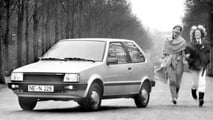

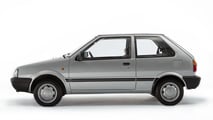
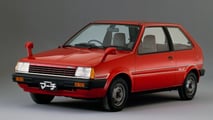
It is one of the oldest model names still in existence: Micra. In 1982, the first generation K10 appeared in Japan with the name "March". The small car from Nissan is expected to be purely electric in 2025, based on the new Renault 5 E-Tech Electric. However, we want to take a closer look at the first generation of the Micra here today. Like so many small cars from the 1980s, it's actually a very worthy classic car, but has now almost disappeared from the roads.
Many people know the problem. In times of increasingly dictatorial assistance systems, you dream of an old car at least 25 years old but preferably even older. Unfortunately, there is an incredible amount of junk on the market for too much money. Not easy for junk lovers on a budget, and it's also clear that a Mercedes S-Class is always a financial drain.
The solution: small cars from the 1980s. No rustier than their big brothers, but perhaps even more reliable. After all, if it's not inside, it can't break. And back then, small cars were really spartanly equipped, which is appealing again today. Get in, turn the key, drive off. A rewarding experience with an unladen weight of usually around 700 kilograms. And positive reactions because who was driving a Porsche 911 in 1985? Almost nobody. But small cars? Almost everyone.
Quirky: The Nissan March for Japan with wing mirrors mounted far forward
Just like the Nissan Micra. The first Micra (internal code K10) was launched on the Japanese market in October 1982 under the name March as a challenger to the Honda City, Daihatsu Charade, Suzuki Cultus/Swift and Toyota Starlet. The Micra had a particularly low fuel consumption, which was made possible by a particularly low weight: only 630 kg in the early European version. The low weight target required a minimum of insulation, which meant that the early Micras were quite noisy.
The body design was (allegedly) originally designed by Giugiaro as a replacement for the Fiat 127, but Fiat then adopted his more radical design for the Uno instead. A striking feature of early versions of the Micra is the bulge below the rear number plate, reminiscent of the early "swallowtail" Golf from 1974. Is it a coincidence that the Golf I was also originally a Giugiaro design?
Nissan Micra (1983)
VW Golf I (1974)
The Nissan Micra was launched on the European market in June 1983 and in Canada in 1984 for the 1985 model year (as a replacement for the slightly larger Nissan Pulsar hatchback). The Datsun badges disappeared completely at the end of 1984. The Micra was initially available with an all-aluminium MA10S SOHC engine with a displacement of 998 cc.
The vehicles for the European market produced 54 PS in conjunction with the standard five-speed gearbox (at that time, five gears still cost extra at Mercedes!); a three-speed automatic transmission called "Nissanmatic" was available as an option, but then there was nothing left of the driving pleasure praised in the brochure: 21 seconds to 62 mph.
It was one of several important small cars launched on the European market in 1983. That year also saw the launch of the Fiat Uno, the Peugeot 205 and the second generation of the Ford Fiesta. The Micra sold well in the UK, where it was launched in June 1983 and peaked in 1989 with more than 50,000 sales, and was one of the most popular imported cars of its time.
The model was revised in June 1985 and was recognisable by a redesigned tailgate and larger, now three-dimensional tail lights. The first Micra Turbo/MA10ET made its debut on the Japanese market, in which Nissan fitted the small 1.0-litre engine with a turbocharger and electronic fuel injection. This version was never sold in Europe. The five-door hatchback version was also launched in Europe at this time.
Our colleagues at Autobild tested economical small cars in 1988, including the Micra GL for 13,395 marks. Unfortunately, the engine was quite thirsty and guzzled 7.8 litres on average. The 3.76 metre long Nissan needed 15.7 seconds to reach 62 mph, and the top speed was 89 mph. The good workmanship and equipment were praised, as were the steering and chassis set-up. It is also "very manoeuvrable", only lacking space in the rear.
Further key data: 72 Nm at 3,600 rpm and 700 kg kerb weight. SEVEN HUNDRED. There are said to be electric car batteries that weigh just as much today ... Towards the end of its career, the weight of the K10 rose to an incredible 735 to 750 kilograms.
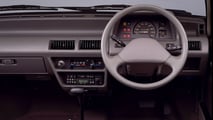
Nissan Micra (K10) Cockpit ab 1989
In 1988, Nissan launched a limited series of 10,000 units of its homologated Micra Super Turbo (EK10GFR/GAR). Both this and the 1988 Micra R (EK10FR) had the same state-of-the-art engine with sequential charging (supercharger plus turbocharger) in the form of a 930 cc inline-four engine with eight valves and MA09ERT, which produced 110 PS at 6400 rpm.
Nissan Micra Turbo
1989 saw the Micra's only major facelift with larger bumpers. In addition, there was now a 1.2-litre engine with 54 PS (60 PS without catalytic converter). The Super S equipment was also introduced for the European market. It included a factory body kit, racing seats and a rev counter and was only available in black, grey, white and red.
Nissan Micra (K10) from 1989
A number of offshoots were created on the basis of the Micra K10. The Be-1 (BK10), which was presented at the Tokyo Motor Show in 1985 (but not sold until 1987), was a limited edition model with a rounder body shape, of which only 10,000 were sold. In 1987, the Pao (PK10) hatchback with a soft top was launched (also at the Tokyo Motor Show) and went on sale in 1989; 51,657 units were sold.
The Figaro coupé (FK10) with a folding roof was presented at the same show in 1989, but was not launched on the market until 1991. As demand for the Figaro exceeded the number of 20,000 vehicles built, Nissan sold the car as part of a lottery: the winners were allowed to order the car.
More small car classics:
Production of the K10 was discontinued on 21 December 1992, although its successor (which was to become the first Japanese "Car of the Year" in Europe) had already gone into production a few months earlier.
Over the course of its life, the Micra earned a good reputation for reliability and economy. In a 1995 reliability test of four- to six-year-old cars carried out by the German automobile club ADAC, it came top in the small car class. In the long term, the Micra also achieved a much higher survival rate than many of its competitors.
RECOMMENDED FOR YOU
Nissan Warns It Must Launch New Cars Faster Or 'We Won't Survive'
JLR's New North American CEO Has A Lot Of Work To Do
The Best New Cars Coming Out In 2027
RIP: These Cars Won't Make It To 2027
The 2027 Nissan Z Is More Expensive, But It Gets One Smart Upgrade
This Trailer Drives Itself Into The Campsite
Woman Buys Nissan. Then Her CARFAX Changes After Purchase. They Missed Something Major