Home
Volkswagen
News
VW ID.3 and Cupra Born to come from Wolfsburg in future
Zwickau loses two electric models following the VW labour agreement
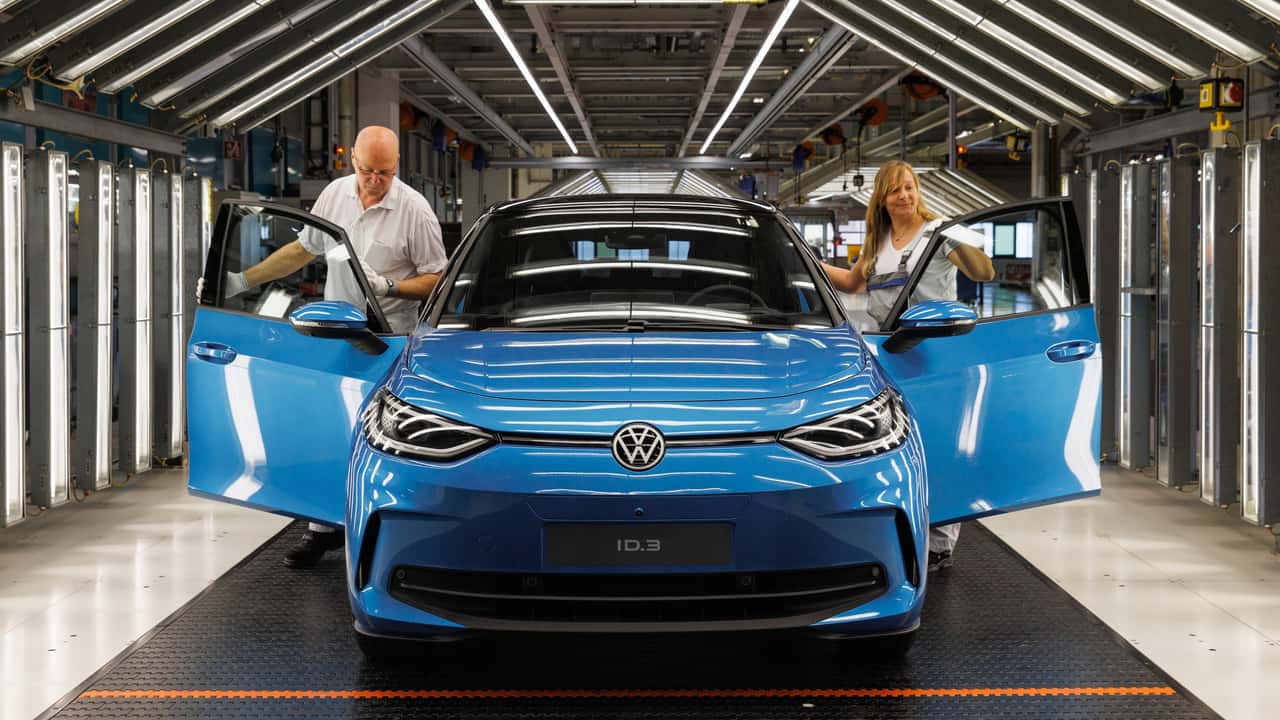
Photo by: Volkswagen

By: Stefan Leichsenring
Published by: Brian Potter
Dec 22, 2024 at 3:13am ET
Add Motor1.com as a preferred source in Google
- (https://twitter.com/intent/tweet?url=https%3A%2F%2Fwww.motor1.com%2Fnews%2F745262%2Fvokswagen-id3-cupra-born-production-moved-wolfsburg%2F&text=VW%20ID.3%20and%20Cupra%20Born%20to%20come%20from%20Wolfsburg%20in%20future&via=motor1com)
- copy
Share
Comment
Yesterday's labour agreement between the collective bargaining parties leads to new arrangements for the plants. In concrete terms, this means that some of the Group's electric models will be produced at other plants in the future.
For example, the VW ID.3 and the Cupra Born will move from the Zwickau plant to Wolfsburg. Wolfsburg had already started overflow production of the ID.3 in 2023 and is therefore capable of doing so. At the end of the decade, Wolfsburg will also receive production of the electric Golf and another model based on the Scalable Systems Platform (SSP).
The plant in Zwickau will therefore lose two of the six electric models that have been produced there to date. Audi Q4 e-tron and its Sportback variant will remain in Zwickau. The press release from the VW Group does not explicitly state whether this also applies to the ID.4 and ID.5.

VW ID.4 (left) and ID.5 have also been built in Zwickau to date
Photo by: Volkswagen
From 2027, Zwickau will "focus on one production line", according to VW**.** Previously, there were two lines there, one for the ID.3 and Born, the other for the ID.5 and the two Q4 models. The ID.4 as the sixth model can be built on both lines, as Elektroauto-News reported in 2022. The first line has apparently been cancelled and the focus is now on the second. This presumably means that the second line will only be used for overflow production of the ID.4 from 2027. The ID.5 is not mentioned at all in the press release.
The ID.4 has been built in Emden since May 2022 - initially as surplus production
The ID.7, ID.7 Tourer and the ID.4 will continue to be produced in Emden, the latter even after the facelift, as expressly stated. This probably refers to the facelift in 2026, which was announced back in August. The electric SUV will then be based on the modified version of the MEB. The ID.4 was last modified in autumn 2023. At that time, it had a 286 PS motor and a larger touchscreen.
The small car production facility at the Gläserne Manufaktur in Dresden, which was previously discussed, will be discontinued at the end of 2025. According to IG Metall, an alternative concept is being developed for the site. Allegedly, a research centre for semiconductor technology and autonomous driving is to be built there, as well as a battery recycling plant. The ID. Buzz and the Multivan (probably including the new electric version of the T7, which is due to be launched in early 2025) will remain at the commercial vehicle plant in Hanover, where costs are to be reduced.
An electric version of the VW Transporter will be launched at the beginning of 2025 - as a low-cost variant alongside the ID. Buzz
Photo by: Volkswagen
The change in plant allocation for electric cars is of course just one detail of the resolutions agreed between the Group and the trade union after 70 hours of marathon negotiations. One of the most important results is probably that none of the German plants will be closed and that there will be no compulsory redundancies until 2030, as IG Metall chief negotiator Thorsten Gröger said at the press conference, which can be viewed in an NTV video.
However, the future of the Osnabrück plant is apparently only secured until 2027. What is to become of the plant after that is still unclear. Rumour has it that the plant may be sold.
In addition, 35,000 jobs will be cut and employees will forgo part of their profit-sharing and additional holiday pay. Furthermore, the agreed wage increase of 5.5 per cent will not be paid out, but will instead be used to cover the costs of the job cuts. In total, labour costs are expected to fall by €1.5 billion per year. In the medium term, costs are expected to be reduced by around €4 billion per year.
In addition, production of the VW Golf will move from Wolfsburg to the Puebla plant in Mexico in 2027, which should reduce costs, but is unlikely to be beneficial for the image of the model and VW - after all, it is the brand's best-known model. Production capacity at the German VW plants will be reduced by 734,000 units. The Group is not disclosing how high this was previously, but the production capacity of the main plant is expected to be 800,000 units.
More production concerns from Germany:
No deal: Audi factory in Brussels closes in February
Porsche and Audi's next EVs could be late
What do you think?
View
Comments
The bottom line
VW's production facilities are not being fully utilised due to the current weak demand for electric cars. VW's costs are also high. Reduced production capacity and a reduction in labour costs will counteract this. We will see in the coming years whether this is enough to secure the future of the Group. It will certainly also depend on the development of the electric car market and the attractiveness of future VW electric cars.
Sources: VW Group, Elektroauto-News (Zwickau 2022), ntv (IG Metall)
We want your opinion!
What would you like to see on Motor1.com?
Take our 3 minute survey.
- The Motor1.com Team
Share this Story
- (https://twitter.com/intent/tweet?url=https%3A%2F%2Fwww.motor1.com%2Fnews%2F745262%2Fvokswagen-id3-cupra-born-production-moved-wolfsburg%2F&text=VW%20ID.3%20and%20Cupra%20Born%20to%20come%20from%20Wolfsburg%20in%20future&via=motor1com)
- copy
GO TO COMMENTS
(
)
Got a tip for us? Email: tips@motor1.com
View all comments ( )
Popular
12 Cars With Names That Make Absolutely No Sense
BMW Kept This Hatchback A Secret For Decades
Bugatti Restores One-Off Veyron With A Mirror-Like Aluminum Body
The Gas BMW M3 Isn't Dead: Next-Gen Prototype Roars
latest articles
- The Strange Reason The Golf GTI Had A Golf Ball Shifter Oct 20 - Motor101 -
- Photos: Porsche's Mission S Concept Takes Over New York City Oct 20 - Design -
- The 2027 Honda Passport TrailSport Looks Noticeably Taller Next To Last Year's Model Oct 20 - Off-Road -
- 12 Cars With Names That Make Absolutely No Sense Oct 20 - Lists -
- The Ford Ranger Is Getting A Bigger V6 For 2027: Report Oct 20 - Rumors -
- BMW Already Has A Deal On The New i3. But It's Not Cheap Oct 20 - Pricing -
- Remember The Ford Flex? This Weird SUV Is Now A Great Used Buy Oct 20 - Why Buy? -
RECOMMENDED FOR YOU
The Strange Reason The Golf GTI Had A Golf Ball Shifter
Photos: Porsche's Mission S Concept Takes Over New York City
12 Cars With Names That Make Absolutely No Sense
The 2027 Honda Passport TrailSport Looks Noticeably Taller Next To Last Year's Model
This German City Exists Because Of Volkswagen
The Ford Ranger Is Getting A Bigger V6 For 2027: Report
10 SUVs That Get 30 MPG Without Hybrid Power