Ferrari F430 (2004-2009): The replacement for the F360 celebrates its 20th anniversary
At the time, some of the innovations came from Formula 1.


20 years ago, at the Paris Motor Show from 25 September to 10 October 2004, Ferrari presented the F430 for the first time. The successor to the F360 was not only a visually appealing and exciting new car, its technical features also attracted attention. Many of the red car's innovations came directly from Formula 1.
The Ferrari F430 (type F131) was not entirely new, however, but rather a complete refresh of the 360 with changes to the exterior and power. The F430 was replaced by the 458, which will be presented on 28 July 2009. Between 2005 and 2009, Ferrari built an estimated 16,750 F430s.
Gallery: Ferrari F430 (2004-2009)


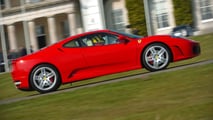


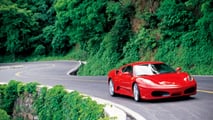
The bodywork of the F430, designed by Pininfarina in collaboration with Frank Stephenson (Ferrari-Maserati's Director of Concept Design and Development), has been reworked compared to its predecessor, the 360. Although the coefficient of air resistance has remained the same, the downforce has been considerably increased.
To ensure that the enormous power is transmitted cleanly to the road, the aerodynamics have been significantly improved compared with the F360. A smooth underbody and the imposing rear diffuser between the twin tailpipes on the left and right have contributed to this.
Although it had the same Alcoa aluminium chassis, the same roofline, the same doors and the same glazing, the 430 was clearly distinguishable from the 360. In the exterior design, much of Ferrari's heritage was used. At the rear, the Ferrari Enzo lights and the bonnet ventilation slots stand out. The car's name was engraved on the driver's mirror in Testarossa style. The large oval openings in the front bumper are reminiscent of Ferrari racing models from the 1960s, including the 156 Formula 1 'Sharknose'.
The F430 was powered by a 4,308cc V8 engine from the Ferrari-Maserati F136 family. This new engine represented a significant change for Ferrari, as all the V8 engines used until then had been derived from the Dino racing programme of the 1950s. This fifty-year development cycle ended with the all-new engine used in the F430, whose architecture replaced the Dino-sourced V12 in most of Ferrari's other cars.
The engine's performance characteristics were 490 PS at 8,500 rpm and 465 Nm of torque at 5,250 rpm, 80% of which was available below 3,500 rpm. Despite the 20% increase in cubic capacity, the engine's weight has only increased by four kilograms, while the diameter has been reduced to facilitate packaging.
The connecting rods, pistons and crankshaft were completely redesigned, while the 4-valve cylinder head, valves and intake trumpets were directly inspired by Formula 1 engines to achieve optimum volumetric efficiency. The F430 reached a top speed of over 196 mph and accelerated from 0 to 62 mph in 4.0 seconds, 0.6 seconds quicker than the previous model.
Ferrari F430 Scuderia Spider 16M (2004-2009)
Per litre of displacement, the engine produced 114 PS. The power-to-weight ratio of the 1,450 kg car was even more sensational: 1 PS displaced just 2.95 kg. This brought the F430 close to the 2.82 kg power-to-weight ratio of the Mercedes SLR McLaren. By comparison, a BMW M3 already weighs 4.5 kilos per PS.
The F430's brakes were developed in close collaboration with Brembo and Bosch, resulting in a new cast-iron alloy for the brake discs. The new alloy contained molybdenum for improved heat dissipation. The F430 was also available with the optional carbon fibre and silicon carbide (C/SiC) reinforced ceramic composite brake package. Ferrari claims that the carbon-ceramic brakes did not degrade after 300-360 laps on the Fiorano test track.
More from Ferrari:
The F430 was also equipped with E-Diff, a computer-controlled active self-locking differential that could vary torque distribution according to steering angle and lateral acceleration.
Premiere of the Manettino
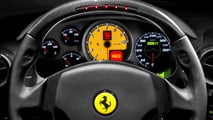
Other notable features included the first use of Ferrari's Manettino button on the steering wheel: the driver can choose between five different settings that influence ESC, Skyhook electronic suspension, gearbox behaviour, throttle response and E-Diff. This function is similar to Land Rover's Terrain Response system. The F1 automated manual gearbox was the work of Graziano Trasmissioni.
The Ferrari F430 was available with exclusive Goodyear Eagle F1 GSD3 EMT tyres, which featured a V-shaped tread pattern, run-flat capability and OneTRED technology.
The F430 Spider is the convertible version of the F430. It was presented at the Geneva Motor Show in 2005, becoming Ferrari's 21st road-going convertible. The transformation from a closed soft top to an open cabriolet was achieved in two stages: the roof folds automatically into a space above the engine compartment. The interior and performance of the spider were identical to those of the coupé, with a slight increase in weight and a 3 mph reduction in top speed.
Ferrari F430 Spider (2004-2009)
The Ferrari SP1 (Special Project Number 1), based on the F430, was the first one-off produced under the Ferrari Portfolio Coachbuilding Programme, also known as the Special Projects Programme (SP).
The bodywork was designed by former Pininfarina designer Leonardo Fioravanti at the request of Junichiro Hiramatsu, a Japanese businessman, former president of the Ferrari Club of Japan and passionate collector. Hiamatsu was an admirer of Fioravanti's 1998 F100 prototype.
RECOMMENDED FOR YOU
Ferrari Is Loving The Luce Haters
Polestar Won't Fight US Ban, Effectively Ending Its American Future
The Most Powerful Cars You Can Still Get With A Manual
The New Maybach GLS Shows Its Face For The First Time
This V12 Ferrari-Based Shooting Brake Is A Glass Masterpiece
What Every Nissan Brake Caliper Color Means
This Company Built A Simulated Manual For Ferraris Before Ferrari Did