Opel Olympia (1935/1967): The story of a sporty name
From the pioneer of the self-supporting body to the noble Kadett
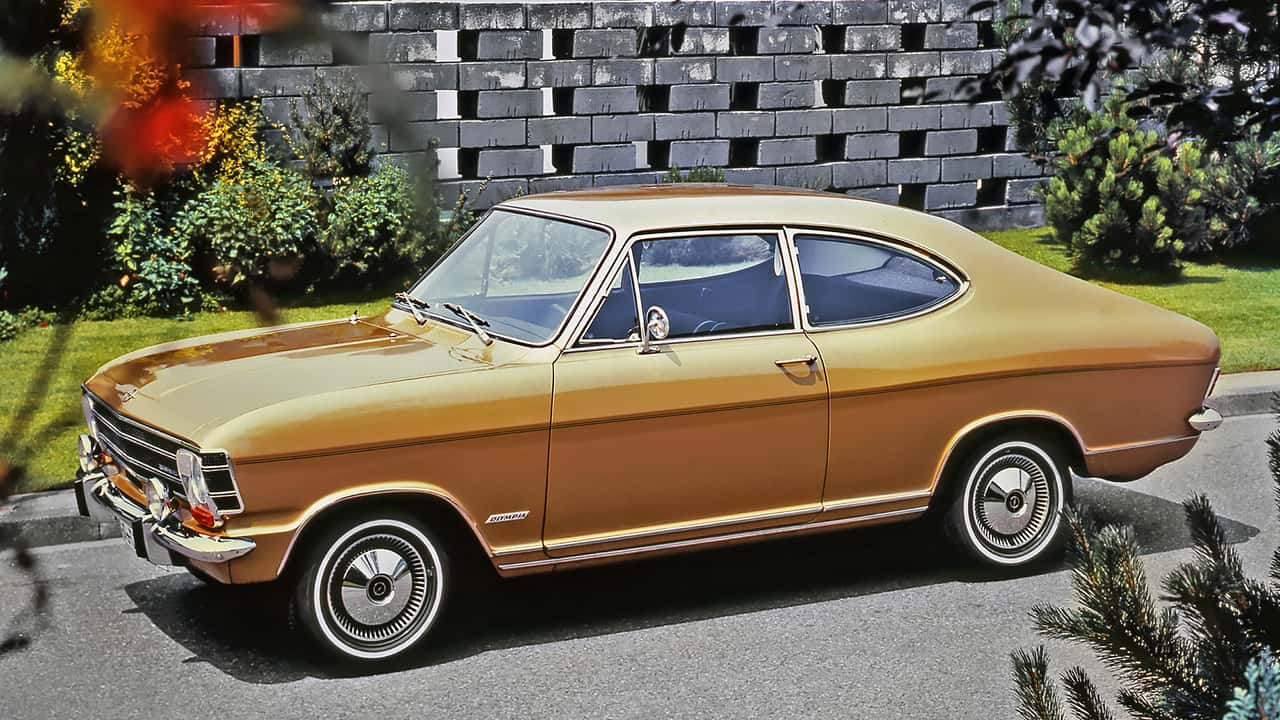

The 2024 Summer Olympics in Paris are currently the centre of attention. Reason enough for us to take a closer look at a car named after the sporting event: the Opel Olympia. After the Second World War, the Opel Olympia was at the heart of the brand's renaissance. Between 1967 and 1970, the name appeared on a noble Opel Kadett.
The first Opel Olympia
In 1935, the Opel Olympia was the first mass-produced German vehicle to feature a self-supporting all-steel body which, thanks to its low weight, improved driving performance and reduced fuel consumption. At the same time, the construction of the modern safety shell paved the way for mass production. The successor to the 1.3-litre Opel, which remained in the Opel range until October 1935, it was named after the 1936 Olympic Games in Berlin and Garmisch-Partenkirchen.
Gallery: Opel Olympia


The Olympia was presented in February 1935 at the 25th International Automobile and Motorcycle Exhibition (IAMA, the predecessor of the IAA) in Berlin and was available the same year at a price of 2,500 Reichsmarks.
Thanks to its self-supporting all-steel body, the car is 14 percent lighter than the 1.3-litre Opel traditionally built with a separate chassis: 835 kg instead of 970 kg. The self-supporting construction enabled a new manufacturing method, still used today: the body and components (engine, gearbox, axles) celebrated their so-called "marriage" on the assembly line using hydraulic lifting tables. In 1936, Rüsselsheim became home to Europe's largest bodywork stamping plant.
The Olympia is available as a cabriolet or a two-door saloon. It was available with two different water-cooled in-line four-cylinder engines: until 1937, with the side-valve engine from the previous Opel 1.3-litre model producing 24 PS, then 29.5 PS at 3,600 rpm; from the end of 1937, with a newly developed 1.5-litre engine with OHV ("hanging valve") control, four-step crankshaft and 37 PS. Until 1964, this design - with the exception of the four-cylinder Kadett A - was the basis for all Opel four- and six-cylinder engines.
Until October 1940, when the Reich Government ordered Opel to cease production of civilian vehicles, 168,875 Olympia cars were produced. After the end of the Second World War, production of a revised model resumed.
Opel Olympia (1947)
Opel Olympia (1947)
Opel Olympia (1947)
In the late autumn of 1947, the Opel Olympia, the first production car after the reconstruction of the Rüsselsheim plant, rolled off the production line. The Olympia 47 differed from its predecessor in that it had an improved front axle with double crossbars and a slightly smaller wheelbase.
The two-door's axle and steering are now derived from the Opel Kapitän. A concept that speeds up passenger car production in Rüsselsheim. Barely a year later, the largest four-door Opel Kapitän went into series production. And on 8 June 1949, Opel announced the completion of the 100,000th 1.5-litre Olympia. From 1950, the Opel Olympia was available as a fast delivery car in addition to the saloon.
Olympia Rekord from 1953
The first Opel to be completely rebuilt after the war is called the Olympia Rekord. With its pontoon bodywork and chrome shark's mouth, the 1953 newcomer ushered in a new era. The design was reminiscent of the style of the great American limousines - exactly what was needed for the economic miracle that was just around the corner. When you're successful, you want to show it again.
Opel Olympia Rekord Caravan (1953)
For the first time, an estate version, called the Caravan, leaves the factory in addition to the closed van version. "An ideal vehicle that harmoniously combines beauty and functionality - on weekdays to deliver customers, at weekends to relax and have fun", as the Opel advertisement of the time put it. It was the first time that a German carmaker had combined the advantages of a comfortable saloon with practical delivery capability in a vehicle destined for mass production.
The Olympia as a luxury cadet
Until 1962, Opel used the name Olympia to complement the Rekord. Then there was a pause. Until a few years later, when it became clear that the gap between the Kadett and the Rekord was widening. Without hesitation, the Kadett C, currently under development, was transformed into the Ascona. But before the latter was launched on the market in 1970, an improved Kadett B had to fill the time.
Opel Olympia A (1967)
Opel Olympia A (1967)
Within the Opel range, the Olympia A was launched in August 1967 as a luxurious addition to the lower middle class. The car featured a chrome grille around the corners and other embellishments, as well as a more elaborate interior without the bare sheet metal of the simple Kadett models.
The 4.18-metre Olympia A is available in three new body variants: the two- and four-door saloons have a hatchback, which is of no practical use, however, as the boot lid remains small. Visibility is even reduced compared to previous Kadett saloons, and the boot is reduced from 337 to 315 litres.
There is also a redesigned coupé (known internally as the 'F Coupé'). The Kadett B LS and Rallye-Kadett also received these body styles. From 1971 onwards, the 'Coupé F' was used for all other Kadett models. Curiously, unlike the Kadett B, the Olympia A never had a hatchback.
Similarly, the technical advances that accompanied the Olympia A (safety steering column, coil-suspension rear axle) were carried over directly to the Kadett B. Production of the Olympia A ended in July 1970. With 80,697 examples built, this model was not a particular commercial success, because it was not sufficiently different from the Opel Kadett B, which was less expensive but sometimes cost more than 700 marks more.
Read also:
RECOMMENDED FOR YOU
Morgan's Best Performance Car Is Coming To America Without An Important Feature
Man Spots Tesla Cybertruck Towing A Boat. Then He Looks Closer And Sees Who's Really Doing The Heavy Lifting
'A Tribute To The Very Beginnings:' McLaren Rebuilt Its First Road Car To Absolute Perfection
Why Red Bull's First Hypercar Had To Have A V10: Interview
Opel Brings Back The Hot Hatch, Minus Its Gas Engine
Woman Gets Safelite To Repair Windshield. Then She Tries To Use Her Windshield Wipers: 'I Emailed Customer Care A Month Ago'
Which Stellantis Brands Should Stay—And Which Ones Should Go?