The United States rejects driver monitoring systems
The IIHS agency monitored 14 systems and only three were rated marginal or acceptable.
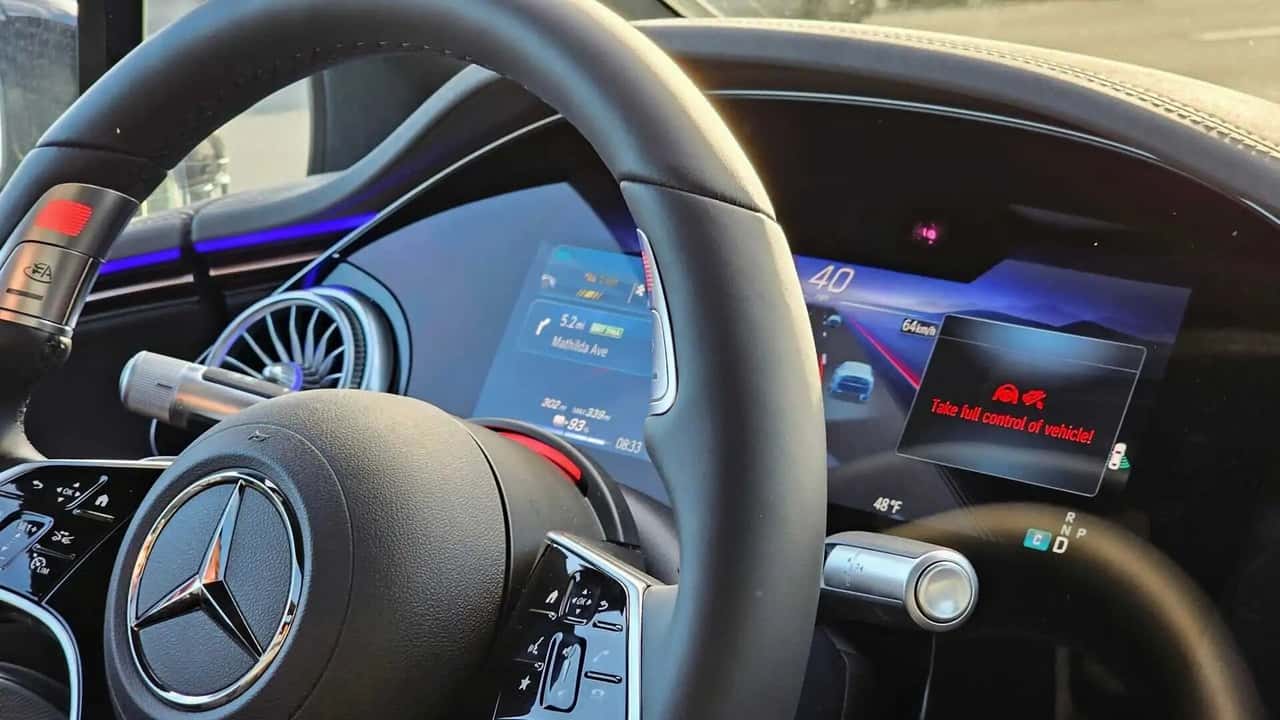

The advanced driver assistance systems do not sufficiently monitor the driver's state of attention, says the US Insurance Institute for Highway Safety (or IIHS), which has rejected 11 of the 14 monitoring/safety systems currently available on the market as "insufficient". Two passed, but with a low pass marks, and only one was deemed 'acceptable'.

The interior of the Mercedes S-Class (drive pilot).
What's the problem?
According to IIHS standards, systems must monitor the position of the driver's eyes and hands and issue two warnings within 10 seconds to achieve a good score.
If, within 20 seconds, the driver is still considered to be inattentive, a third alarm must be activated or the car must initiate an emergency action to slow down and leave the road safely. Whatever the alerts, after 35 seconds of inattention, vehicles must slow down and leave the road of their own accord.
Monitoring systems should also encourage drivers to initiate lane changes. The lane-keeping system must not be deactivated if the driver is making manual adjustments when it is supposed to be active.
Similarly, adaptive cruise control should not automatically resume after a long stop, probably in heavy traffic, where things could get hectic. Finally, if seatbelts are not fastened or if automatic emergency braking is deactivated, the monitoring system must prevent the activation of driver assistance devices.
The Mercedes S-Class display.
The solution is in the software
The IIHS study looked at vehicles from a number of brands (Ford, General Motors, Tesla, Mercedes-Benz, BMW, Genesis, Lexus, Nissan and Volvo). Lexus received an acceptable rating, while General Motors and Nissan received the two marginal ratings.
The IIHS admits that Ford comes close to a better score, but the bottom line is that all of the group's driver monitoring systems have shortcomings in one or more areas. "The shortcomings vary from system to system," said Alexandra Mueller, senior research scientist at the IIHS.
"Many vehicles do not correctly check whether the driver is looking at the road or is ready to take control. In many cases, there is a lack of attention reminders that arrive early and forcefully enough to wake up an inattentive driver. Many can be used despite occupants not wearing seatbelts or when other vital safety devices are deactivated."
Although the study criticises these systems, the IIHS believes that corrective measures can largely be achieved through software modifications. "These results are worrying, given the speed with which vehicles equipped with such partial automation systems are arriving on our roads," said IIHS president David Harkey.
"But there is a silver lining when you look at the performance of the group as a whole. No system performed well overall, but in every category at least one system did what was expected of it. This means that solutions are readily available and, in some cases, can be achieved with a simple software upgrade."
Read also:
Source: L'Institut d'assurance pour la sécurité routière
RECOMMENDED FOR YOU
Why Does BMW's Headquarters Look Like That?
Polestar Won't Fight US Ban, Effectively Ending Its American Future
Electric BMW M3 Will Have More Power Than The Gas Car, Without Going Overboard
The New Maybach GLS Shows Its Face For The First Time
BMW Explains Why It Finally Gave The M2 All-Wheel Drive
What Every Nissan Brake Caliper Color Means
Audi Q7 Vs BMW X5: Which New Luxury SUV Is Worth Your Money?