For No Particular Reason, These Are The Most Beautiful Ferraris Ever Made
From the iconic 250 GT to the modern Roma—these gorgeous Ferraris are a far cry from the new Luce.

Ferrari finally unveiled its first electric car, the Luce, earlier this week—and the fact that it's electric somehow may just be one of the least controversial things about it.
Design is subjective, and while I will refrain from calling the Luce ugly (Ferrari’s old boss, Wall Street, and countless internet commenters have already done their bits), right now feels like the perfect time to reminisce and run down some of Ferrari’s best-looking production cars in its 79-year history.
For no particular reason whatsoever and in no particular order, then, here are 10 Ferraris that simply look lovely—no "polarizing" euphemisms, no mental gymnastics over "progress," no "actuallys" required.
Ferrari 550 Maranello

As a child of the 1990s, the Ferrari 550 Maranello (and, later, the 575M Maranello) will always hold a special place in my heart aesthetically. It was simple, bluntly proportioned, and an aggressively lean foil to the fried-egg 996 Porsche 911 of the era. Imprinting itself in pop culture and dodging cars on a Miami bridge in Bad Boys II, it may just be the only Ferrari ever to look more correct in silver than it does in red, which says a lot about its inherent design.
Its powertrain is even more correct: A 5.5-liter V12 hooked up to a six-speed manual exclusively for the 550. The engine grew to 5.7 liters, and a Graziano auto was added as an option for the 575 for 2002.
Ferrari Roma
Don’t worry, it’s not nostalgia-bait all the way down because the Ferrari Roma is proof that Italy’s most famous automaker can still pen a banger that complies with modern safety standards. The Amalfi recently replaced this car, but the Roma still clears as the visually superior vehicle.
It’s gorgeously flow-y, has a face that looks alive even standing still, and overall feels like the Maranello art department's answer to Aston Martin. A twin-turbocharged 3.9-liter V8 sits under its perfectly sculpted hood, and with seating for four, the Roma is one of the most beautiful ways for you and the family to cross a continent.
Ferrari 250 GT California Spyder
A list of the 'Most Beautiful Ferraris With 250 In Their Name' could be an entire article unto itself, but the best-looking one, to me, has got to be the 250 GT California Spyder. Yes, it’s the Ferris Bueller car, but its beauty predates the movie by almost 30 years. Its look is default, classic, timeless, and undeniable. It’s so undeniable, in fact, that a gray one sold for more than $25 million at Monterey Car Week last year. Made in long- and short-wheelbase forms, the world’s most famous valet joyride vehicle is powered by a 3.0-liter V12 connected to a four-speed manual gearbox.
One aside that’ll undoubtedly make you feel ancient: The 250 GT is about as old in FBDO as the 550 Maranello would be in a movie made today.
Ferrari Testarossa
As an '80s icon, the Testarossa is probably the least romantic-looking Ferrari on this list, but it makes up for it with sheer presence, attitude, and excess. It’s late-season Miami Vice and served as one of the very first racing game hero cars as the star of OutRun. Even Michael Jordan showed up to Chicago Stadium for another on-court bloodbath, "M AIR J" vanity plate and all.
A 4.9-liter, mid-mounted flat-12 sent power to a five-speed gated manual. I’m not of the mind that everything was cooler in the past, but I’ll be damned if that sentence right there isn’t a reminder that some things just were.
Ferrari Dino
The 206 and subsequent 246 GT cars were the most significant models sold under the Dino brand as a tribute to Enzo’s late son, Alfred "Dino" Ferrari. Less expensive and less powerful than full-on Ferraris, the mid-engined Dinos used V6s before turbos and hybrid systems made V6s bona fide supercar material.
But much of their legacy lies in the styling. Balanced, frog-like, and some of the lowest-slung cars that ever did slung, its compact, mid-engined influence can still be seen in newer stuff like the Alpine A110 and the softer lines of Ferrari’s own 296 GTB.
Ferrari Daytona
While Ferrari never actually made a muscle car in the American sense, the closest it ever got spiritually and stylistically was probably the Daytona. A long-hooded, front-engine, two-seat grand tourer that came in both coupe and convertible forms, the V-12 Daytona was made in the era of the C3 Corvette and frankly carried a similar aura.
This car, by the way, is technically called the 365 GTB/4 coupe and 365 GTS/4 convertible, and "Daytona" was actually an unofficial nickname that caught on and never left, referencing Ferrari’s 1-2-3 finish at the 24 Hours of Daytona in 1967. If a scrappy, fan-given nickname shared with a NASCAR track in Florida doesn’t scream muscle car, then its imposing styling surely does.
Ferrari 12Cilindri
The Daytona’s shape struck such a chord, in fact, that Ferrari couldn’t help but bring it back 50 years later with the 12Cilindri, Maranello’s current flagship V12 grand tourer. It gets the classic long hood, an almost non-existent hatchback-like deck, and a black bar in between the headlights that very much tips its cap to the Daytona.
As its name implies, this car is a bit of a last stand statement vehicle celebrating the V12 engine, and the 12Cilindri is indeed the only production car other than Ferrari’s own Purosangue to use a non-hybrid, naturally aspirated V12 in 2026. Stepping out of it, though, it’s also a statement vehicle that says at least somebody in Ferrari’s design department still knows what they’re doing.
Ferrari F40
Arguably, no list of greatest Ferraris by any criteria is complete without the F40. As a kid, that huge, body-integrated rear wing always reminded me of a shopping cart, but Maranello’s 40th birthday present to itself is anything but pedestrian.
As the story goes, the F40 was the final production car Enzo personally signed off on before his death in 1988. It was the most extreme road-going Ferrari ever at the time, and featured newfangled technology such as a turbocharged V8 and a body made of carbon, Kevlar, and aluminum. Despite this, some period reviews slammed it for not being nearly as advanced or refined as the Porsche 959—a sentiment that feels borderline crazy today.
Ferrari 458 Italia
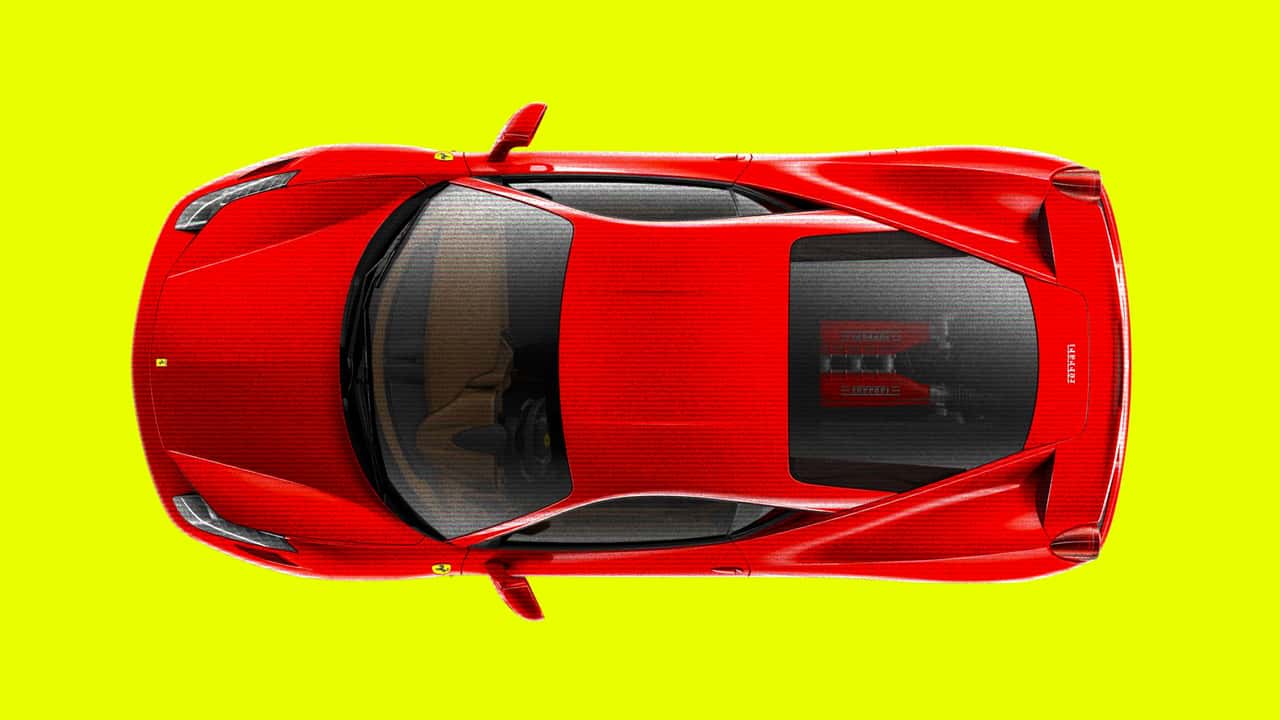
Ask a millennial car enthusiast which Ferrari they’d most like in their garage, and there’s a decent chance they’ll pick some version of the 458. Not only does it sit in a sweet spot of being the last in its lineage to use a naturally aspirated V8, but it’s also visually less fussy than its successors and a whole lot prettier than the F430 that came before.
A more track-ready 458 Speciale came later with more fins, stripes, a front hood that let air run through itself, and has entered holy grail territory in terms of internet lore and residual values. But style-wise, a simple, Rosso Corsa 458 Italia remains a high-water mark of what a modern Ferrari can look like.
Ferrari 288 GTO
In terms of Ferrari’s flagship hypercars, the original 288 GTO may not look quite as nutty as the ones that came after it, but that’s arguably what makes it so cool.
To me, it reads the least try-hard of any of the other cars here. Simple wedge proportions, restrained vents, pop-up headlights, and a rear three-quarter view that would bring car internet to a standstill if it were recreated in a new Ferrari today—for good reasons this time. Rather than, well, you know.
Check Out These Lists
RECOMMENDED FOR YOU
The Most Powerful Cars You Can Still Get With A Manual
Man Gets 4 New Tires For His Lexus. Then The Shop Calls Him About A Missing Part: 'I Threw That Away'
This V12 Ferrari-Based Shooting Brake Is A Glass Masterpiece
Woman Buys Chevrolet Tahoe. Then Her Wheel Flies Off. Then The Dealership Ghosts Her—After Agreeing To Take Accountability
This Company Built A Simulated Manual For Ferraris Before Ferrari Did
The 10 Fastest Cars At Goodwood This Year
Every New Car Debuting At The Goodwood Festival Of Speed 2026