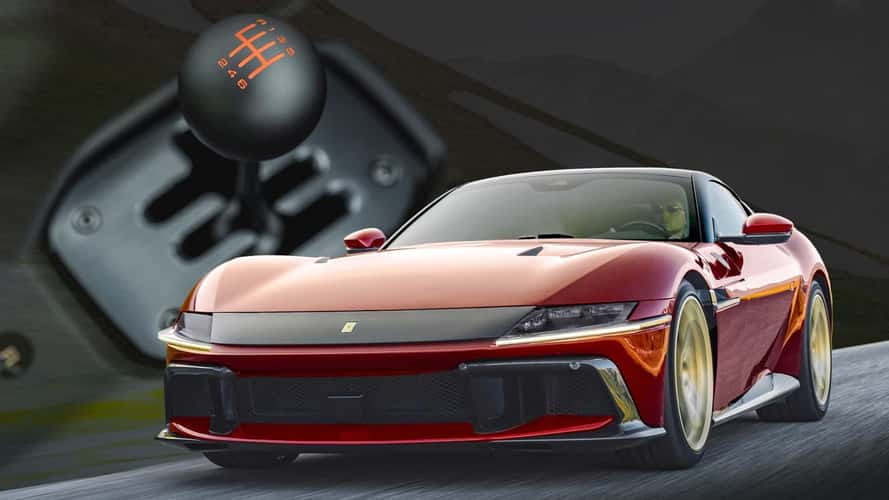





Ferrari 12Cilindri Manuale: the official photos of the new Maranello supercar with a manual transmission
Ferrari returns to the manual transmission. It had never happened—at least not like this. The Ferrari 12Cilindri Manuale is a special series limited to 1,499 units that marks the return of the shifter and clutch pedal on a Prancing Horse Gran Turismo, twenty years after the last time, with the 599 GTB Fiorano. The official photos tell the story of a car that doesn’t merely reinterpret the past, but rewrites it with an entirely new technology called Manuale by-wire, developed entirely in Maranello. No compromises on performance: the engine remains the 6.5-liter naturally aspirated V12 with 830 hp, capable of revving to 9,500 rpm, with the eight-speed DCT unchanged. What changes is everything that sits between the driver’s hands and the car.
The official photo gallery shows every angle of this extraordinary car, from the exterior to the cabin, focusing on the details that make the 12Cilindri Manuale an object in its own right compared with the standard version. The first element that catches the eye is the center tunnel, redesigned to house the new shift lever and transformed— in the words of Flavio Manzoni, head of Maranello’s Centro Stile—into something that looks like it was born with the car, not added later. An aesthetic coherence that also comes through in the photos: nothing clashes, nothing feels out of place.
The gated shifter reprises the classic six-speed grid with reverse up and to the left, a direct nod to Ferrari’s manual models throughout history. The round anodized aluminum knob, machined from solid, lights up with white and amber lettering that changes depending on the selected driving mode—manual or automatic—and is perhaps the most photographed detail on the entire car. The three-pedal set, completely redesigned, rounds out an interior that in the official images conveys a sense of cleanliness and design intent that’s hard to find even in cars in this segment.
The exterior photos, instead, tell the story of a 12Cilindri that brings new styling cues compared with the base version. The chalky finish on the front band and rear wings is a direct tribute to the Ferrari 365 GTB/4 Daytona, one of the most beloved Gran Turismo cars in the brand’s history. The key has received an anodized treatment coordinated with the new side shields, while the five-spoke forged wheels—available in four different finishes—can be seen in all their refinement in the shots that frame the car’s profiles. The door sill, visible in the interior photos, is available in aluminum with the 12Cilindri logo engraved, or in carbon fiber on request.
The Ferrari 12Cilindri Manuale can be configured through the Tailor Made program, and the official images show some of the available color possibilities. The palette includes 25 iconic brand colors: from the Rosso Rubino chosen for the launch photos to historic shades such as Argento Nürburgring, Blu Pozzi, and Nero Daytona. A dedicated livery is also available, playing chromatically on the theme of the transmission’s six gears, with combinations developed specifically for this special series. The seats—offered in Comfort or Racing versions—carry the same common thread with six vertical ribs stitched into the upholstery, a subtle detail that reappears throughout the car like a hidden signature.
From a technical standpoint, the photos of the lever and the gate give an idea of the build care Ferrari devoted to the Manuale by-wire system. The lever control weighs less than 3.5 kg and is based on a high-strength steel rotating block machined from solid, with surfaces finished to very tight tolerances to eliminate any play in the movement. The lever automatically returns to the neutral position thanks to a system of eccentric rollers, while gear engagement happens through a shaped rotating drum that first generates resistance and then a sudden click—that physical sensation the driver feels through the knob and that faithfully recreates the feel of a traditional mechanical gearbox.
Two Hall-effect sensors—devices that detect position and movement through the magnetic field, without direct physical contact—capture the lever’s position in real time on both axes of rotation. A small electromagnetic actuator intervenes as a physical lock when an engagement isn’t allowed. The clutch is also by-wire: an angular position sensor reads the pedal travel and translates it into a hydraulic command that acts on the DCT clutch pack, while a passive mechanism made up of a preload spring, cam, and roller reproduces underfoot the typical load of a mechanical clutch.
Finally, the front and front three-quarter photos show a car that, while not overturning the lines of the standard 12Cilindri, carries its own distinctive, recognizable visual identity. It’s not a simple styling update: it’s a special version that justifies its existence on multiple levels, from technological to emotional, from design to driving dynamics. With only 1,499 units available and a starting price of 590,000 euros, the Ferrari 12Cilindri Manuale is set to become one of the most sought-after and collectible models in Maranello’s entire recent production. The photos that follow document every detail, from the exterior to the cabin, from the wheels to the illuminated knob: a visual archive for anyone who wants to get to know this car down to the smallest particulars, even before being able to see it in person.