Man Gets Into His Toyota. Then He Discovers A Hidden Feature: ‘Most Owners Have No Idea’
"Not a lot of Toyota users know about this until they are shown."
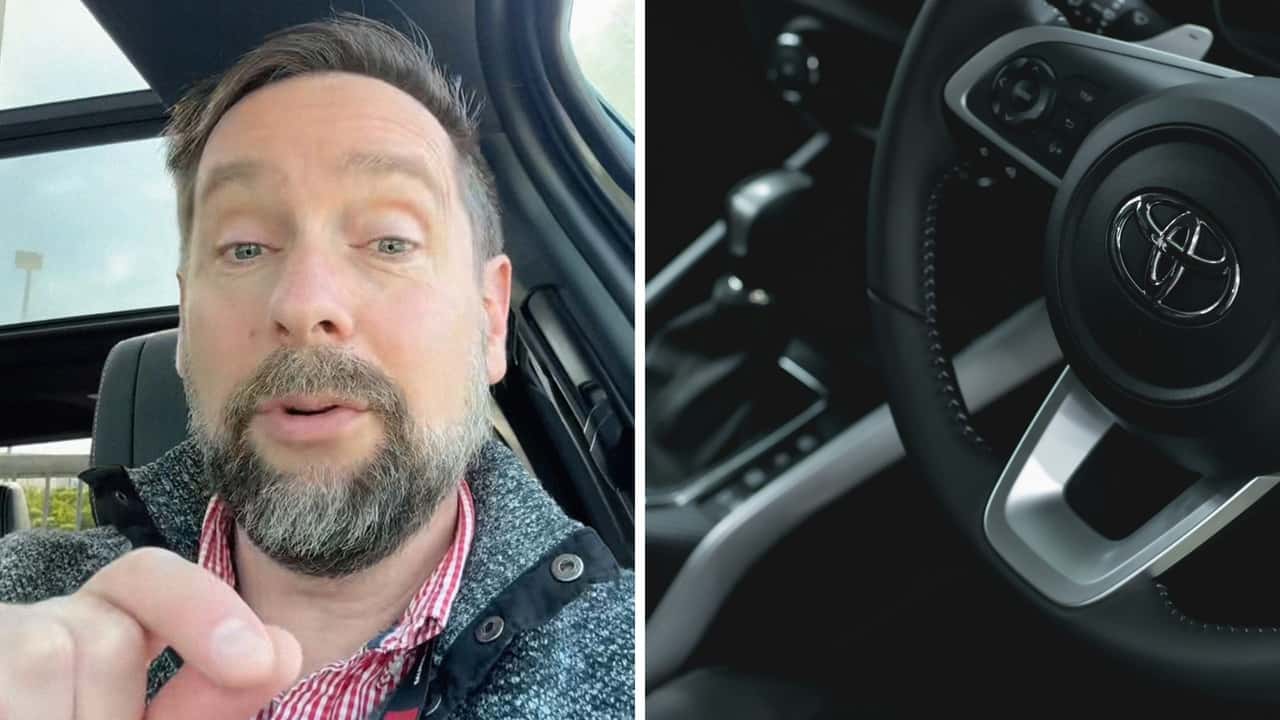

It started as a simple video intended to help Toyota owners use an often-overlooked bit of technology made to help them back up more easily. But a TikTok video from a Canadian car salesman wound up launching a low-grade flame war among automaker loyalists arguing over who’s leading the way in useful innovations for motorists.
The argument started innocuously enough, with a Toyota Tundra’s side mirrors tilting downward in reverse to help keep an eye on the truck’s tires while operating in reverse. Creator Scott Hutchison (@goseescott), a Toyota salesman in British Columbia, intended the video he posted, which has been viewed almost 100,000 times, to offer a quick moment of appreciation for one of the lesser-known ways modern vehicles aim to make driving as easy and accommodating as possible.
"If I preset this in reverse, I can have my mirrors automatically reorient and show me the back tires," he explains as the side view mirrors pivot down to help back up as elegantly as possible. "I know it's just a simple little thing, but it's one of those little details that help us to love our vehicles just a little bit more."
New Technology Sparks Heated Debate
It didn’t take long for viewers to flood into the comment section, trying to figure out whether their own Toyotas had been hiding the same feature for years. Some discovered it instantly.
Others experienced disappointment and used the occasion to test their comedy chops.
"I just tested it on my 2025 Tacoma and I went flying out of the parking garage," one viewer joked. "The mirror thing didn’t work thanks"
The problem, other commenters quickly pointed out, may have come down to trim level. Hutchison demonstrated the feature inside a Tundra Limited, while the frustrated Tacoma owner later clarified he was driving an SR5.
Other viewers chimed in, trying to determine which Toyotas supported the setting and which ones didn’t, turning the comments section into a kind of crowdsourced troubleshooting session.
"I guess it depends on what trim u have," one commenter wrote.
Others were surprised the feature existed at all. A few owners claimed they immediately ran outside to test their own trucks and SUVs after watching the clip. Meanwhile, longtime Toyota fans seemed baffled that anyone considered the feature new.
"My 2001 Land Cruiser does this," one viewer wrote.
That split quickly evolved into a much larger argument about Toyota’s approach to technology in general. One commenter complained that the automaker tends to lag behind competitors on convenience features and modern interfaces.
"Toyota is late on so many modern car technology," the viewer argued, pointing to automatic liftgates and other features that have become commonplace elsewhere.
Hutchison didn’t exactly disagree.
"Yup, if you want the latest technology from 10yrs ago… get a Toyota," he replied. "The plus side is it will still be working perfectly in 20yrs."
In an email to Motor1, Hutchison said the clip was intended to reveal a nuance of the Tundra that may have gone largely unnoticed: "It's not much of a hack. It's more of a 'not a lot of Toyota users know about this until they are shown.' As you can see by the comments... it's been a thing for decades. At least the early 2000s with BMW and Honda product, but I would assume The Big 3 would have had something like it back in the day."
How Does Toyota Approach New Tech?
The debate among commenters comes down to what buyers expect from manufacturers regarding leading-edge innovations. Some customers want risk-taking "Wow!" moments, while others take a more slow-and-steady approach to changes made to long-established models.
Toyota has spent decades building a reputation for introducing new technology cautiously, often refining systems slowly instead of racing competitors to market with flashy features.
Critics see that approach as outdated. Loyal owners often see it as the reason older Toyotas routinely stay on the road for hundreds of thousands of miles.
Toyota’s caution stands out in the marketplace as modern, software-heavy vehicles become more commonplace and consumers increasingly expect cars to behave more like smartphones. Toyota’s infotainment systems have frequently drawn criticism for feeling dated compared to rivals, even as the company continues to dominate long-term reliability rankings and resale value studies.
In some ways, the mirror debate that Hutchison's video kicked off, accidentally, exposed the strange middle ground Toyota occupies in the automotive world. The company often isn’t first to introduce a feature, but it also tends to avoid removing buttons, overcomplicating interfaces, or gambling heavily on unproven systems. That tradeoff can make some Toyotas feel oddly old-school while simultaneously helping them age better than many competitors.
Update June 1: This article originally incorrectly spelled Scott Hutchison's last name.
RECOMMENDED FOR YOU

The Best New Cars Coming Out In 2027
Want A One-Off Cayenne Or Panamera? Porsche Will Make It Happen
Toyota's New TRD Pro Paint Is Sweet As Honey
Man Spots Used Toyota Camry For $7,000. Then He Sees How Much It Costs At CarMax: ‘Crazy’
Mechanic Says Your Toyota May Be Getting The Wrong Oil. Then He Changes Mobil 1 Formula: ‘As A Warranty Inspector This Would Void’
Woman's Land Rover Headlight Goes Out. Then She Finds Out How Much It Costs To Fix: ‘AutoZone Put Them In For Free’
2027 Toyota Tundra Gets An Overlanding Trim Straight From The Factory