Home
Ford
F-150
News
‘Worst Feature Ever:’ Houston Woman Buys F-150. Then She Tries to Return it 30 Minutes Later After Discovering Annoying Feature
"I don’t like it anymore."
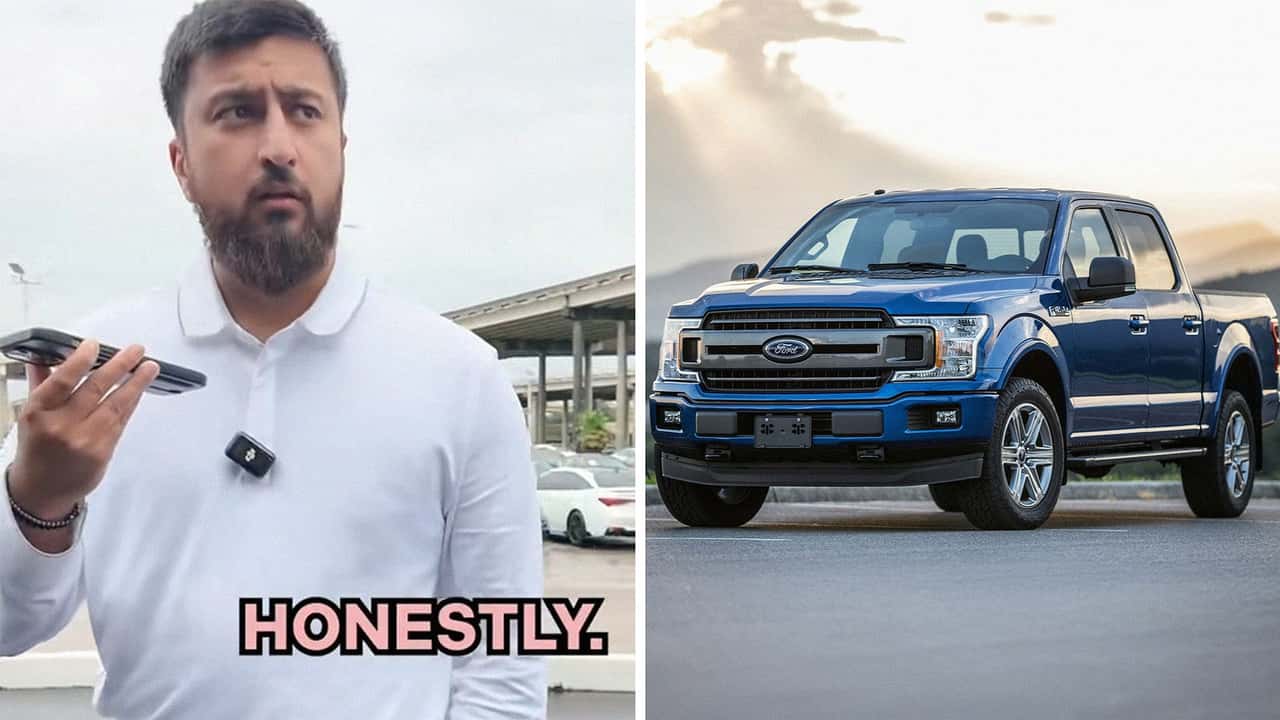
Photo by: americasxtremeauto & Caleb White
JT Wilson 
By: JT Wilson
Aug 7, 2025 at 9:00pm ET
Add Motor1.com as a preferred source in Google
- (https://twitter.com/intent/tweet?url=https%3A%2F%2Fwww.motor1.com%2Fnews%2F768209%2Fwoman-returns-f-150-30-minutes-later%2F&text=%E2%80%98Worst%20Feature%20Ever%3A%E2%80%99%20Houston%20Woman%20Buys%20F-150.%20Then%20She%20Tries%20to%20Return%20it%2030%20Minutes%20Later%20After%20Discovering%20Annoying%20Feature&via=motor1com)
- copy
Share
Comment
Sometimes unfamiliar new automotive technology can feel like a glitch, especially when no one bothers to explain what’s actually happening under the hood.
Houston-based dealership America’s X-Treme Auto (@americasxtremeauto) captured a perfect example of this disconnect in a one and a half minute video posted on July 6.

Get the best news, reviews, columns, and more delivered straight to your inbox, daily.
back
Subscribe For more info, read our Privacy Policy & Terms of Use.
The clip shows a conversation between Dan, a salesman at their Atlanta, Georgia branch and a frustrated customer who wanted to return her Ford F-150 just 30 minutes after purchase. The trouble was caused by one misunderstood feature.
The 30-Minute Panic
The call was recorded from Dan’s end, with him standing in the dealer lot talking to the customer on speaker. Right from the start, the customer is in audible distress.
“Hey, Dan, I actually bought an F-150 from you, about 30 minutes ago,” she says.
Trending Now
When Dan asks how she’s doing, she replies, “Not very hot. I want to return this car.”
She adds, “I don’t like it anymore. I just want to come and return it to you. I don’t like it. I don’t like it.”
When pressed for details, her explanation reveals the source of her buyer’s remorse. “Yeah, it keeps on stopping me,” she says. “Like, every time you’re like, it stops… It’s just cutting off. Every time I stop or I come to a stop, it cuts off.”
The customer’s frustration escalates as she tries to make the salesman understand.
“What part of me telling you that it cuts out every time I stop don’t you understand?” she elaborates. “I don’t like the truck.”
The Revelation
After several attempts to clarify whether the truck was randomly dying, the salesman finally understood what was happening.
“No, okay. So if I come to a stop sign and hit the brake and I stop there, the truck just kills itself and it goes off on its own,” the customer says. “It’s crazy.”
The salesman’s response was both educational and reassuring. “That’s a new feature,” he replies. “The new F-150s have this feature in.”
He explains further, “You see, there’s a small A in the middle of the console underneath the radio. You see that with the circle around says A. So that’s a feature to help you save gas.”
What had seemed like a catastrophic mechanical failure is actually Ford’s auto start-stop technology working exactly as designed.
“If you turn it off, the car won’t turn off,” the salesman says, acknowledging the widespread dislike for the feature.
“A lot of people don’t hate it. A lot of people don’t like it,” he shares. “I don’t like it either.”
The resolution is remarkably simple—just press a button to disable the system.
Industry-Wide Frustration
The video resonated with viewers who shared the customer’s frustration with auto start-stop technology.
“Its really the most ridiculous feature they ever invented,” commented user Just me said, capturing the sentiment of many drivers.
Several viewers noted the feature’s temporary nature—it must be disabled each time the vehicle is started. Gabriel Macias wrote, “Pressing the off button is now muscle memory to me.”
Other viewers added a dash of conspiracy theory to concerns about mechanical wear. Threecil claimed it was “built to make starter components wear out and fail prematurely, planned obsolescence in the automotive world.”
Others got political. Nick Palermo opined, “No, it was another democratic law related to gas mileage and emissions. It’s ridiculous and barely saves anything.”
His comment contains a grain of truth. Auto start-stop systems became more prevalent after 2012, when the Obama administration finalized stricter fuel economy standards for automakers that would require all cars built by 2025 to run at 54.5 miles per gallon or better.
But there’s little evidence that auto start-stop systems wear out components dramatically faster than other systems. Some research indicates that anxieties about cold starts are overblown given that a car in traffic will have been running for some time.
That didn’t stop many commenters from taking up that cudgel.
A user going by lefthandedsmokeshifter listed what he claimed were potential issues: “starter, battery, flywheel teeth, no oil pressure start cycle.”
Ronnie summarized the cost-benefit analysis many drivers make: “Helping you save gas while shortening the lifespan [of] your 400 dollar starter and 300 dollar battery is diabolical.”
Several users mentioned workaround solutions. AllegedlyAnAlias suggested, “20 bucks on Amazon for a bypass,” while others discussed fuse-pulling methods to permanently disable the system.
The Sales Process Question
Multiple viewers wondered why the feature wasn’t disclosed during the test drive. Justin Keys476 pointed out a fundamental issue, writing, “A good salesman would’ve went over all the features before the customer drove off.”
Another echoed a similar sentiment, writing, “Guess no test drive. Or salesman didn’t explain features??”
This highlights a broader issue in automotive sales—the importance of thoroughly familiarizing customers with their vehicle’s technology before they drive off the lot.
The Resolution
The call ends positively, with the salesman assuring the customer that disabling the feature would solve her concerns.
What do you think?
View
Comments
The incident serves as a reminder that advanced vehicle features, even those designed to improve efficiency and meet regulatory requirements, can create confusion and frustration for drivers who aren’t properly prepared for how they work.
Motor1 contacted America’s X-Treme Auto for comment via its website. We’ll update this if it responds.
More From Motor1
 10 Trucks With the Best Towing Capacity for 2025
Ford's Newest Incentive Is Even Better Than Employee Pricing
The Legendary Street Truck Is Back. Meet the Ford F-150 Lobo
We want your opinion!
What would you like to see on Motor1.com?
Take our 3 minute survey.
- The Motor1.com Team
Share this Story
- (https://twitter.com/intent/tweet?url=https%3A%2F%2Fwww.motor1.com%2Fnews%2F768209%2Fwoman-returns-f-150-30-minutes-later%2F&text=%E2%80%98Worst%20Feature%20Ever%3A%E2%80%99%20Houston%20Woman%20Buys%20F-150.%20Then%20She%20Tries%20to%20Return%20it%2030%20Minutes%20Later%20After%20Discovering%20Annoying%20Feature&via=motor1com)
- copy
GO TO COMMENTS
(
)
Got a tip for us? Email: tips@motor1.com
View all comments ( )
Popular
12 Cars With Names That Make Absolutely No Sense
BMW Kept This Hatchback A Secret For Decades
Bugatti Restores One-Off Veyron With A Mirror-Like Aluminum Body
The Gas BMW M3 Isn't Dead: Next-Gen Prototype Roars
latest articles
- Every Rolls-Royce Has A Hidden Feature Most People Don't Know About Oct 20 - Motor101 -
- Subaru Built A 510-HP Electric Wagon Without Toyota's Help Oct 20 - Official -
- The Strange Reason The Golf GTI Had A Golf Ball Shifter Oct 20 - Motor101 -
- Photos: Porsche's Mission S Concept Takes Over New York City Oct 20 - Design -
- The 2027 Honda Passport TrailSport Looks Noticeably Taller Next To Last Year's Model Oct 20 - Off-Road -
- 12 Cars With Names That Make Absolutely No Sense Oct 20 - Lists -
- The Ford Ranger Is Getting A Bigger V6 For 2027: Report Oct 20 - Rumors -
RECOMMENDED FOR YOU
Mechanic Can’t Figure Out How To Remove F-150 Tires. Then He Realizes Why
The Strange Reason The Golf GTI Had A Golf Ball Shifter
The Two-Tone Ford F-150 Is Back, But Only For Certain Trims
Photos: Porsche's Mission S Concept Takes Over New York City
12 Cars With Names That Make Absolutely No Sense
The 2027 Honda Passport TrailSport Looks Noticeably Taller Next To Last Year's Model
The Ford Ranger Is Getting A Bigger V6 For 2027: Report