Home
Volkswagen
Transporter
News
Syncro: VW Commercial Vehicles celebrates 40 years of all-wheel drive
The first T3 Syncro went into series production in 1985, but the 4x4 history goes back even further
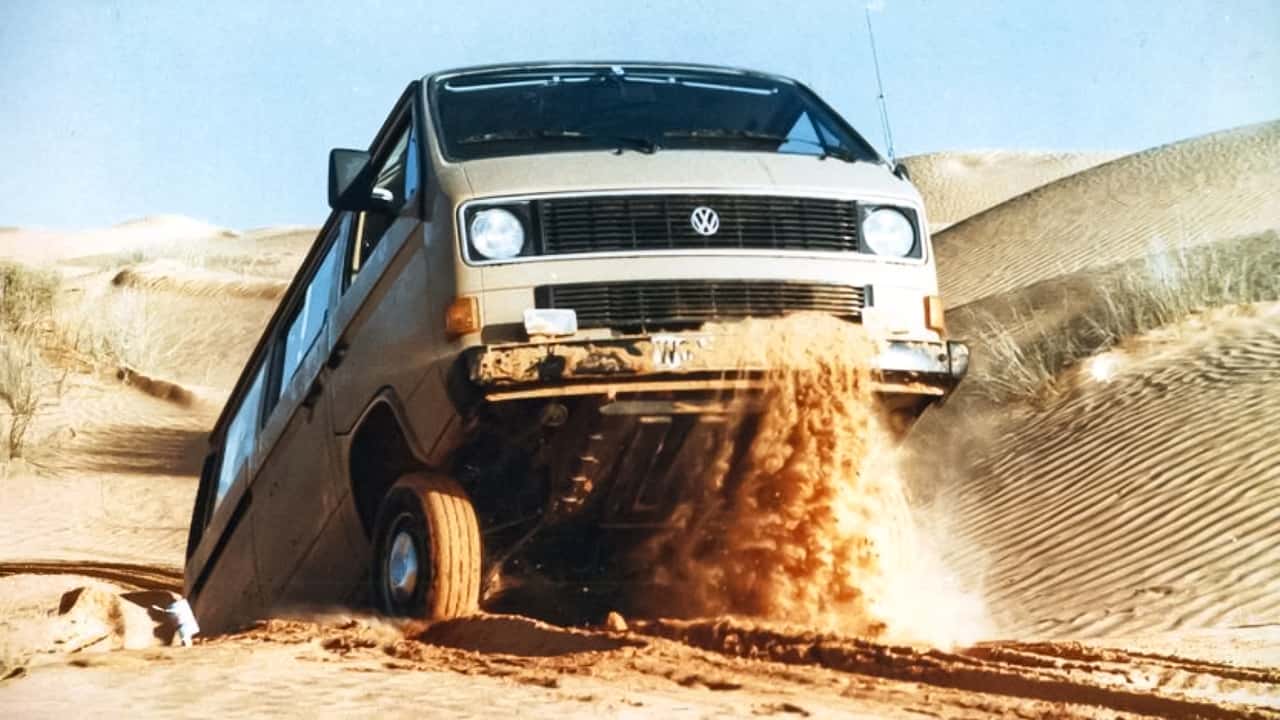
Photo by: Volkswagen

By: Roland Hildebrandt
Published by: Brian Potter
Feb 1, 2025 at 5:42am ET
Add Motor1.com as a preferred source in Google
- (https://twitter.com/intent/tweet?url=https%3A%2F%2Fwww.motor1.com%2Fnews%2F749306%2Fvolkswagen-commercial-vehicles-syncro-40year-anniversary%2F&text=Syncro%3A%20VW%20Commercial%20Vehicles%20celebrates%2040%20years%20of%20all-wheel%20drive&via=motor1com)
- copy
Share
Comment
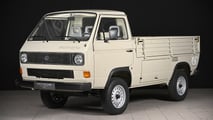
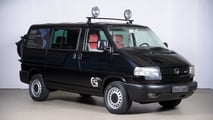
The Bremen Classic Motorshow opens its doors on 31 January. Volkswagen Commercial Vehicles Oldtimer will be exhibiting a freshly restored T3 Syncro 16' platform lorry, of which only 60 were built, and a record-breaking T4 Multivan Syncro. And with good reason: In 2025, Volkswagen Commercial Vehicles will be celebrating "40 years of all-wheel drive".
Mr Mayer drives into the Sahara
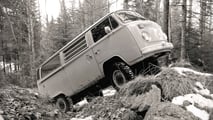
But the story of the Bulli's (aka Bus or Camper) all-wheel-drive adventures began much earlier - in the 1970s, with VW's then head of Transporter development, Gustav Mayer (1925-2014). He loved travelling and challenges, which is why he was always drawn to the Sahara in a T2. However, the T2 was only available with rear-wheel drive.
Gallery: VW Commercial Vehicles celebrates 40 years of all-wheel drive

24
Source: Volkswagen
But when Mayer got tired of shovelling sand out of his van in the deserts of North Africa, he and his team simply built a four-wheel drive T2. The tests of the first prototype, some of them again in the dunes of the Sahara, were positive. In 1978 the construction of five T2 test cars with selectable front-wheel drive began. However, the T2 - introduced in 1967 - was already approaching the end of its life cycle. The T3 was therefore the first Bulli to be equipped with all-wheel drive.
Photo by: Volkswagen
Premiere in the T3
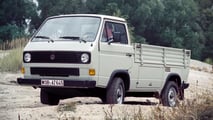
The T3 Syncro made its debut in 1985: right from the start, the T3 was designed not only as a commercial vehicle, but also as a tool for the really big journeys around the world. Because there is simply no such thing as a spacious bus. The floor structure of the T3, first introduced in 1979 with rear-wheel drive, therefore provided space for a drive shaft and a front-axle differential from the outset.
Volkswagen enters into a cooperation agreement with Steyr-Daimler-Puch for the series development and construction of the Syncro variants. The company is recognised in the industry as a highly competent specialist in the development and production of four-wheel drive vehicles. As a result, final assembly of the T3 Syncro is also carried out at the Steyr-Daimler-Puch plant in Graz. At the same time as the Mercedes G.
Photo by: Volkswagen
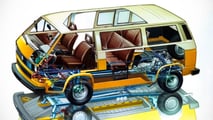
Unlike the T2 test vehicles, the T3 Syncro has no selectable four-wheel drive, but - much more conveniently - a permanently integrated front axle via a drive shaft. A viscous coupling is responsible for its integration. It proves to be very robust and works perfectly in almost all conditions.
Another advantage of the viscous coupling is that it eliminates the need for an intermediate differential, which normally compensates for the difference in speed between the front and rear axles. A multi-piece skid plate protects the four-wheel-drive technology from damage during off-road adventures.
More ground clearance
Different springs and harder shock absorbers are also used. As a result, the body of the Syncro models is 60 millimetres higher. The transmission is a 4+G gearbox with four conventional forward gears and a very low ratio for off-road use. Differential locks on the front and rear axle and an off-road package are also available as options.
These include reinforced drive shafts, a vibration damper in the drive train and various body reinforcements. Equipped in this way, the Syncro models score with a ground clearance of 215 millimetres at the front, a slope angle of 22 degrees and a ramp angle of 24 degrees. In terms of drivetrain technology, the Bulli has reached the level of off-road vehicles - but with much more space and comfort on board for life's great adventures.
Photo by: Volkswagen
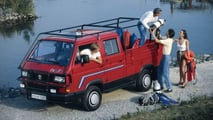
From 1987, the T3 Syncro was even available with 16-inch wheels and extensive modifications to the chassis and body, including larger brakes and a rear axle lock as standard for the most extreme off-road use. The reinforcements increased the off-road payload to one tonne. Ground clearance increased to 246 mm (plus 25 mm). By 1992, 2,138 of these heavy-duty four-wheel-drive vehicles - out of a total of 45,478 T3 Syncros built - had left the production halls in Graz, accompanying expeditions, globetrotters, foresters and craftsmen.
Only around 60 of these expedition-quality Volkswagens were built with a cargo bed, as the Syncro drive and 16-inch wheels added around 50 per cent to the price of the rear-wheel-drive version. Today it is almost impossible to find such an early four-wheel drive pickup as a classic.
Revolution in the T4
The T4 Syncro was launched in 1993: a genuine world record holder is standing next to the Syncro platform at the Bremen Classic Motorshow. It is a 1999 T4 Multivan Syncro with which a team from Volkswagen Commercial Vehicles crossed the legendary Panamericana from Alaska to Tierra del Fuego 26 years ago faster and with fewer problems than any previous traveller. But before this adventure could begin, the T4 had to be developed.
Looking back: When the T4, the new and now fourth generation of Volkswagen vans, made its debut in 1990, it was a technical revolution: new design, new drive, new engines, new concept. The boxer left the ring. It was replaced by modern, water-cooled four- and five-cylinder engines that were no longer located at the rear but at the front, driving the front wheels - with advantages all round: the T4's load area was lower and more accessible.
Most notably, the driver and passenger seats were now located behind the front axle, improving passive safety. In 1993, Volkswagen completed the range with the new T4 Syncro, whose viscous clutch now transmitted power from front to rear.
Photo by: Volkswagen
On course for a record in the Multivan T4 Syncro
The fact that Volkswagen Commercial Vehicles once again has one of the world's best off-road vehicles in its range in the form of the four-wheel drive T4 was demonstrated in 1999 by the world record drive from Alaska to Tierra del Fuego. On 25 September of that year, two teams set off from Prudhoe Bay in the US state of Alaska to reach Ushuaia in Argentina via the longest north-south route on the American continent - the Panamericana. Apart from a larger fuel tank, additional headlights on the roof and Plexiglas windows in front of the headlights, the technology of the vehicles is the same as that of the series.
One of the challenges for man and machine was the fact that the Panamericana was in less than ideal condition at the time due to an earthquake in Mexico and numerous riots in South America. Nevertheless, the first T4 Multivan Syncro - registration number WOB-AZ 152 - with professional globetrotters Andreas Renz and Matthias Göttenauer on board reached its destination after exactly 15 days, 14 hours and 6 minutes and 22,880 kilometres, earning it an entry in the Guinness Book of Records.
The second T4 Multivan Syncro also reaches its destination - a few days later due to severe storms. The record-breaking journey of the Multivan T4 Syncro is the final impetus for Volkswagen Commercial Vehicles to develop even more powerful four-wheel-drive vehicles. The T4 Syncro thus became the initial spark for the development of the PanAmericana models - first as a special model (T4), then as a special series (T5) and since the T6 as an off-road version.
From Syncro to 4Motion
In 2004, the T5 is launched as a 4Motion: Volkswagen Commercial Vehicles presents the T5 as a world premiere in 2003. More powerful engines and, more importantly, the Electronic Stability Programme (ESP) required a new four-wheel drive system. This is available from 2004 with the equally new designation 4Motion. At the heart of the system is an oil-immersed, axially compressed multi-plate clutch.
The pressure is generated by two pumps. The greater the pressure on the discs, the greater the power transfer and therefore the greater the engagement of the rear axle. Thanks to the quick response of the multi-plate clutch, it is now possible to engage the rear axle continuously only when one of the front wheels loses traction. The 4Motion models available as Transporter, Caravelle, Multivan and California therefore have front-wheel drive in normal operation. And that saves fuel.
Photo by: Volkswagen
2010 saw the launch of an enhanced 4Motion variant with a new multi-plate clutch and an electronically controlled high-pressure pump that maintains a constant 30 bar oil pressure in a reservoir. This means that it is no longer necessary to slip the front axle to get the rear wheels to work together. The high-pressure pump receives its information from the ESP sensors just as the wheels are about to lose traction.
Power is now available at the wheels where it is needed within hundredths of a second. Furthermore, the new 4Motion system can handle virtually all driving conditions with ease. It can even move forward when one wheel is in the air - thanks to an optional locking rear differential. From 2015, the system with electronically controlled multi-plate clutch will be adapted for the sixth generation of the model series (T6) and used in the T6.1 from 2019.
Photo by: Volkswagen
Turning one into three
Due to completely new requirements in terms of drive systems and application scenarios, the seventh generation of the Bulli is now divided into three model series: the Multivan, including the new California based on it, the all-electric ID. Buzz including the commercial vehicle version ID. Buzz commercial vehicle version and the new Transporter including the Caravelle shuttle version.
What do you think?
View
Comments
Of course, Volkswagen Commercial Vehicles also offers various derivatives of all three model series as four-wheel drive versions: The Multivan and California have been available with the new and first plug-in hybrid four-wheel drive (eHybrid 4Motion) since autumn 2024. Here the rear axle is driven purely electrically for the first time.
In the newly developed Transporter TDI 4Motion and Caravelle TDI 4Motion, the rear axle is connected via an electronically controlled differential. And on the four-wheel drive models ID. Buzz Cargo Pro 4Motion and ID. Buzz GTX, all four wheels are driven purely electrically. This means that even in 2025 there will be nothing to stop you taking a trip to the Sahara in a VW Bus.
More from VW Commercial Vehicles:
Volkswagen Commercial Vehicles 'hold' in 2024 - here are the figures
Volkswagen California announced in the UK - sales start later in October
VW’s next-gen Transporter panel van goes on sale in the UK
VW Transporter and Caravelle (2025): Special model with a sporty look
We want your opinion!
What would you like to see on Motor1.com?
Take our 3 minute survey.
- The Motor1.com Team
Share this Story
- (https://twitter.com/intent/tweet?url=https%3A%2F%2Fwww.motor1.com%2Fnews%2F749306%2Fvolkswagen-commercial-vehicles-syncro-40year-anniversary%2F&text=Syncro%3A%20VW%20Commercial%20Vehicles%20celebrates%2040%20years%20of%20all-wheel%20drive&via=motor1com)
- copy
GO TO COMMENTS
(
)
Got a tip for us? Email: tips@motor1.com
View all comments ( )
Popular
Honda Wants To Take On The Tahoe With An Even Bigger SUV. Here's What We Know
BMW's First Electric 3 Series Wagon Spied Looking Nearly Ready For Production
The 2027 Honda Passport TrailSport Proves An Extra Inch Goes A Long Way: Driven
Forget The Sedan: This Alfa Romeo Giulia Quadrifoglio Is A Two-Seat Convertible
latest articles
- The Rotary Engine Should Be Everywhere. Why Isn't It? Oct 21 - Motor101 -
- Acura Wants More Models Than Ever Before Oct 21 - Rumors -
- GM Is Turning OnStar Into An AI Assistant For Your Car Oct 21 - Technology -
- This Custom Gunther Werks Porsche Is An 860-HP Tribute To A Racing Legend Oct 21 - Aftermarket / Tuning -
- Ford Recalls 102,000 F-Series Trucks Over A Strange Gauge Issue Oct 21 - Recalls -
- Honda Wants To Take On The Tahoe With An Even Bigger SUV. Here's What We Know Oct 21 - Everything We Know -
- The Michelin Man Has A Strange History. And His Original Design Was Terrifying Oct 21 - Motor101 -
RECOMMENDED FOR YOU
The Strange Reason The Golf GTI Had A Golf Ball Shifter
Acura Wants More Models Than Ever Before
12 Cars With Names That Make Absolutely No Sense
GM Is Turning OnStar Into An AI Assistant For Your Car
This German City Exists Because Of Volkswagen
This Custom Gunther Werks Porsche Is An 860-HP Tribute To A Racing Legend
10 SUVs That Get 30 MPG Without Hybrid Power