Home
News
Technology
Solid-state batteries improve with trilayer electrolyte
It has 3 different materials that all perform a specific task: resisting fires, preventing subsidence and promoting the passage of ions


By: Francesco Barontini
Published by: Brian Potter
Jan 5, 2025 at 4:43am ET
Add Motor1.com as a preferred source in Google
- (https://twitter.com/intent/tweet?url=https%3A%2F%2Fwww.motor1.com%2Fnews%2F746241%2Fbattery-solid-state-trilayer-electrolyte%2F&text=Solid-state%20batteries%20improve%20with%20trilayer%20electrolyte&via=motor1com)
- copy
Share
Comment
Solid-state batteries will set new standards in the field of lithium-ion batteries. They will have higher density and also greater charging power. Efforts are currently focusing on developing mass production methods, but scientists are also thinking about how to get the maximum potential out of this type of battery.
Now a team of South Korean researchers has developed a lithium metal battery with a solid polymeric triple-state electrolyte that promises to be safer and also more long-lasting.
The secret of the triple-state electrolyte
Lithium metal batteries with 'traditional' solid polymer electrolyte have a limitation. They do not allow optimal interaction between the electrodes. This limits performance because otherwise, there is a risk of dendrites, those famous growths that form during charge and discharge cycles.
The research team, working in the Energy and Environmental Technology Division of the Daegu Gyeongbuk Institute of Science and Technology, has developed a special 3-layer solid polymer electrolyte that counteracts the formation of dendrites and thus provides greater resistance to overheating and fire.
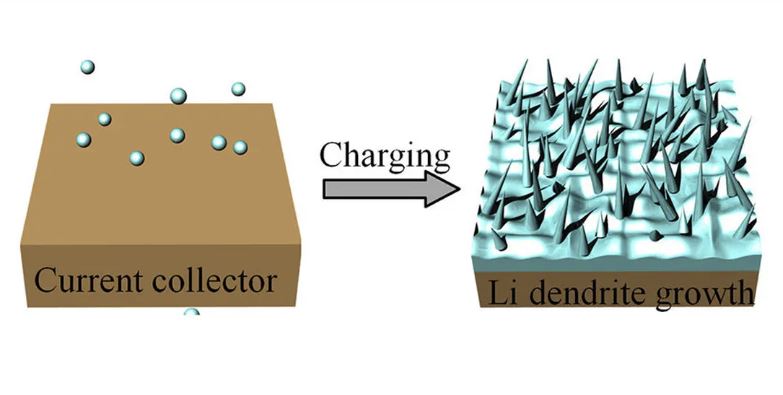
The formation of dendrites during charge and discharge phases
Photo by: InsideEVs
Each layer of this electrolyte fulfils a specific task. The first layer, which contains decabromodiphenylethane, prevents fires; the second, composed of zeolite, a mineral with a microporous and crystalline structure that increases the structural strength of the electrolyte itself; finally, the third contains a high concentration of lithium bis(trifluoromethane)sulphonimide salt, which facilitates the movement of lithium ions between anode and cathode and vice versa.
What do you think?
View
Comments
Superior durability and safety
Laboratory tests on lithium metal cells equipped with this trilayer electrolyte showed that the battery retained 87.9 per cent of its initial performance after 1,000 charge and discharge cycles. 'Conventional' solid-state batteries, subjected to similar cycles, reach a maximum of 70-80%. Moreover, thanks to their special design, even in the event of overheating, these revolutionary batteries are able to switch themselves off.
Kim Jae-hyun, professor leading the research said: "From the initial findings, we believe this research will contribute significantly to the commercialisation of lithium metal batteries using solid electrolytes. They will be suitable for various uses, from electronic devices to electric cars and storage systems'.
About solid-state batteries:
 MG announces new model debuting semi-solid battery
Honda demonstrates solid-state battery production line
Stellantis installs solid-state batteries in the Dodge Charger
Mercedes announces its solid-state batteries
We want your opinion!
What would you like to see on Motor1.com?
Take our 3 minute survey.
- The Motor1.com Team
Share this Story
- (https://twitter.com/intent/tweet?url=https%3A%2F%2Fwww.motor1.com%2Fnews%2F746241%2Fbattery-solid-state-trilayer-electrolyte%2F&text=Solid-state%20batteries%20improve%20with%20trilayer%20electrolyte&via=motor1com)
- copy
GO TO COMMENTS
(
)
Got a tip for us? Email: tips@motor1.com
View all comments ( )
Popular
The Rotary Engine Should Be Everywhere. Why Isn't It?
The 2027 BMW X5 Is Hugely Improved Where It Matters Most: Driven
Toyota's Next Mid-Engined Coupe Is Going Racing This Weekend
Alfa Romeo Has Had It With Huge Screens Inside Cars, Says They'll Inevitably Become Obsolete
Subaru Teases A New Manual WRX, But Only For Japan
latest articles
- 2027 Subaru Outback Base Trim Returns, Lowering Price Oct 23 - Pricing -
- Alfa Romeo Has Had It With Huge Screens Inside Cars, Says They'll Inevitably Become Obsolete Oct 23 - Technology -
- Audi Q9 Debuts World-First Curved OLED Taillights Oct 23 - Technology -
- Man Lets The Dealership Think He Wants To Trade In His Car. Then He Plays Their Service Department To Score A Deal Oct 23 - Trending -
- Toyota's Next Mid-Engined Coupe Is Going Racing This Weekend Oct 23 - Spy Shots -
- Volvo, Mercedes And VW Turn To Nvidia For European Self-Driving Push Oct 23 - Autonomous Vehicles -
- Subaru Teases A New Manual WRX, But Only For Japan Oct 23 - Teasers -
RECOMMENDED FOR YOU
Audi Is The First To Offer Spotify As A Native App Without Your Phone
Why Do Some Semi Truck Tires Look Like They're Not Touching The Ground?
GM Is Turning OnStar Into An AI Assistant For Your Car
‘This Should Be On The Dealership’: Woman Buys VW at Hyundai Dealership. Then Her Mechanic Finds A Shocking Problem No One Caught
Mercedes Isn't Sold On Extended-Range EVs: 'Would You Really Switch?'
The New Lexus LFA Inches Closer To Production With Fresh Spy Photos
Tesla Flips The Roadster Upside Down In Crazy Flying Demo