TWR Supercat: Sensational Jaguar XJS restomod made in the UK
In addition to the opulent appearance, a supercharged V12 causes a stir.

The Jaguar brand as we know it is dead. The recent presentation of the new logo and a foretaste of the future direction provided plenty of material for discussion worldwide. To put it kindly. The British marque is entering a new era, leaving the combustion engine behind and wanting to compete in the ultra-luxury e-car segment in future (with a car that has no rear window). Do you prefer something more traditional? This vehicle might be something for you then.
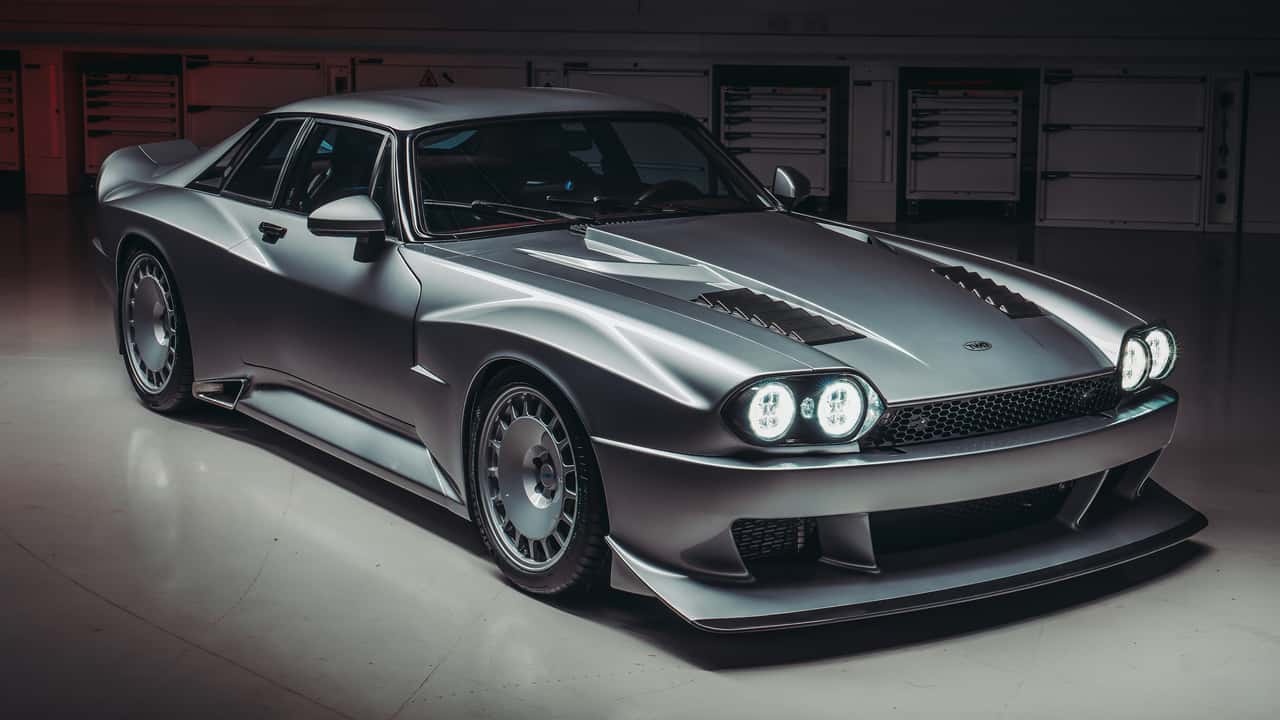
Say hello to the TWR Supercat, a spectacularly styled Jaguar XJS restomod with carbon fibre bodywork, designed by Khyzyl Saleem. Behind the company name, which many of you have probably heard before, is an engineering company that was founded in 2020 as a separate unit of the legendary Tom Walkinshaw Racing company.

The gentlemen are not necessarily committed to Jaguar or restomods, but their first project was the refresh of this noble grand tourer. The Supercat is almost 10 per cent lighter than the original from the 70s/80s/90s and now weighs in at 1,605 kilograms thanks to the exuberantly shaped carbon body. The brakes are also made of carbon fibre on request.
The extremely angular wheel arches, the aggressive aero elements at the front and rear, the bonnet - no matter where you look, there is a lot going on here visually. Among other things, there is also a side-exit exhaust system, which TWR has fitted to the car not just for show. This also creates space for the flatter underbody and the large rear diffuser. The car is also wider than the original XJS and is mounted on much larger wheels. The original car has 15-inch wheels, here 18-inch wheels are used at the front and 19-inch wheels at the rear.
However, the TWR endeavours do not end with the radical visual makeover; a lot has also happened under the bodywork. The chassis is reinforced with carbon fibre and high-strength stainless steel is used on the subframe. There are double wishbone axles with active dampers, a limited-slip differential, and traction control. And if you want to keep up with the times, you naturally need driving modes. In the case of the Supercat, there are five.
However, the star of the show is clearly to be found under the heavily ventilated bonnet. Instead of the familiar 6.3-litre unit, a 6.5-litre supercharged V12 now does the work. The displacement-enhanced engine delivers 660 bhp and 730 Nm of torque. The power is transmitted to the rear wheels via a 6-speed manual gearbox (!) with Launch Control. Originally, the XJS selected by TWR produced 281 bhp and 431 Nm and had a three-speed automatic transmission.
The 2+2-seater layout of the donor car is also history. The Supercat is a pure two-seater with electric seats and a larger luggage area. The fully digital instrument display is certainly a matter of taste in this context. Classic analogue displays would probably have suited the retro look of the interior better. Nice on the other hand: the leather seats with carbon fibre shells and the gear knob. In addition to the instruments, there is another screen for the infotainment system, which supports Apple CarPlay and Android Auto.
All in all, TWR wants to convert 88 Jaguar XJS into Supercats. Not an arbitrary number, by the way, as it refers to the year 1988 when Tom Walkinshaw's XJR-9 triumphed at Le Mans. The car will be available as a right and left-hand drive model. Orders are already being taken and apparently, only a few vehicles are still available. In the UK, the base price before tax is £225,000.
Source: TWR
RECOMMENDED FOR YOU
The 2026 Audi A3 Loses Even More Buttons
Your Car Has a Hidden Mechanical Key. Here's Why It's There
Volkswagen Axes A Minivan It's Been Selling For 11 Years
Woman Leaves Dodge Charger Parked Outside. Then Her Airbags Deploy For No Reason: ‘Never Seen This Happen Before’
Starter Motors Make Your Life Easier. Here's How They Work
Monterey Car Week 2026: Every New Supercar, Hypercar, And Concept
You're Probably Using Threadlocker Wrong