Nissan Santana (1984-1990): A VW for Japan
The saloon didn't even get a Nissan emblem
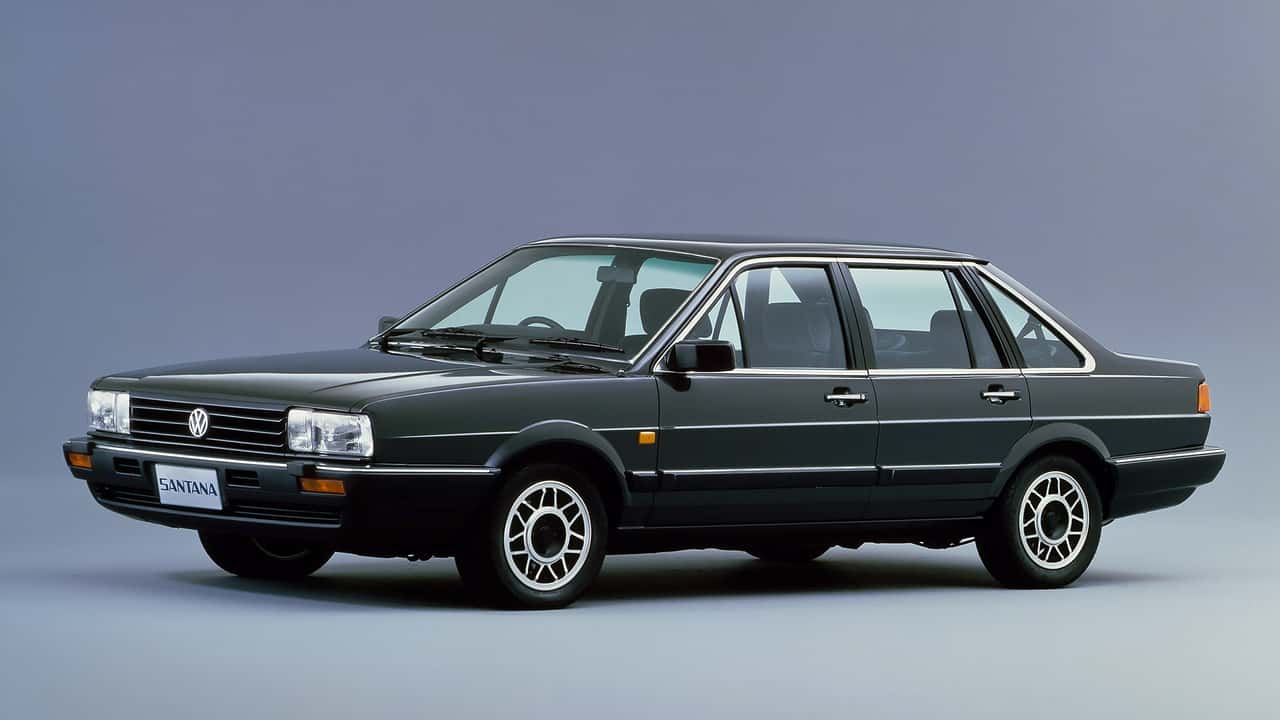

We were actually just looking for pictures of the first Micra and then this happened. Suddenly we are presented with a rather familiar sight, namely the VW Santana. But underneath the pictures are names like "M30 (1984-1989) 1984 Nissan Santana 2000Xi5 (A/T)", "1988 Nissan Santana MEISTERWERK" or "1985 Nissan Santana 2000Xi5 motorway". What was going on there?
A wild mix-up by Nissan interns in Japan? Even a belated April Fool's joke? Not at all, because as little luck as Volkswagen had with its notchback models in Europe (just think of the Derby or Vento), the same cars were just as successful in other parts of the world, and the Santana was no exception. In Germany, it struggled against Japanese competition and in-house rivals of the calibre of the Audi 80 and Audi 100, with just over 200,000 units rolling off the production line in Europe.
Gallery: VW Santana (1984-1990)


But in other countries the Santana became a bestseller. At times, plants in nine countries around the world produced it simultaneously.
However, the VW Santana became legendary in China. This model name was still in the programme there until 2021, albeit at some point on a completely new car. In 1983, the first Santana was assembled at Shanghai-Volkswagen (now SAIC-Volkswagen) from CKD kits, and production began in-house in 1985. A facelift to the "Santana 2000" took place in 1995, followed by the "Santana 3000" in 2004. Particularly popular as a taxi, the model was still one of the most-built cars in China in 2010.
Over 3,000,000 units of the "original" VW Santana based on the 1981 model were built in China.
VW Santana 2000 (1995-2004) for China
The Santana was built in Brazil from 1984 to 2006, where it became the most successful car in the upper mid-range segment. The Santana was also available there with two doors, a variant that was never offered in Europe. At the time of Autolatina, a strategic cooperation between VW and Ford, the Santana became the Ford Versailles and Royale with stylistic modifications, the former a four-door saloon, the latter a two-door estate.
Nissan VW Santana 1988 MASTERWORK
From February 1984 to 1990, the Santana was produced under licence by Nissan in Japan. The vehicles there were sold by Nissan dealers and were assembled from parts largely produced in Japan, which featured the Volkswagen and Audi logos as well as the Nissan logo, but not on the outside or on the steering wheel. The VW emblem was always affixed there. Background: Volkswagen wanted to gain a foothold in the Japanese market with this co-operation.
The then President of Nissan, Takashi Ishihara, wanted a comprehensive partnership with Volkswagen and decided that the production of the Santana would be a good springboard for the Japanese market.
Negotiations began in 1981, and in February 1984, Nissan began production of the Santana as a CKD model at its Zama plant in Kanagawa, Japan. The Santana was given the internal model code M30. The price of the Santana was significantly lower than that of the imported Volkswagen.
Nissan VW Santana 2000Xi5 A/T (1985)
The Santana from Nissan was modified for Japan with a right-hand drive wiper arrangement (parking on the passenger side), which required a new linkage mechanism as well as a new bonnet press, as there were cut-outs in the rear edge for the wiper pins. The vehicles built by VW, like some other models from the manufacturer at the time, e.g. the Golf II, had the same wiper pattern for the left-hand side regardless of the position of the steering wheel.
At launch, the Santana was available with three different engines: a 100 PS four-cylinder with 1,781 cc (Li, Gi), a 110 PS five-cylinder with 1,994 cc (Gi5, Xi5) and a 72 PS turbodiesel four-cylinder with 1,588 cc (Lt, Gt Diesel Turbo). All were equipped with a five-speed manual gearbox as standard, while the petrol engines were also available with a three-speed automatic transmission.
Nissan VW Santana 1987 JN Engine
NIssan VW Santana 1987 J Engine DOHC
The Santana was 5 mm narrower than its German counterparts to avoid a massive Japanese tax on cars wider than 1690 mm. In addition, the radiator grille and headlights were unique to the M30 Santana.
In May 1985, the Xi5 Autobahn version was added, which offered velour sports seats, an electric sunroof and 14-inch alloy wheels. In January 1987, the Santana was given a facelift with a new front end and new, larger bumpers. The turbodiesel was discontinued, so that only versions with a petrol engine were offered. The 1.8-litre Gi version now only had 91 PS, and the Li and Gi5 equipment variants were discontinued.
Nissan VW Santana 2000Xi5 Motorway DOHC (1987)
However, the Xi5 Autobahn was now available with a new engine, as a DOHC version of the 2-litre five-cylinder engine with 140 PS appeared. As sales, originally targeted at 4,000 to 5,000 vehicles per month, only reached 50,000 in seven years, Nissan discontinued production in October 1989.
More from the VW history:
Sales of the remaining stock continued until May 1990. Instead of renewing the production licence, Nissan began selling the new third-generation Volkswagen Passat through its dealer network. When Volkswagen and Toyota began a co-operation in 1991 (VW Taro), Volkswagen sales through Nissan dealers came to a standstill.
Gallery: VW Santana (1981-1985)


RECOMMENDED FOR YOU
Volkswagen's New ID. Cross Is Its Cheapest Electric SUV Yet
Aston Martin's Single-Seat Supercar Sounds Glorious On The Track
Volkswagen Group Internal Memo Reportedly Calls For Doubling Layoffs
Man Buys A Hyundai. Then He Gets An Email Thanking Him For Signing Up For Tracking Services. There’s Just 1 Problem
The 10 Fastest Cars At Goodwood This Year
Electric BMW M3 Will Have More Power Than The Gas Car, Without Going Overboard
Jetta And Taycan Among 10 Cars Facing The Axe At VW Group: Report