Home
Mercedes-Benz
News
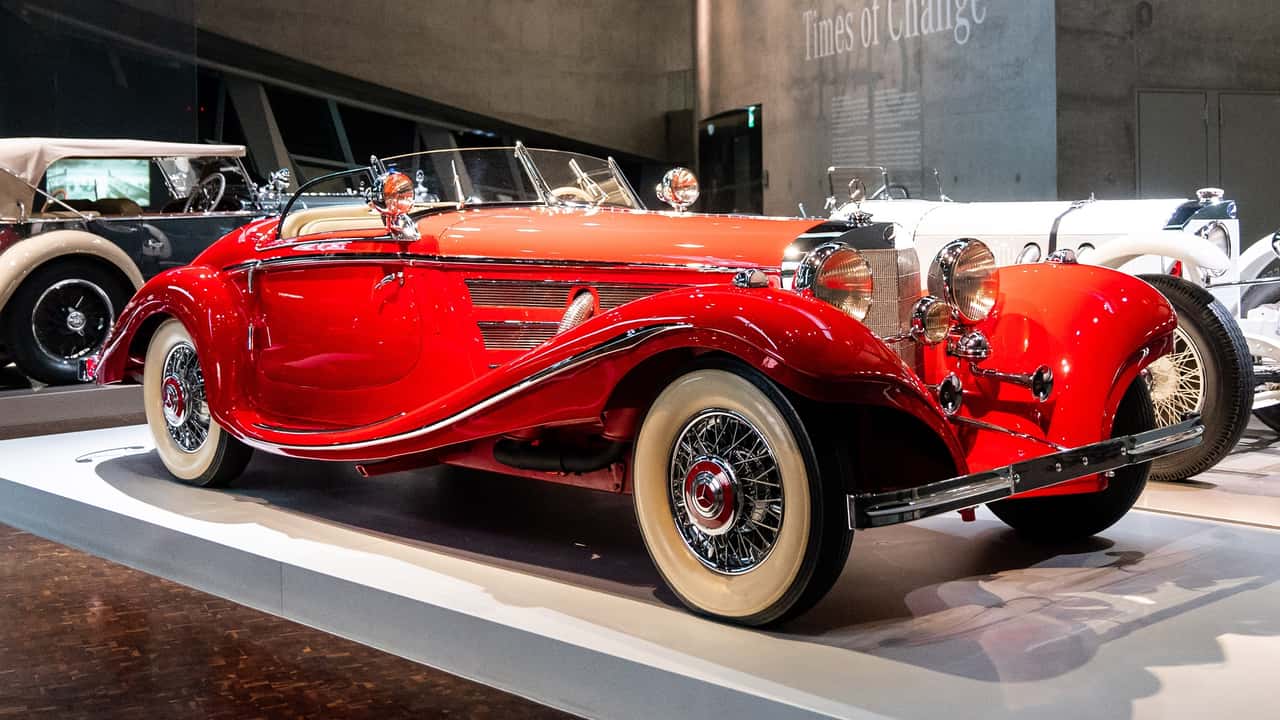
Mercedes-Benz 500 K Special Roadster (W 29): Red beauty
Rarely have 90 years looked better

By: Roland Hildebrandt
Published by: Brian Potter
Mar 17, 2024 at 7:09am ET
Add Motor1.com as a preferred source in Google
- (https://twitter.com/intent/tweet?url=https%3A%2F%2Fwww.motor1.com%2Fnews%2F712699%2Fmercedes-benz-500k-special-roadster-w29%2F&text=Mercedes-Benz%20500%20K%20Special%20Roadster%20%28W%2029%29%3A%20Red%20beauty&via=motor1com)
- copy
Share
Comment
An old lady in the limelight: The 500 K special roadster is a superstar in the Mercedes-Benz Museum. What makes this 500 K so fascinating? The colour, of course, but the manufacturer itself says, "It is an extraordinary automotive sculpture whose elegance radiates effortlessly from the 1930s to the present day. The best technology, highly elegant style and luxurious equipment come together here." There is some truth in that.
The Mercedes-Benz 500 K made its debut at the International Automobile and Motorcycle Exhibition (IAMA) in Berlin from 8 to 18 March 1934 - 90 years ago. The luxury automobile was on display there as a spectacular "motorway courier" with a closed, aerodynamically optimised body.
Gallery: Mercedes-Benz 500 K Spezial-Roadster (W 29)

11
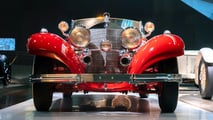
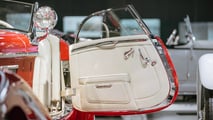
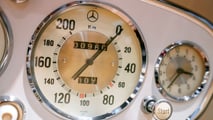
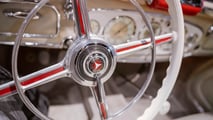
The special roadster with a recessed radiator is the eighth and most expensive body variant added to the range in October 1934. It costs 28,000 Reichsmarks. An exorbitant amount, for which you could easily buy a detached house in a prime location at the time.
This naturally narrowed the circle of buyers. Well-known names from the worlds of culture, show business, and politics bought the 500 K - and also adorned themselves with this vehicle.
The great effort that went into building the special roadster still amazes today. It starts with the design. The body with the large, elegantly curved wings and the metre-long bonnet was designed by stylist Friedrich Geiger. Today we would call him a designer. After the war, he also designed the 300 SL Gullwing and, as his last project, the W 116, the first S-Class.
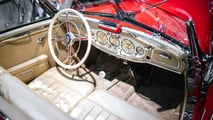
The interior resembles an elegant salon. Leather caresses the driver and front passenger and is used as seat upholstery and on the doors with the finest craftsmanship. Everything is colour-coordinated. The driver's hands grip an ivory-coloured steering wheel. The driver's gaze falls on a dashboard with instruments as if from a watchmaker's workshop.
Even back then, many customers had individual wishes, and so the vehicles were produced under the direction of Hermann Ahrens as one-offs in the special vehicle construction department at the Sindelfingen plant - an address of the time for the best bodywork construction. The "Sindelfingen bodywork" badge on the side of the special roadster was a sign of quality. Holy metal, so to speak.
The highest standards were also applied under the bodywork. The M 29 supercharged engine is legendary in the 500 K. It produces 100 PS and 160 PS with the supercharger switched on. The two-bladed Roots blower located in front of the carburettor is activated by moving the accelerator beyond the full throttle position via a pressure point (kickdown effect). This is followed by the distinctive roar of the supercharger and the immediately noticeable increase in power. Consumption? If you can afford a 500 K, you don't think about it.
The modern chassis of the 500 K by the standards of the time, adopted from the Mercedes-Benz 380 (W 22), takes the engine power into account. With its trapezoidal-link front axle and rear swing axle, the Daimler-Benz design, which was protected by patents, was not only progressive, but quickly developed into a common feature of automotive engineering that is still valid today and is used worldwide. The rear axle design enables high speeds with outstanding driving safety.
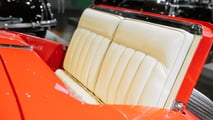
The 500 K invites you to indulge in the details. What might the step on the rear mudguard be for? Surprise - the special roadster is not a two-seater. The flap behind the interior opens up another bench seat, commonly known as the "mother-in-law's seat". The step makes it easier to get in.
What do you think?
View
Comments
The 500 K was already rare in the 1930s. Only 342 were produced in all body variants between 1934 and 1936. This was followed seamlessly by the 540 K with a larger displacement engine. Today, both versions of the W 29 series are guaranteed top prices at auctions. Occasionally, they even break the 10 million barrier.
Read also:
Maserati GranTurismo: The ten most iconic examples
Marcello Gandini's 10 most famous car designs
The special roadster in particular is so sought-after that body shops from the 1950s onwards converted saloons or cabriolets into special roadsters in the hope of increasing their value. Of course, only original vehicles from Sindelfingen achieve the highest prices. The experts at Mercedes-Benz Classic can establish authenticity beyond doubt.
We want your opinion!
What would you like to see on Motor1.com?
Take our 3 minute survey.
- The Motor1.com Team
Share this Story
- (https://twitter.com/intent/tweet?url=https%3A%2F%2Fwww.motor1.com%2Fnews%2F712699%2Fmercedes-benz-500k-special-roadster-w29%2F&text=Mercedes-Benz%20500%20K%20Special%20Roadster%20%28W%2029%29%3A%20Red%20beauty&via=motor1com)
- copy
GO TO COMMENTS
(
)
Got a tip for us? Email: tips@motor1.com
View all comments ( )
Popular
12 Cars With Names That Make Absolutely No Sense
BMW Kept This Hatchback A Secret For Decades
Bugatti Restores One-Off Veyron With A Mirror-Like Aluminum Body
The Gas BMW M3 Isn't Dead: Next-Gen Prototype Roars
latest articles
- Subaru Built A 510-HP Electric Wagon Without Toyota's Help Oct 20 - Official -
- The Strange Reason The Golf GTI Had A Golf Ball Shifter Oct 20 - Motor101 -
- Photos: Porsche's Mission S Concept Takes Over New York City Oct 20 - Design -
- The 2027 Honda Passport TrailSport Looks Noticeably Taller Next To Last Year's Model Oct 20 - Off-Road -
- 12 Cars With Names That Make Absolutely No Sense Oct 20 - Lists -
- The Ford Ranger Is Getting A Bigger V6 For 2027: Report Oct 20 - Rumors -
- BMW Already Has A Deal On The New i3. But It's Not Cheap Oct 20 - Pricing -
RECOMMENDED FOR YOU
Mercedes Isn't Sold On Extended-Range EVs: 'Would You Really Switch?'
Subaru Built A 510-HP Electric Wagon Without Toyota's Help
Mercedes Says Coupe SUVs Are Here To Stay: 'There's A Fan Base'
The Strange Reason The Golf GTI Had A Golf Ball Shifter
Mercedes Admits It Underestimated The V8 Crowd, Teases A V12 Surprise
Photos: Porsche's Mission S Concept Takes Over New York City
Mercedes-AMG GT SUV Revealed: Up To 1,153 HP And Three Electric Motors