Tesla Robovan revealed: Autonomous bus with 20 seats
Tesla remained even more vague about this future project than with the Cybercab


At the "We, Robot" event early Friday morning UK time, Tesla not only presented its robotaxi called Tesla Cybercab. At the end of the event, another vehicle was presented that hardly anyone had expected: another autonomous driving model called Robovan. The futuristically styled bus has 20 seats. An approximate price or launch date has not yet been announced.
At the event, the main focus was on the Tesla Cybercab, an autonomous taxi with just two seats. The Robovan, on the other hand, offers 20 seats, so it would almost be something of a supplement to local public transport.
"What if you need a vehicle that's bigger than a Model Y?" asked Tesla CEO Elon Musk at the event. The answer is apparently the Robovan. The vehicle could transport up to 20 people, for example a sports team, it was said; freight transport is also possible.
Gallery: Tesla Robovan

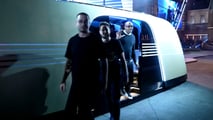
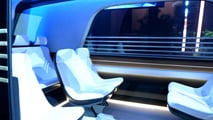
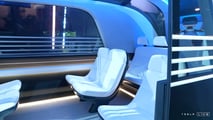
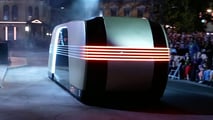
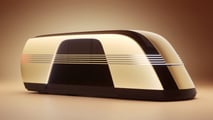
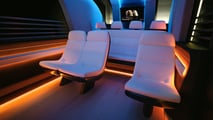
During the presentation, there were hardly any concrete details about the vehicle's technical data, the price or the launch of the model. What we do know, however, is that the vehicle has sliding glass doors, a light-coloured interior and rows of seats facing each other like a coach.
Sliding doors and numerous individual seats: the interior of the Robovan
The wheels of the Robovan cannot be seen in the pictures, so the vehicle resembles a futuristic tram that floats along without touching the ground. Like the Cybercab, the Robovan does not appear to have a steering wheel.
"One of the things we want to do, and you saw this with the Cybertruck, is we want to change the way the roads look", Musk said. "We want the future to look like the future". On the realisation of the project, Musk said: "We're going to do this, and it's going to look like this". Various renderings from Tesla also show the Robovan as a school bus, mobile garage and food truck.
The Robovan as a mobile sausage stand
The idea of a self-driving van is not new. General Motors, for example, planned the Cruise Origin, an electrically powered shuttle. However, the project failed due to the uncertain prospects of whether the design would be compatible with regulatory requirements. Zoox, a company belonging to Amazon, also presented a similar vehicle. However, both had a less chic but perhaps more realistic design.
Tesla doesn't exactly have the best track record when it comes to realising announced vehicles and technologies. The Semi and the Cybertruck came much later than promised, the Roadster is still not in production four years after it was announced, and Tesla production cars have not yet mastered "Full Self Driving" either.

The bottom line
Surprisingly, Tesla not only presented the long-awaited Robotaxi with two seats at its "We, Robot" event. Surprisingly, a 20-seater bus was also presented, which is also intended to drive autonomously. However, Elon Musk failed to provide any technical details or more or less concrete details.
More from Tesla:
Source: InsideEVs.com
RECOMMENDED FOR YOU
Car Buyers Don’t Want More Tech. They Just Want Heated Seats
Woman Says She’s Never Had Oil Change Because It’s A ‘Scam.’ Then Valvoline Has Something To Say: ‘I’ve Had This Car For 4 Years’
Tesla Driver Gets New Tires Installed. Then He Takes A Closer Look At The Fine Print On Them: 'Just Drive In Reverse'
Woman Puts Bath & Body Works Air Freshener In Her Car. Then She Sees What She Comes Back To: ‘Sent Her A $1,500 Check’
RIP: These Cars Won't Make It To 2027
Can You Actually Drive On A Flat Tire? It Depends On The Tire
Woman Shops For Tesla. Then She Learns The Real Reason It's Better To Lease—Not Buy