Mercedes A-Class (W 169, 2004-2012): Classic of the future?
The more solid second generation is already 20 years old


Everything should be better, but the basic concept remains the same: In 2004, the 169 model series replaces the first generation of the Mercedes A-Class. The model once again had a body based on the sandwich principle. In addition to the five-door version, there is now also a three-door A-Class coupé, both with the same wheelbase.
In seven years of production, the first A-Class has emphatically emphasised its role as a successful model with over 1.1 million units sold. Mercedes begins another chapter in this success story in summer 2004 with the launch of the second A-Class generation, the 169 model series. The new car arrives in dealerships in autumn 2004.
Gallery: Mercedes A-Class (2004-2012)

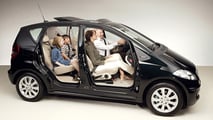



The designers have further developed the unmistakable one-box concept. Like the predecessor model, the second generation of the A-Class also has a sloping front section, which is followed by a curved roof surface and a steeply sloping rear door.
Mercedes shows continuity in the technical foundations of the A-Class: the basis of the 169 model series is once again the unique sandwich construction, which gives the A-Class good occupant safety, exemplary economy of space and great variability. The interior space has been improved compared to its predecessor and now surpasses comparable vehicles even more clearly.
The A-Class also achieves a considerable lead in terms of perceived value. This is urgently needed, as the interior of the predecessor always looks rather cheap and not as high-quality as a Mercedes deserves.
Mercedes A-Class (2004-2012)
A song for the market launch
Mercedes-Benz celebrates the launch of the second generation of the A-Class with the "Star Tour". The motto of this programme in 2004 is "Follow your own star": 800 selected drivers from 24 countries are given the opportunity to get to know the A-Class intensively on four one-day stages through the most beautiful regions of Europe before the official market launch.
Mercedes A-Class (2004-2012)
The Star Tour ends at the Castello Sforzesco in Milan. This is where Christina Aguilera performs her song "Hello", which she produced exclusively for the launch campaign of the new A-Class.
Three or five doors
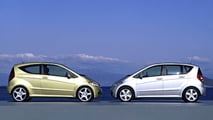
The A-Class (drag coefficient 0.29) is now offered with one wheelbase, but with two body versions, both of which have their own unique character: In addition to the five-door W 169, a three-door model is being offered for the first time in this model series. It is intended (as Mercedes claims in all seriousness) " to follow in the tradition of Mercedes-Benz coupés with its sporty and particularly youthful appearance." Accordingly, this body version is also referred to internally as the C 169.
Mercedes A-Class (2004-2012)
The difference between the two body variants is particularly noticeable in the side view. And while we're on the subject of Mercedes-speak: "The lines of the body convey the values of dynamism, intelligence and likeability." In case you didn't already know.
Changed proportions make the second A-Class visually more powerful. Compared to the predecessor model, the vehicle is now 232 millimetres longer and 45 millimetres wider. In concrete terms: up to 3.88 metres long, plus 1.76 metres wide, 1.59 metres wide and 2.57 metres wheelbase. These dimensions mean that the long version of the predecessor model is no longer available.
The interior of the 169 model series is also spacious: The car surpasses its predecessor in all comfort-relevant interior dimensions. The shoulder room has been increased by up to 97 millimetres, the elbow room by up to 95 millimetres and the knee room in the rear by 30 millimetres. The distance between the front and rear seats is 805 millimetres, which is on a par with a mid-size saloon.
Mercedes A-Class (2004-2012)
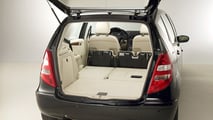
The boot has grown to 435 litres, and the load volume can be increased to up to 1,370 litres thanks to variable interior design. Even more space is created by the optional EASY-VARIO-PLUS system, which gives the A-Class a maximum load capacity of 1,995 litres.
The load compartment floor, which can be adjusted in height by 90 millimetres, creates a flat loading area in the rear when the rear seat backrest is folded down. As the A-Class is now equipped with the TIREFIT tyre sealant as standard, the spare wheel recess serves as a storage space. Depending on the position of the load compartment floor, it has a volume of 67 or 118 litres. A further storage compartment is located behind a flap in the right-hand side panelling of the boot.
In total, more than 200 patents are used in the model. The pioneering innovations include a newly developed, high-performance seat belt and airbag system. These include, for example, adaptive, two-stage front airbags, belt tensioners at the front and on the outer rear seats, adaptive belt force limiters and newly developed head/thorax side airbags instead of the previous sidebags.
The increased use of higher-strength and ultra-high-strength steel alloys, high-strength bonded joints and additional support profiles in the body structure also help to ensure that the occupants are well protected even in the event of serious accidents.
Mercedes A-Class (2004-2012)
Mercedes-Benz sets standards in the field of driving safety and stability in the A-Class with a series of new developments. At the forefront of the chassis innovations is the parabolic rear axle, which is characterised by precise wheel guidance and good roll support in bends.
The suspension offers a new selective damping system as standard, a world first in automotive engineering. This technology adapts the shock absorber forces to the respective driving situation: During normal driving, a soft shock absorber characteristic ensures a high level of ride comfort, while during dynamic cornering the full damping force is available and the A-Class is stabilised in the best possible way.
More power, less fuel consumption
The engines and transmissions of the Mercedes-Benz A-Class now offer more power and torque with exemplary fuel consumption and comfort. This ensures great driving pleasure with environmentally friendly consumption values. The engines are designed so that they can be installed at an angle of up to 59 degrees behind the front axle. This makes the four-cylinder engines important components of the intelligent safety concept: in the event of a serious frontal collision, they slide downwards without damaging the passenger compartment.
Mercedes A-Class (2004-2012)
The engine programme of the second edition consists of seven four-cylinder engines, including three newly developed CDI direct injection engines and one petrol engine with turbocharging. Compared to the predecessor model, the output of the petrol and diesel engines for the A-Class has been increased by up to 38 percent; torque has been improved by up to 46 percent. All four-cylinder engines fulfil the strict EU 4 emissions limits, and a particulate filter system is available as an option for the diesel engines. Despite the higher output, the fuel consumption of the petrol engines is significantly reduced.
Second-generation CDI
The engine of the A 160 CDI produces 82 PS, the A 180 CDI is powered by a 109 PS diesel engine and the top-of-the-range A 200 CDI produces 140 PS. The main differences compared to the predecessor models include the increased displacement from 1,689 to 1,991 cubic centimetres, higher ignition pressures and the second-generation common-rail injection system, which operates with dual pilot injection, higher injection pressure (1,600 bar) and newly developed seven-hole injection nozzles instead of the previous six-hole nozzles. The optional particulate filter reduces the already low soot emissions by a further 99 per cent.
Powerful petrol engines
Compared to the W 168, the four-cylinder petrol engines offer up to 38 per cent more power and up to 36 per cent more torque. At the same time, fuel consumption, exhaust and noise emissions are reduced. The higher output and torque of the new models A 150 with 95 PS, A 170 with 115 PS and A 200 with 136 PS are based on a 100 cubic centimetre increase in displacement and the use of a shift intake manifold, which increases the pulling power in the lower engine speed range.
Alternative drives, but not in series production
As early as 1997, a version of the A-Class with battery-electric drive and the so-called Zebra battery was developed. The E-Cell model with a lithium-ion battery followed in 2011 in the successor series 169. The fuel cell also makes the A-Class mobile: at the IAA 1997, Mercedes-Benz presents the NECAR 3 (New Electric Car) research vehicle with fuel cell drive. This was further developed in several stages and renamed F-CELL in 2002.
Mercedes A-Class (2004-2012)
Stepless automatic transmission
In the second generation of the A-Class, Mercedes-Benz introduces a continuously variable automatic transmission for the first time, which can be combined with all engines on request: the "Autotronic" works according to the principle of a "Continuous Variable Transmission" (CVT), in which the gear ratios are infinitely variable by means of a conical disc variator and push link belt. As a result, the A-Class accelerates without any interruption in tractive power, and the engine reaches its maximum output faster than with a conventional automatic transmission.
The continuously variable transmission also offers a high level of ride and noise comfort. The driver can decide the characteristics of the transmission by choosing between the Comfort and Sport programmes. The complete Autotronic measures just 330 millimetres in length, making it the most compact continuously variable automatic transmission in the world. The standard six-speed manual transmission in the A 180 CDI, A 200 CDI and A 200 Turbo models is also a new development.
Three equipment lines
The 169 model series is offered in the three equipment lines "Classic", "Elegance" and "Avantgarde". All three variants have extensive standard equipment, and even the basic Classic model scores with important safety and comfort details as standard. These include adaptive front airbags, head/thorax side airbags, adaptive belt force limiters, multifunction steering wheel, speed-sensitive power steering (parameter steering), selective damping system and air conditioning.
Mercedes A-Class Elegance
The Elegance line sets accents with additional comfort and design details, while the Avantgarde line emphasises its sporty character with 16-inch tyres and projection headlights, among other things. An electrically operated panoramic sunroof is available as an option for the new A-Class. Its transparent louvres are made of tinted plastic and are protected by a scratch-resistant coating, which also prevents the transmission of UV rays from the sunlight. When the sunroof is opened, the foremost slat rises first and remains in this position as a wind deflector.
2005 - The A 200 Turbo arrives
In July 2005, the second-generation A-Class family is complete: initially, the 169 model series is launched with three diesel and three petrol models. Now the Mercedes-Benz A 200 Turbo completes the programme. With 193 PS, it offers the driving characteristics of a sports car.
The four-cylinder petrol engine therefore guarantees astonishing performance. The A 200 Turbo accelerates from zero to 62 mph in just 7.5 seconds; the top speed is 142 mph. Nevertheless, fuel consumption remains comparatively modest at 7.9 litres per 100 kilometres (35.8 mpg-UK). Like all A-Class models, the A 200 Turbo is available as a five-door or three-door coupé.
From 2005 onwards, Mercedes-Benz offers a sports package for all A-Class models. This includes 17-inch alloy wheels, a perforated radiator grille painted in matt silver, sports pedals with rubber studs, a sports gear lever, a sports-look steering wheel with perforated leather cover and an instrument cluster with a silver background.
Mercedes A-Class Facelift (2008)
In the first twelve months after the launch of the 169 model series, more than 200,000 vehicles are delivered. In Germany alone, around 105,000 buyers opt for the new edition of the A-Class by summer 2005. The most popular engine is the A 180 CDI, which is chosen by a good third of all customers. The A 150 base model follows in second place with a 25 per cent share of buyers. The most popular optional extras for the A-Class are the leather steering wheel, light and visibility package and the continuously variable automatic transmission.
More from the history of Mercedes:
In spring 2008, the A-Class model series is given an extensive facelift. It can be recognised externally by the larger headlights. In July 2010, production of the three-door coupé version is discontinued due to weak sales figures. In October 2010, the curtain also falls on the A 200 Turbo. General production of the W 169 ended on 19 April 2012, with its successor, the W 176, appearing on 15 September 2012; it is now a very ordinary compact car.
The 169 series in the press
Let's take a quick look at the media of the time: "The Mercedes A II can do everything better than the A I. And when the door slams shut with a rich sound, we recognise that the little Mercedes has the virtues of its bigger brothers." (Frankfurter Allgemeine Zeitung, issue of 26 October 2004)
"In the new small car from Mercedes, you feel like you're in an eight-cylinder engine." (Die Zeit, issue of 11 November 2004)
RECOMMENDED FOR YOU
Man Always Parks His Mercedes Far Away From The Office Parking Lot. Then He Reveals Why
Woman Charges Her Rivian At Costco For 1 Hour. Then She Sees How Much It Costs: ‘Electric Car People Have Been Lying’
I Bought My Dream Mercedes SL For $8,000. Here's What It Really Cost Me
Man Shops For Ford Mustang At CarMax. Then He Sees What They Want For It: ‘These Prices Have Gotten Outrageous’
I Rode In Mercedes-AMG's New SUV. It Leaves The EQ Models In The Dust
Chrysler Dealership Gives Florida Woman 'Brand-New' Goodyears. Then She Inspects Them
The New Mercedes C-Class Doesn't Bring Back The AMG C63 V8