Home
Volkswagen
News
VW Polo III (1994-2001): Classic of the future?
The small car played mini golf very successfully 30 years ago

Photo by: Volkswagen

By: Roland Hildebrandt
Published by: Brian Potter
Sep 8, 2024 at 4:12am ET
Add Motor1.com as a preferred source in Google
- (https://twitter.com/intent/tweet?url=https%3A%2F%2Fwww.motor1.com%2Fnews%2F732932%2Fvolkswagen-polo-3-1994-history%2F&text=VW%20Polo%20III%20%281994-2001%29%3A%20Classic%20of%20the%20future%3F&via=motor1com)
- copy
Share
Comment
Our regular readers have probably already read the "Do you remember?" series. There we present cars from the past that are now almost forgotten. But what about the models that are still on the road in large numbers? The types that everyone knows, that have been on the road for well over 20 years, or in some cases much less.
Will they become classic cars one day? This is a source of controversy. We want to present some of these models in our "Classic of the future?" series.
1994: A litre of Super costs DM 1.56, diesel DM 1.14. Not really a bargain even then. So a new car arrives just in time to replace its predecessor after a long 13 years.
Gallery: VW Polo III (1994-2001)

75




Source: Volkswagen
"Small can be this big." Volkswagen presented the Polo III with this slogan in August 1994. Compared to the Polo II, it has been extensively revised as the body, chassis and engines are completely new. The cubic design of its predecessor was reinterpreted and the new Polo appeared much more modern. At the start of production, only the hatchback variant with three and, for the first time, five doors is offered. The body impresses with good aerodynamics, the Cd value is 0.32, and 275 to 590 litres of luggage fit in the boot.
As big as the first Golf
The Polo III is 3,715 millimetres long, putting it on par with the Golf I. The more material-intensive safety structure and the higher equipment level increase the kerb weight to 915 kilograms. The 1.0-litre four-cylinder entry-level engine with 45 and later 50 PS is popular, but also the 1.4 with 60 PS and the 1.6 with 75 PS.
Speaking of popularity: in the first ten months after its premiere, VW already sold 240,000 new Polo cars across Europe.
VW Polo III (1994-2001)
Volkswagen
What does the press say? The good driving comfort, which is almost on a par with the Golf, is praised, as is the manoeuvrability. It also has good seats, even for tall people. The basic version with 45 PS (price: 18,295 marks) runs quite quietly, but is rather poorly powered as it takes 21.4 seconds to reach 62 mph. The 60 PS variant is over six seconds quicker in this discipline, and also offers power steering as standard. And even the 64-PS naturally aspirated diesel is faster.
Notchback and Caddy
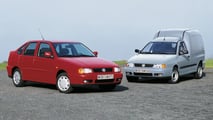
The 4.14 metre long Polo Classic, available from October 1995 as a notchback version, was produced in Spain and was based on the larger platform of the Seat Cordoba. As a result, it not only offers more space in the interior, but also under the bonnet. This allows the new 1.9-litre turbodiesel with 90 PS to be fitted. Alternatively, it is equipped with the 1.4-litre engine (60 PS) and the 1.6-litre unit (75 PS). A boot capacity of 455 litres is on offer, with the rear seat bench folded down it is 760 litres.
VW Polo Classic und Caddy (1996)
Volkswagen
Also in 1995, Volkswagen presented another Caddy, which, however, had nothing in common with the first generation (until 1992). The chassis comes from the Seat Inca, while the front end is similar to the Polo, from which the engines also originate. The Caddy II is initially available as a two-seater platform van and as a five-seater estate with glazing.
1996: At the beginning of the year, customers look forward to a new powerful petrol engine with 1.4 litres, 16 valves and 100 PS. An automatic gearbox for the 1.4 and 1.6 litre engines is available from spring. In March, the 1.7-litre diesel will appear as a naturally aspirated engine (60 PS) - the TDI does not fit under the bonnet. The 1.9-litre SDI replaces the previous 1.9 D and 1.7 SDI. In the autumn, the 45 PS engine will be replaced by the 50 PS all-aluminium engine. From the autumn, the anti-lock braking system (ABS) will be available at extra cost.
The most colourful VW of all time
In the same year, the most eye-catching Polo, the Polo Harlequin, is launched: the colours blue, red, yellow and green are available as optional extras - all at once. The fact that the vehicle is available with 60 PS, 75 PS or 100 PS tends to fade into the background in view of the splendour of the colours. If you also like sky blue, take the Polo Harlequin in the open-air version.
VW Polo III Harlequin (1995-1997)
Volkswagen
The Harlequin was originally only built by VW in 20 vehicles (original Harlequin) for advertising purposes as a symbol of the modular principle of the equipment modules. Due to the demand for the colourful Polo, the model variant is realised. Only 3,806 vehicles are delivered between 1995 and the beginning of 1997, as the Harlequin is not too cheap.
The Polo Harlequin is available in four different colour combinations, which the customer cannot choose when ordering. The colour scheme is based on a fixed pattern, whereby two surfaces of the same colour may never be next to each other during production.
Estate and GTI
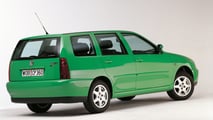
From July 1997, the Polo is also offered as an estate. It corresponds to the Seat Cordoba Vario and is equipped with the same technology as the Polo Classic. It is also 4.14 metres long and offers a boot capacity of 390 or 1250 litres.
In 1998, the Polo is allowed to bear the three letters of its big brother Golf for the first time: Volkswagen takes up the idea of the special series again after the Polo G40: There was a limited edition of 3,000 Polo GTIs (only as a hatchback with three and five doors). It sells out quickly. A new 1.6-litre 16V engine with 120 PS offers acceleration from 0 to 62 mph in 9.1 seconds.
VW Polo Variant Colour Concept
Volkswagen
VW Polo III GTI
15-inch aluminium wheels from BBS sport up the look. Other recognisable features include a lowered chassis, white indicators and a high-quality interior. Not all colours are available to match a special series; only red, silver and black are available here.
In a departure from usual practice, Volkswagen does not offer equipment lines for the Polo III, but bundles various extras into equipment packages.
1999: Major facelift
The Polo III is thoroughly revised in September 1999: Among other things, it is given a redesigned front end with a large Volkswagen logo in the radiator grille. New headlights with a clear-glass look are just as striking as the modified bumpers and redesigned rear lights. The interior is of a higher quality than before, and the instruments are now backlit in blue. The rear is more in keeping with the style of the Golf IV, with the licence plate now integrated into the bumper.
VW Polo III Facelift (1999)
Volkswagen
VW Polo III Facelift (1999)
The safety features are improved, airbags and ABS are now on board as standard, ESP can be selected as an optional extra. The body structure is reinforced and protected with full galvanisation. In addition, the buyer receives a twelve-year guarantee against rusting through.
For automotive history buffs:
1961 Pontiac Tempest Monte Carlo Concept - the speedster never born
The Lamborghini Countach turns 50 - how it was built back then
Seat 133 (1974-1981): Do you remember?
Audi 50 (1977) driving report: Solo for Polo
What do you think?
View
Comments
The engine range has also been revised: A 1.4-litre turbodiesel with pump-nozzle direct injection (75 PS) is new, while the 1.9-litre naturally aspirated diesel (64 PS) remains in the range. The output of the 1.4 16V is reduced to 75 PS. Thanks to the use of a variable camshaft, the 1.6-litre 16-valve engine in the Polo GTI now produces 125 PS. The latter has the Electronic Stability Programme (ESP) on board as standard.
The VW Polo III was launched in 1994 as type 6N and was called 6N2 from 1999 to 2001. Production ends after a total of 645,000 units have been built.
We want your opinion!
What would you like to see on Motor1.com?
Take our 3 minute survey.
- The Motor1.com Team
Share this Story
- (https://twitter.com/intent/tweet?url=https%3A%2F%2Fwww.motor1.com%2Fnews%2F732932%2Fvolkswagen-polo-3-1994-history%2F&text=VW%20Polo%20III%20%281994-2001%29%3A%20Classic%20of%20the%20future%3F&via=motor1com)
- copy
GO TO COMMENTS
(
)
Got a tip for us? Email: tips@motor1.com
View all comments ( )
Popular
12 Cars With Names That Make Absolutely No Sense
BMW Kept This Hatchback A Secret For Decades
Bugatti Restores One-Off Veyron With A Mirror-Like Aluminum Body
The Gas BMW M3 Isn't Dead: Next-Gen Prototype Roars
latest articles
- Subaru Built A 510-HP Electric Wagon Without Toyota's Help Oct 20 - Official -
- The Strange Reason The Golf GTI Had A Golf Ball Shifter Oct 20 - Motor101 -
- Photos: Porsche's Mission S Concept Takes Over New York City Oct 20 - Design -
- The 2027 Honda Passport TrailSport Looks Noticeably Taller Next To Last Year's Model Oct 20 - Off-Road -
- 12 Cars With Names That Make Absolutely No Sense Oct 20 - Lists -
- The Ford Ranger Is Getting A Bigger V6 For 2027: Report Oct 20 - Rumors -
- BMW Already Has A Deal On The New i3. But It's Not Cheap Oct 20 - Pricing -
RECOMMENDED FOR YOU
12 Cars With Names That Make Absolutely No Sense
Photos: Porsche's Mission S Concept Takes Over New York City
This German City Exists Because Of Volkswagen
The 2027 Honda Passport TrailSport Looks Noticeably Taller Next To Last Year's Model
10 SUVs That Get 30 MPG Without Hybrid Power
The Ford Ranger Is Getting A Bigger V6 For 2027: Report
Man’s Car Gets Hit. A Tow Truck Shows Up. Then The Alarm Bells Start Going Off: ‘Don't Let It Take Your Car’