UK: Toyota Hilux BEV and FCEV in a short test - the double track
For the future of the pick-up, the focus is on various emission-free drive systems


Toyota is pursuing a multi-pronged strategy on the road to complete CO2 neutrality by 2050: CEO Akio Toyoda clearly states that electric cars will only make up a good third of the Group's range in future. The conditions in the 170 or so countries in which Toyota sells cars are too diverse.
Toyota recently showed us what this colourful mix can look like in the truest sense of the word by letting us drive several Hilux models. In addition to the classic 2.8-litre diesel, there were two near-production prototypes: The all-electric Hilux BEV in yellow and the Hilux FCEV in blue with fuel cell and hydrogen. Wait a minute? Didn't Toyota engineers recently admit that the Mirai was the wrong horse?
Gallery: Toyota Hilux BEV and Hilux FCEV driving report

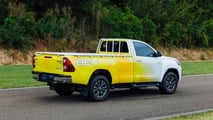

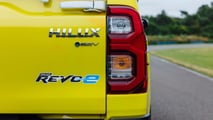

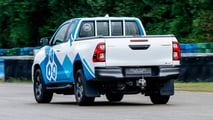

Absolutely, if only because the space for hydrogen tanks in a car is limited. The situation is different for commercial vehicles, even the lighter ones like the Hilux. Commercial users such as the military, airports or mines, where a hydrogen refuelling station is always installed in the same place, would come into question here.
Toyota Hilux FCEV in detail
Let's first take a look at the technology of the two fairly clean Hiluxes. Firstly, the FCEV: the first ten units of the pick-up were produced at the Toyota Motor Manufacturing UK plant in June 2024. The model was presented to the public for the first time in September 2023.
From the outside, the prototype is indistinguishable from the standard Hilux; the dimensions remain unchanged at 5,325 x 1,855 x 1,810 millimetres (L x W x H). Under the bonnet is the fuel cell drive already tried and tested in the Toyota Mirai. This has proven itself in commercial use for almost a decade - since Toyota launched the first generation of the fuel cell saloon on the market in 2015.
Toyota Hilux FCEV
Toyota Hilux FCEV
In the Hilux, the fuel cell drive has a range of up to 373 miles - more than could be achieved with a battery-electric drive. Thanks to the low weight of hydrogen, a higher payload and more towing capacity can be achieved compared to other emission-free alternatives, says Toyota.
The company has not yet commented on the weight of either concept. When I asked them about payload and towing capacity, they also remained mum. But they want to reach the level of the combustion-powered Hilux. That would be a good one tonne payload and 3.5 tonnes towing capacity.
The hydrogen is stored in three high-pressure tanks, each with a capacity of 2.6 kilograms. These are installed in the pick-up's ladder-frame chassis. The polymer electrolyte fuel cell contains 330 cells and is located directly above the front axle. The Hilux with fuel cell drive is powered by an electric motor via the rear axle. The unit delivers an output of 182 PS and a maximum torque of 300 Nm. The only emissions produced while driving are water vapour.
The fuel tanks in the Toyota Hilux FCEV
Part of the electricity generated by the fuel cell is temporarily stored in a lithium-ion battery, which is housed under the loading area in the rear of the pick-up directly above the hydrogen tanks, so that no space is lost in the driver's cab.
A key element in Toyota's plan to increase the use of hydrogen is the new generation of fuel cells currently under development and scheduled for market launch in 2026 to 2027. These systems will offer a higher power density and an expected 20 per cent greater range. Technical developments and higher production volumes will also reduce costs by more than a third.
And the Hilux BEV?
After the presentation of a prototype at the end of 2022, the Hilux Revo BEV will go into production towards the end of next year, according to Toyota. This was announced by a senior company executive in an interview with Reuters this week. The all-electric workhorse will be built in Thailand, where pick-ups account for more than 50 per cent of all sales.
Toyota Hilux BEV
Toyota Hilux BEV
The new Hilux without an internal combustion engine will compete with the electric Isuzu D-Max, which will also be built in the Southeast Asian country. Toyota mentions that its upcoming electric truck will primarily be a Thai affair, but is also considering export markets.
Technical specifications were not revealed during the interview, but Toyota previously said the range is "about 200 kilometres (124 miles)" without mentioning the test cycle. In addition, recuperation is not yet installed. The Concept Revo BEV was a Hilux with a single cab, 4x2 body and long loading area, based on the model sold in Thailand.
How they drive
Now let's get going! Our test drive is not too extensive, two laps on a closed-off track. Firstly, the Hilux BEV: the electric pick-up accelerates quite briskly, in addition to the concept-related smooth running. The batteries underneath the loading area and passenger compartment result in a low centre of gravity, thanks to which this Hilux can be driven through bends surprisingly quickly.
Toyota Hilux FCEV
Not dissimilar is the Hilux FCEV, which accelerates a touch slower and sounds more turbine-like. The latest version of the diesel Hilux with 48V technology, which is well insulated but still has an unmistakable nagging sound, is completely different. It makes a cosy impression, and it is already available to buy. For BEVs and FCEVs, that will take some time.
More on the Hilux:
RECOMMENDED FOR YOU
Toyota Driver Goes To Walmart. Then She Parks Her Celica In The Cart Return Bay: ‘Banned From The Store’
A Mercedes Executive Reportedly Said The Electric GT 'Shouldn’t Exist'
Spotted: Toyota Is Already Testing A Hotter GR GT Supercar
‘Toyota, Do Better’: Mom Gets Toyota Highlander Recall Notice In The Mail. She Can’t Believe The ‘Fix’
‘We’ve Specialized In Toyota Tacomas, Toyota 4Runners’: Man Goes To Dealership. Then Salesman Explains Why They Don’t Sell Tundras
This Clever New EV Drive System Achieves Incredible Efficiency
Thieves Steal 2 Cars From Dealership. Then The Small Business Owner Realizes His Troubles Are Just Starting: 'Big, Big Problem'