Home
News
Patents & Trademarks
GM's Novel Axial Flux Motor Could Be Key to Smaller, Cheaper EVs
Using a unique hydraulic system, the automaker could boost the efficiency of an electric motor that is already lightweight and compact.

Peter Holderith 
By: Peter Holderith
Jun 4, 2024 at 2:30pm ET
Add Motor1.com as a preferred source in Google
- (https://twitter.com/intent/tweet?url=https%3A%2F%2Fwww.motor1.com%2Fnews%2F722078%2Fgm-axial-flux-motor-patent%2F&text=GM%27s%20Novel%20Axial%20Flux%20Motor%20Could%20Be%20%20Key%20to%20Smaller%2C%20Cheaper%20EVs&via=motor1com)
- copy
Share
Comment
All BEVs today use radial-flux motors. In a radial-flux motor, a doughnut-shaped wound-copper stator sits around a central rotor often embedded with a series of permanent magnets. They are extremely efficient and well-suited to the task, but they have limitations. Axial flux motors could address many of their shortcomings, and General Motors has a plan to take some of the technology's design advantages even further.
The automaker has published dozens of patents related to the emerging motor topology, but one in particular caught our eye. It describes a system of mechanical field-weakening, which increases the speed of an electric motor at the cost of torque, just like a conventional transmission does.
It could mean smaller, lighter motors with a more useful powerband if it works. The biggest winners would be compact, inexpensive electric vehicles.

Field weakening is typically achieved through complex inverter controls. It creates the "constant power" region of an electric motor's output curve. If you didn't know, almost all permanent magnet motors have the same horsepower and torque curve, just at various magnitudes. This is presented in the chart above.
Mechanical field-weakening systems make it much easier to visualize how it works. Here's an example of a radial flux motor utilizing mechanical field weakening. This is an "outrunner" style radial flux motor where the rotor sits outside the stator. They're more popular in direct-drive applications.
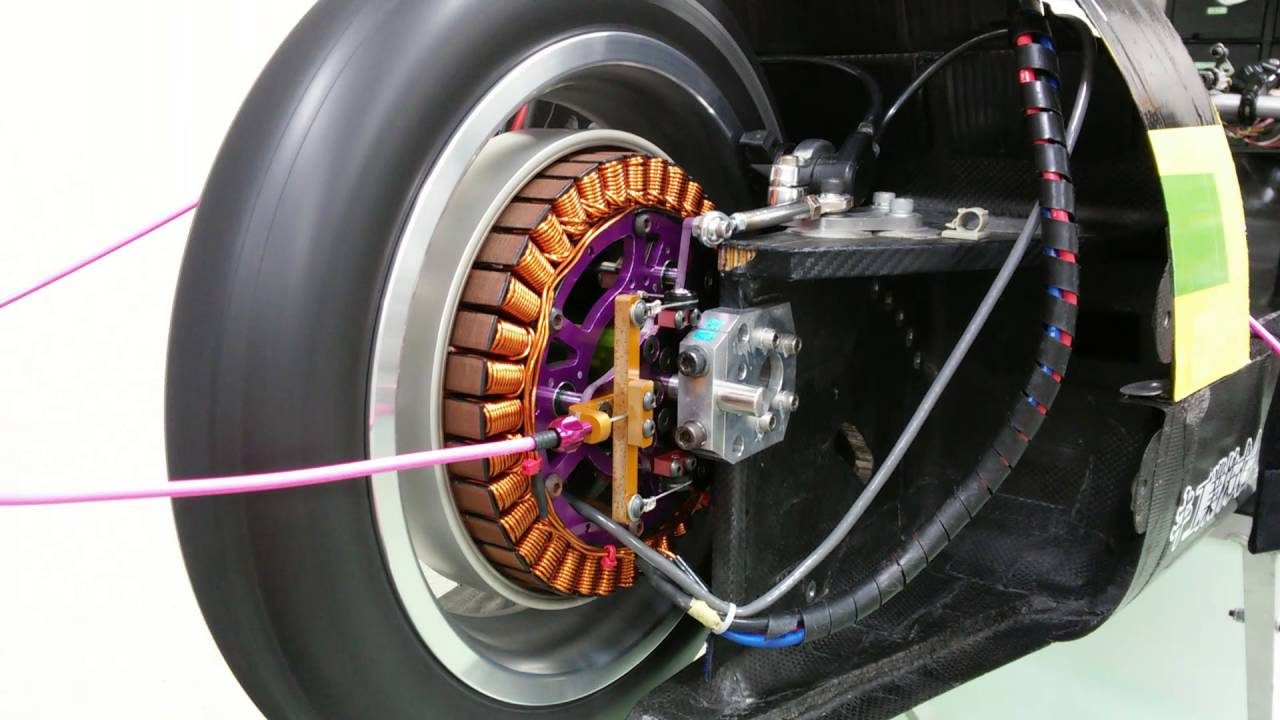
As the stator is drawn further away from the rotor, the magnetism emanating from the stator gets weaker in relation to the rotor, which means less torque but also higher motor speeds. Just like shifting into second gear, it's a compromise to get the engine—electric in this case—into a different operating region that works better for a particular situation.
Why go mechanical if field-weakening software works with no moving parts? There are losses associated with doing it electronically. In Japan, for instance, people compete against each other in so-called "Econo Power" races, and many of the vehicles utilize mechanical field weakening to eke out high efficiency.

Mechanical field-weakening is conceptually simpler to achieve with an axial-flux motor, although there are still serious challenges. Axial flux motors are basically two disks opposed to each other with an air gap between them. When turned on, they spin, sure, but they also try to pull each other together. They're magnets, that's what they do. It'd be weird if they didn't.
The force trying to bring these two plates together at high torque ratings is extreme. This isn't usually a huge problem because you can use a fixed bearing to keep them apart. When you want to do mechanical field weakening, though, the rotor or stator has to move axially to adjust the air gap, but both must also stay totally rigid once they've found a new position.
GM plans to do this using a hydraulic system, which makes sense. It will use hydraulic fluid to narrow the gap when it wants more torque but less speed. It will widen the gap when it wants less torque but more speed.

A cutaway of an axial flux motor made by YASA
If this sounds like a lot of cost, complexity, and trouble, consider how good automakers and suppliers have gotten at making something like an automatic transmission. This is much simpler than that, and the implications are impressive.
Smaller, less powerful EVs operating on lower-voltage architectures would be able to get plenty of torque off the line and then widen the air gap to achieve highway speeds. Smaller, lighter motors would be considerably more useful. This chart below from the patent explains it pretty well. The available torque is reduced, but the range at which it can be applied grows.

The Y axis in this graph is the motor torque. The X axis is motor speed.
What do you think?
View
Comments
This system could theoretically operate like a CVT, continuously adjusting the air gap to tailor the motor's characteristics to a variety of situations.
All of this technology sure is interesting, but it likely won't be available for some time. Before we see anything like this, the next generation of mass-market EVs will likely feature more advanced battery technologies and minor enhancements to radial flux motors. Still, when someone like GM is hard at work on axial flux, you have to assume the company sees a future in it.

Get the best news, reviews, columns, and more delivered straight to your inbox, daily.
back
Subscribe For more info, read our Privacy Policy & Terms of Use.
We want your opinion!
What would you like to see on Motor1.com?
Take our 3 minute survey.
- The Motor1.com Team
Share this Story
- (https://twitter.com/intent/tweet?url=https%3A%2F%2Fwww.motor1.com%2Fnews%2F722078%2Fgm-axial-flux-motor-patent%2F&text=GM%27s%20Novel%20Axial%20Flux%20Motor%20Could%20Be%20%20Key%20to%20Smaller%2C%20Cheaper%20EVs&via=motor1com)
- copy
GO TO COMMENTS
(
)
Got a tip for us? Email: tips@motor1.com
View all comments ( )
Popular

I Bought This Skoda 10 Years Ago. I Don't Think I'll Ever Sell It
BYD's Boxy SUV Banned In The EU After Land Rover Defender Copycat Ruling
What If Koenigsegg Had A Sterrato Fighter? Meet The Jesko Terrang
Audi Has 7 New Models Coming In 2027. Here's All Of Them
Latest Stories
- I Bought This Skoda 10 Years Ago. I Don't Think I'll Ever Sell It Nov 21 - Opinion -
- This Chevy Engine's Timing Belt Should Last 150,000 Miles. A Teardown Says Otherwise Nov 21 - Engines -
- Most Drivers Have No Idea What The Little Switch Under Their Rearview Mirror Does Nov 21 - Motor101 -
- BYD's Boxy SUV Banned In The EU After Land Rover Defender Copycat Ruling Nov 21 - Corporate / Financial -
- Ram CEO: New Dakota Will Do 'Some Serious Fun Things' Nov 20 - Manufacturing / Production -
- Can You Drive An American Car In Europe? Yes, But It's Complicated Nov 20 - Motor101 -
- Hyundai Sonata Dead In Australia, But America Still Wants Sedans Nov 20 - Manufacturing / Production -
RECOMMENDED FOR YOU
Volkswagen Secures ID. UP Name As New Electric City Car Takes Shape
I Bought This Skoda 10 Years Ago. I Don't Think I'll Ever Sell It
Lamborghini Trademarks Two Outlandish Names, Hinting At Its Next Supercars
This Chevy Engine's Timing Belt Should Last 150,000 Miles. A Teardown Says Otherwise
Jaguar May Already Have A Name For Its Next Car
Most Drivers Have No Idea What The Little Switch Under Their Rearview Mirror Does
Sony Wants Your Car To Smell Like Whatever Ad You're Driving Past