Honda Shows eVTOL Hybrid Mobility Concept That's Not A Flying Car
It's actually called an aircraft, but it links up with Honda vehicles on the ground for door-to-door transportation.


Flying cars have long been portrayed as the future of motoring. With electrification and autonomous systems expanding, some automakers have taken steps in that realm with so-called flying car conceptsthat aren't cars at all. Honda is the latest automaker to announce an airborne concept, but the company makes no pretense about this being car. However, it still plays a role in Honda's vision for the future of air and ground-based mobility.
The Honda eVTOL is a concept vertical takeoff and landing vehicle that Honda specifically calls an aircraft. It grabs our attention for two reasons, starting with its hybrid design. Its eight lift-rotors and two pusher props are electric, but the eVTOL also carries a gas turbine engine as a range-extender, keeping the batteries charged.

Honda estimates that future electric air taxis will be severely limited by range and function only as intra-city transport. That could be more trouble than it's worth when cars can perform the same service in nearly the same time without the added complexity – and dangers – of flight. The eVTOL concept eliminates this problem by offering a projected range of 400 kilometers (249 miles).
That's enough to bridge the gap between short-distance intra-city travel and jumping on a legit airplane for long trips, and Honda would combine the eVTOL with an entire "mobility ecosystem" including ground-based vehicles to take commuters door-to-door without ever climbing behind the wheel. For those working in the city while yearning for country living, it could be an ideal solution.
Gallery: Honda eVTOL Hybrid Mobility Aircraft

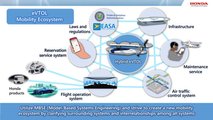


Of course, it's not nearly that simple. Coordinating autonomous machinery is still very much a work in progress, and regulations involving flight are far more stringent than ground travel. That's the second reason Honda has our attention, because the company recognizes this. Any mobility plan involving flight will require coordination with multiple organizations and entities, not the least of which being state and federal governments. Honda is prepared to make these connections and seek certifications by 2030, provided the eVTOL project is deemed worthy of commercialization.
Driving In The Sky, Flying On The Ground:
By that, we suspect Honda means whether it can make the system cost-effective and that's also a terrific challenge anytime flight is involved. The decision process will begin in 2023 with flight tests of the eVTOL, which right now only exists as a small-scale model for wind-tunnel testing. From there, further decisions on commercialization will happen by 2025.
Source: Honda
RECOMMENDED FOR YOU
Monterey Car Week 2026: Every New Supercar, Hypercar, And Concept
Man Trades In Lexus. Then He Realizes It’ll Sell For More Used Than It Did Brand-New: 'It's Disgusting'
Honda Will Sell You Its Actual Race Cars, Then Restore Them For You
What Actually Happens If You Shift Into Neutral While Driving?
Why Some Cars Have 'Hidden' Door Handles
Woman Drives New GMC. Then She Sees The New Gearshift: ‘This Is So Much Worse'
The Screenification Of Cars Is Creating A New Problem: Sweeping Recalls