Man Drives 1998 Honda That’s Missing Doors, Hood, And Roof. Is That Legal?
'Dude chilling on a family reunion fold up chair.'
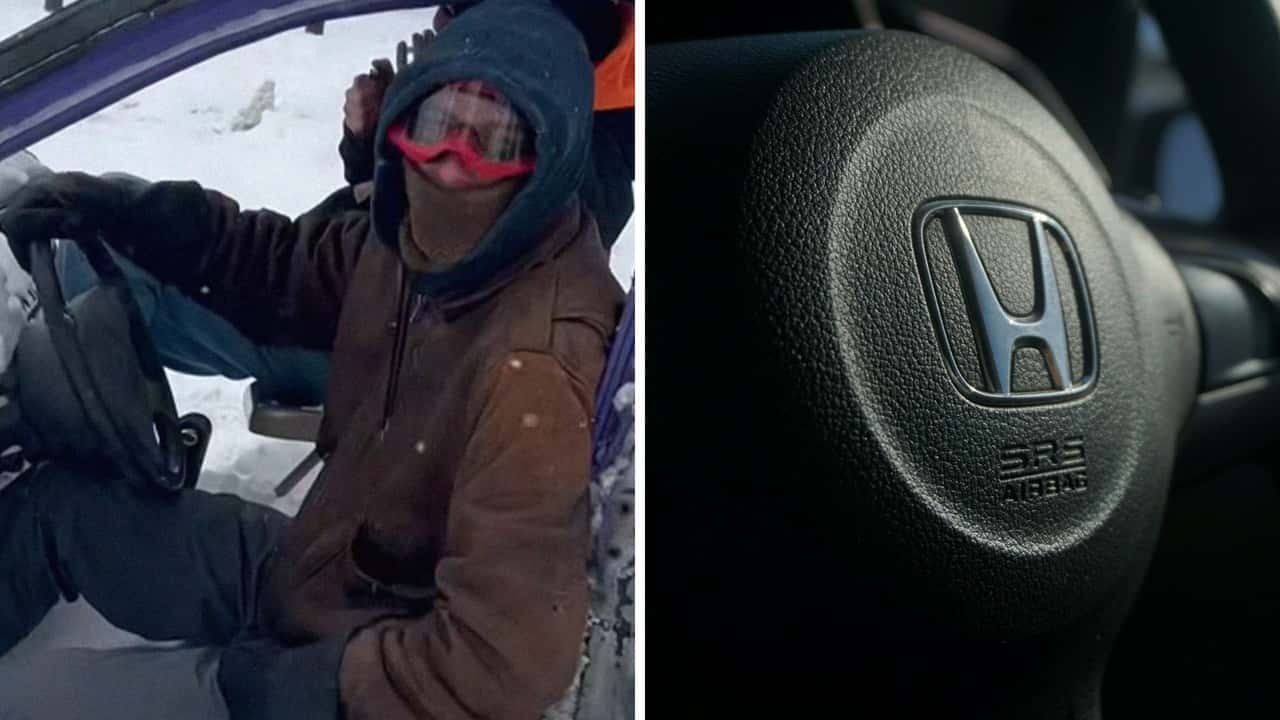

A St. Louis man’s bad morning took a happier turn after he saw someone driving around in the snow in a uniquely equipped 1998 Honda Accord. Facebook user Cane, who was stunned by just how stripped-down the vehicle is, uploaded his interaction with the driver.
Cane’s clip begins with him walking on a snowy street. He can be heard talking off-camera as the rumble of a car is heard approaching.
"Ain’t no [expletive] way," the social media poster says. Following this, a small sedan, or at least what remains of it, appears on-screen. The vehicle is missing all of its doors, the hood, the back portion of its roof, and the windshield. As the men riding in the vehicle come into view, they are wearing snow goggles and are entirely decked out in winter wear. Furthermore, the car is covered in snow, including the back seat.
The Facebook user asks the driver of the bare-bones vehicle, "What the hell y’all got out here?" to which the driver states, "Sir, this is a 1998 Honda Accord, also known as the [expletive] piece of [expletive] that just gets [expletive] done, brother."
Cane, appreciating the bizarre-looking ride, then says to the driver, "Yeah, that [expletive] get it," before the clip comes to a close.
In a separate video containing even more footage of the ride, Cane reveals that the passenger in the Accord is actually sitting on a metal folding chair.
Is It Legal To Drive A Car Without A Hood, Doors, Or Roof?
Vehicular laws vary from state to state, and as this Auto-Bodyparts.com blog post shows, certain parts of the country have specific ordinances to ensure a car is street legal. In some states, it’s vital that your vehicle be equipped with a hood when it’s on the road, like in Oregon and Maryland, the website states. This is to ensure that vital internal components, such as the engine, transmission, fluid receptacles, belts, and other parts, are protected from road debris.
However, legal firm Tom Fowler Law also echoed that not every state actually requires drivers to take to the road with hoods equipped on their vehicles. Additionally, a team write-up stated that some areas of the U.S., such as Alaska, Hawaii, North Dakota, and West Virginia, allow folks to roll around in cars without hoods, but there are "particular driving requirements" when doing so.
Most States Allow Drivers To Drive Cars Without Hoods
Moreover, Tom Fowler Law writes that the majority of areas in the United States don’t have any laws explicitly stating drivers can’t cruise around without a hood on their vehicle. They are as follows:
- Alabama
- Arizona
- Arkansas
- California
- Connecticut
- Delaware
- Florida
- Georgia
- Idaho
- Illinois
- Iowa
- Kansas
- Kentucky
- Louisiana
- Maine
- Massachusetts
- Michigan
- Minnesota
- Mississippi
- Montana
- Nebraska
- Nevada
- New Hampshire
- New Jersey
- New Mexico
- New York
- North Carolina
- Ohio
- Oklahoma
- Pennsylvania
- Rhode Island
- South Carolina
- South Dakota
- Tennessee
- Texas
- Utah
- Vermont
- Virginia
- Washington
- Wisconsin
- Wyoming
However, the law firm did go on to state that if you’re intending on riding around in a car like the one Cane showed off on Facebook, you may want to check with local law enforcement and traffic authorities to ensure your whip’s road-compliant.
Basic Vehicle Inspection Requirements
Again, different parts of the United States have different vehicle requirements to ensure cars pass inspection. But generally speaking, there are seven primary areas that are necessary to pass inspections, according to auto manuals purveyor Haynes. A vehicle’s ability to safely brake is paramount: Brake pads must be in good working order and not worn to the point that they inhibit the car’s stopping power.
Then, there are the car’s various lighting systems. Headlamps must be functional to illuminate roads at night or during inclement weather. Also, a car’s brake lights should turn on whenever a vehicle is stopped, and both front and back turn signals need to operate reliably, as well as a car’s hazard/emergency lights.
Third, vehicles must also be equipped with tires in good working condition, free of any visible damage. They must also not be too worn down so they don’t have enough tread to grip the road, and they must be inflated to the correct PSI per a vehicle’s specifications.
Also, inspection agencies will assess a car’s exhaust system, which must adhere to the driver’s local emissions standards.
Next, a car’s suspension and steering systems must be aligned properly and in good working order.
Various other safety components, such as seat belts, windshield wipers, mirrors, horns, and even defrosting mechanisms (when there’s a windshield), need to be in good working order.
Lastly, each car must have a valid Vehicle Identification Number. These are the general categories considered whenever a car is brought in for inspection across all 50 states. But it bears repeating: Look at your own area of residence’s laws when it comes to making the car you intend to drive street legal.
Motor1 has reached out to Cane via Facebook direct message for further comment. We will update this story if he responds.
RECOMMENDED FOR YOU

Honda Could Resurrect The High-Riding Accord Crosstour
The Genesis G70 Is Losing Its Best Engine
Woman Brings Honda To Tires Plus. Then They Reveal Mavis Put On 3 Different Tire Brands: ‘Discount Tire Would Never’
School Principal Rents Ford Van For Practice. Then Enterprise Tells Her Where She Has To Pick It Up
Honda Driver Pays $10,000 For Bodywork. Then His Mechanic Finds Something Startling: ‘Sure They Did'
'Buc-ee's Gave Me 448 Miles': Man Fills Up. He's Sure This Gas Lasts Longer. It's Not Just Him
Your Car Has a Hidden Mechanical Key. Here's Why It's There