Renault Megane I (1995-2003): Compact 30
The French golf opponent celebrates a milestone birthday


How do you replace a really big number? With a name. The Renault 19, which was also very successful in Germany, was followed 30 years ago by the first Megane. At that time, it still had the accent on the first E. And an enormous number of body variants, including the pioneer of compact vans. We take a look back.
The Megane follows new names at Renault such as Clio, Safrane, Twingo and Laguna. It faces the challenge of replacing the Renault 19, which sells very well in Europe and especially in Germany.
Gallery: Renault Megane I (1995-2003)

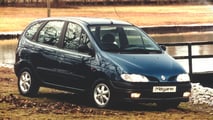
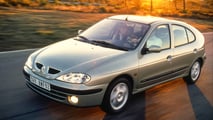
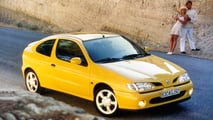
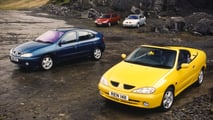
Development of the X64 (the internal code name for the first Megane) began in early 1990, with the first sketches of the X64 programme being drawn in the first six months of 1990. Very quickly, several themes were sketched and developed into four small-scale models (1:5) by September 1990. The name Megane was coined by Manfred Gotta, who also coined the name Twingo.
In the sign of the ellipse
The retained designs are developed into four themes. Theme A: a version with six headlights reminiscent of the Laguna; Theme B: a model with clearly wedge-shaped lines; Theme C: another design with elliptical glazing and a rear notch; Theme D: a model with the same elliptical glazing and a rounded rear end.
In March 1991, all four designs were realised on a 1:1 scale. Theme C by Michel Jardin is selected by Renault's head of design Patrick Le Quement and frozen for production in April 1992. The first prototypes are created and presented to the management in December 1992. Approximately 432 prototypes are built and destroyed during development.
In June 1993, Renault bought the production tools for the X64, the first test vehicle was assembled at the Douai plant in October 1994, and pre-series vehicles were built from December 1994 to mid-1995.
Renault Megane I (1995-2003)
Premiere at the IAA 1995
The Mégane I is finally presented at the Frankfurt Motor Show IAA in September 1995 as a replacement for the Renault 19. The car is essentially a new version of its predecessor and adopts the floor assembly, engines, transmission and chassis of the 19, albeit with many changes.
The Mégane, which takes its name from a Renault concept car shown in 1988, develops the new design theme introduced by Patrick Le Quément on the Laguna, in particular the "bird's beak" radiator grille - a design feature inherited from the Renault 16 of the 1960s. Renault decides to add an accent to the car's name (Mégane) to emphasise its European identity in the face of growing competition from newer car manufacturers from Japan.
Like the 19 and 11, the Mégane is produced from July 1995 at Renault's Douai plant in northern France and the Palencia plant in Spain. The market launch begins on 15 November 1995 in France and on 15 December 1995 for the Coupé. Sales in the United Kingdom started in April 1996. In Germany, prices start at DM 22,500 for the 1.4-litre with 70 PS and five doors.
Renault Megane I Coach (1995-2003)
The Mégane is available as a five-door hatchback and three-door coupé called "Coach" right from the market launch. The "Classic" notchback model followed in 1996, the Mégane Cabriolet in 1997 and the "Grandtour" estate in 1999. The Scénic compact van presented in 1996 was also initially known as the Mégane Scénic.
The rounded style of the five-door model (in line with the organic design trend) is reminiscent of its big brother, the Laguna, which was launched almost two years earlier, in January 1994. Like many Renaults, the rear doors of the 4.17 metre long Mégane are elliptically cut out and do not wrap around the wheel arch, which is the brand's true stylistic trademark.
Driver and front passenger airbags are standard right from the start, and side airbags are added in 1998. The particularly stable body structure with defined deformation zones at the front and rear and the fitting of pyrotechnic belt tensioners and belt force limiters were also pioneering.
Enormous variety of models
The 3.94 metre short coupé is an innovation, as it is intended to replace a conventional three-door version by pulling prices upwards. The top engine in the Mégane Coupé since 1998 is the first European direct-injection petrol engine 2.0 16V IDE (Injection Directe Essence) with 140 PS. In Ireland, there is even a commercial vehicle version of the five-door Megane with sheet metal rear side windows and without rear grab handles, called the Renault Megavan.
Renault Megane Scenic (1996)
September 1996 sees the launch of the Mégane Scénic model, the first relevant European compact van. In the same year, the notchback version called "Classic" was also launched, followed by the convertible in 1997. This is the philosophy behind the Megane series: to diversify the range. Over the course of seven years, seven models with different bodies were launched.
Speaking of the Scenic: The name comes from the compact concept car S.C.E.N.I.C. from 1991, which stands for "Safety Concept Embodied in a New Innovative Car". The first generation of the Scenic was an immediate success, selling almost 2.8 million units.
The estate version, which was launched in September 1998, was manufactured by Oyak-Renault in Turkey and initially only marketed in this country. It was only launched abroad with the facelift in 1999.
Renault Megane Grandtour (1999)
With this slight facelift in spring 1999, the Megane I received a modified radiator grille, more advanced safety features and improved equipment, and 16-valve engines were used throughout the entire model range.
In the shadow of the Scénic
Although the Megane family is extensive, it is overshadowed by the Scénic (60% of the range's sales in 2000). Buyers are attracted by its comfort, road-holding and modesty. However, the ergonomics suffer from shortcomings (badly positioned buttons for the hazard warning lights and central locking, headrests too short, cigarette lighter and ashtray too close to the gear lever), which also displeased the press. The all-round visibility was particularly miserable, criticised the ADAC at the time. But even the 1999 facelift did not include any modifications to the interior.
This second version also saw the introduction of one of Renault's first common-rail diesel engines, the 1.9 dCi ("F engine"). This engine was an adaptation of the high-pressure injection system to an older engine, the 1.9 dTi.
Renault Megane I (1995-2003)
In the seven years of its existence in Europe, however, the Mégane was produced a total of five million times in all body variants and continued to be manufactured abroad for some markets (above all Argentina). In Latin America, the Megane I continued to be sold alongside the Megane II series at a significantly lower price until 2011. A good seven million Megane I models are produced in total.
A little motorsport
In the 1990s, Renault Sport developed a rally car based on the 2-litre coupé with an F7R "F" engine and complying with kit car regulations. The Maxi Mégane officially represented the brand in the French Rally Championship in 1996 and 1997 with Philippe Bugalski, Jean Ragnotti and Serge Jordan at the wheel. After the official team withdrew, many private drivers continued to use the car.
More from the Renault's history:
RECOMMENDED FOR YOU
How Renault Outsmarted Cheap Chinese EVs, And Profited
New Jersey Woman Starts Up Toyota RAV4. Then It Rains: ‘Never In My Life Have I Seen This’
Rare Mazda 767B Engulfed In Flames At Laguna Seca
Man Gets Intoxalock Breathalyzer After DUI. Then He Tries To Use It In 90-Degree Heat: ‘They Put A Camera In There Too?!?’
1958 Ferrari Reappears With A Shocking $5 Million Estimate
Ferrari Wants To Turn Taillights Into Active Aero
This Lovely Mercedes 190 Evo II Restomod Packs 765 Horsepower