Home
Jeep
Wrangler
News
Turbo-4 Or N/A V6? 2019 Wrangler Dyno Test Helps You Decide
There's quite a sizable difference in the torque figures of both engines.

Jacob Oliva 
By: Jacob Oliva
Nov 17, 2018 at 10:13am ET
Add Motor1.com as a preferred source in Google
- (https://twitter.com/intent/tweet?url=https%3A%2F%2Fwww.motor1.com%2Fnews%2F276660%2F2019-jeep-wrangler-dyno-test-video%2F&text=Turbo-4%20Or%20N%2FA%20V6%3F%202019%20Wrangler%20Dyno%20Test%20Helps%20You%20Decide&via=motor1com)
- copy
Share
Comment
As you know by now, the 2019 Jeep Wrangler is offered with two gasoline engine choices – a direct injection, four-cylinder 2.0-liter with a turbocharger and the Chrysler's revamped naturally-aspirated Pentastar V6. Buyers of the off-roader are facing a tough decision, especially when you take a quick peek at both of each variant's spec sheet: 285 horsepower and 260 pound-feet of torque for the V6, while the force-inducted mill is at 270 horsepower and 295 pound-feet of torque.
It's all about this iconic model from Jeep:
 Donate To Charity And You Could Win This 450-HP Jeep Wrangler
If you're looking for a stick-shift Wrangler, the decision would be easy as the V6 option comes with a six-speed manual transmission exclusively. Now, if you're up for the eight-speed slushbox, then there's the problem.
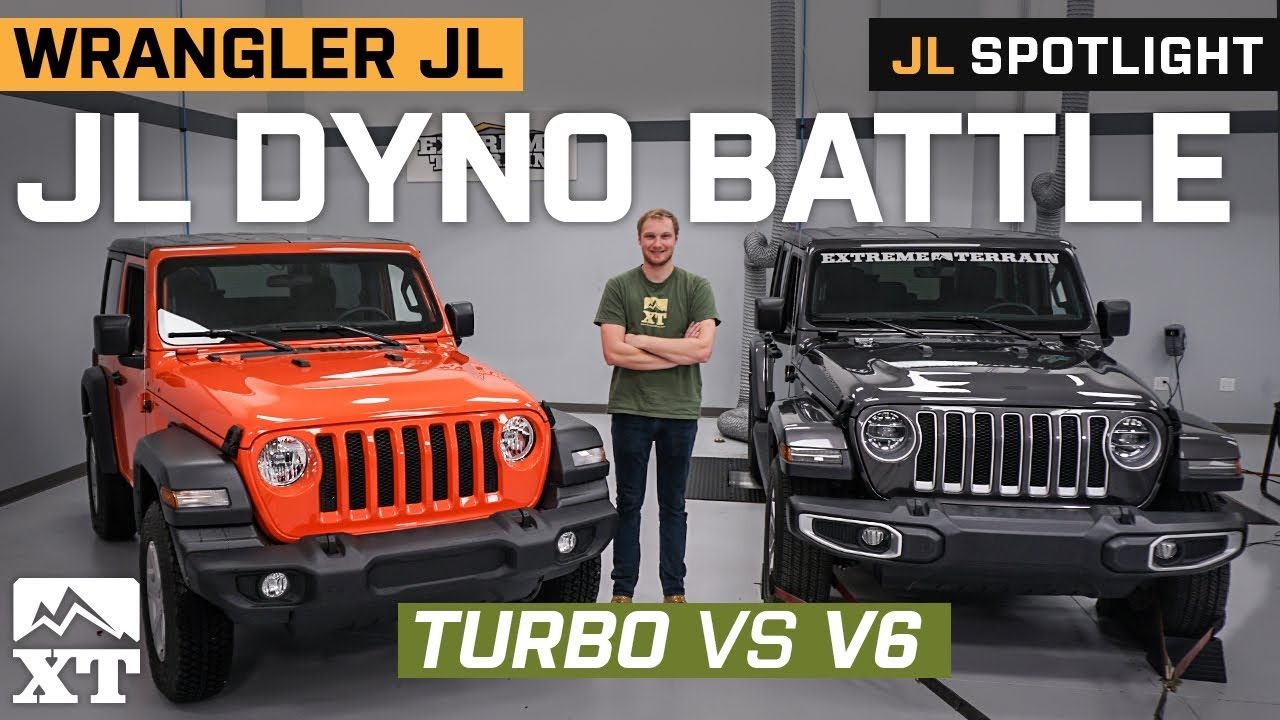
Good thing, Extreme Terrain did its own dyno test of the two Wrangler choices to see which one produced more power and torque, as well as analyze the dyno graph of each powertrain. Surprisingly, as seen in the images below, there is quite a difference between each graph.
Gallery: 2019 Wrangler Turbo-4 versus N/A V6 Dyno Test
4


As you can see, the horsepower curve of the turbocharged engine is steeper, with acceleration starting at around 2,500 RPM and reaching the maximum 233 hp at around 5,800 RPM. Translation? More abrupt acceleration due to the boost, but kind of short-lived. On the other hand, the naturally-aspirated V6 employs gradual acceleration, starting from around 2,300 RPM and then reaching the maximum 239 hp at 6,700 RPM.
The torque graph is more interesting, though. The force-inducted powertrain could reach its peak 270 lb-ft torque as early as 3,500 RPM, but there won't be low-end pulling power due to the lack of boost at an early onset. The V6, as expected, provides a more constant torque delivery, with an early pull at 2,000 RPM but reaching peak 223 lb-ft torque at 6,500 RPM. This tells us that although the 2.0L turbo could provide more pulling power, the V6 could implement the pull constantly at any given driving condition.
What do you think?
View
Comments
Watch the video of the dyno test below:
Source: Extreme Terrain
We want your opinion!
What would you like to see on Motor1.com?
Take our 3 minute survey.
- The Motor1.com Team
Share this Story
- (https://twitter.com/intent/tweet?url=https%3A%2F%2Fwww.motor1.com%2Fnews%2F276660%2F2019-jeep-wrangler-dyno-test-video%2F&text=Turbo-4%20Or%20N%2FA%20V6%3F%202019%20Wrangler%20Dyno%20Test%20Helps%20You%20Decide&via=motor1com)
- copy
GO TO COMMENTS
(
)
Got a tip for us? Email: tips@motor1.com
View all comments ( )
Popular
12 Cars With Names That Make Absolutely No Sense
BMW Kept This Hatchback A Secret For Decades
Bugatti Restores One-Off Veyron With A Mirror-Like Aluminum Body
The Gas BMW M3 Isn't Dead: Next-Gen Prototype Roars
latest articles
- Subaru Built A 510-HP Electric Wagon Without Toyota's Help Oct 20 - Official -
- The Strange Reason The Golf GTI Had A Golf Ball Shifter Oct 20 - Motor101 -
- Photos: Porsche's Mission S Concept Takes Over New York City Oct 20 - Design -
- The 2027 Honda Passport TrailSport Looks Noticeably Taller Next To Last Year's Model Oct 20 - Off-Road -
- 12 Cars With Names That Make Absolutely No Sense Oct 20 - Lists -
- The Ford Ranger Is Getting A Bigger V6 For 2027: Report Oct 20 - Rumors -
- BMW Already Has A Deal On The New i3. But It's Not Cheap Oct 20 - Pricing -
RECOMMENDED FOR YOU
Jeep Reveals Mismatched 2027 Wrangler Switchback As Final Twelve 4 Twelve Build
Mercedes Isn't Sold On Extended-Range EVs: 'Would You Really Switch?'
Salesman Talks Customers Out Of Black Car. He Says They Get Hotter In The Sun
Cadillac Driver Is Fed Up With Auto Stop. Then She Buys A $9 Item On Amazon To Disable It
5 Vehicles That Are Surprisingly Great For Camping
Bugatti Restores One-Off Veyron With A Mirror-Like Aluminum Body
Woman’s Car Goes To Shop. Then The Dealership Says They’re Out Of Loaners—And Offer An Insulting Solution