Alfa Romeo Spider/GTV (916, 1994-2004): The cult wedge turns 30
The second generation of the Spider broke with many traditions and also got a brother ...
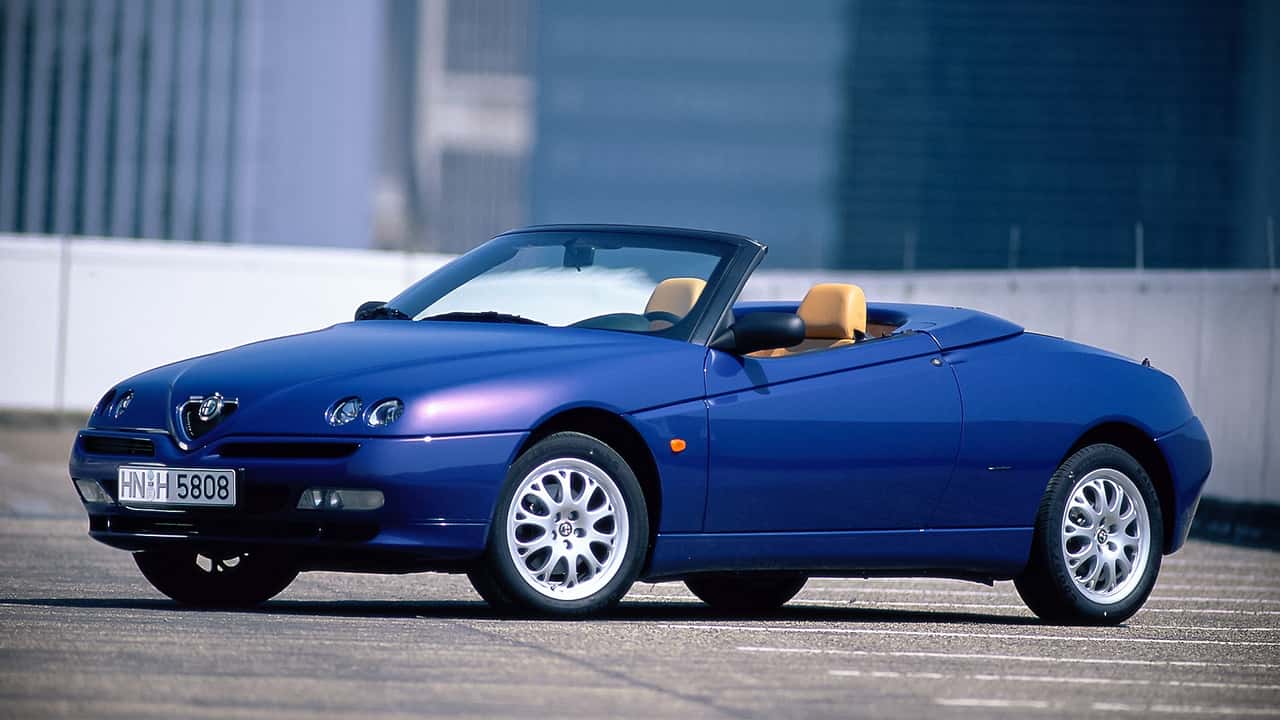

All good things come to those who wait? After almost 30 years, Alfa Romeo finally launches a new Spider at the end of 1994. It was also joined by a GTV coupé brother. This 916 series surprised the Alfisti with an unusual design and front-wheel drive. But 30 years later, the cars have found a firm fan base.
Like the GTV, the Spider is based on the Fiat Group platform known internally as Tipo Due and is therefore related to the Fiat Tipo, among others. The cars were initially built by Alfa Romeo in Arese and finally by Pininfarina in Turin.
Gallery: Alfa Romeo Spider and GTV (916, 1994-2004)

Seven years of development
How do you renew an icon? Alfa Romeo struggled with this for a long time, partly because there were plenty of other automotive construction sites within the Group. After Fiat took over Alfa Romeo in autumn 1986, Vittorio Ghidella, the head of Fiat's car division, endeavoured to make the brand more attractive with new models. In future, the Spider was to play the role of a flagship model. At the same time, he pushed for the integration of Alfa Romeo into the Fiat Group's platform strategy.
In spring 1987, the decision was made to develop a completely new Spider and a related sports coupé as an Alfetta GTV replacement, based on Fiat's Tipo-Due platform. Fiat commissioned the Bertone and Pininfarina studios in Turin to draw up design drafts. The decision is made early in favour of Pininfarina. The basic designs were completed in September 1987, and in July 1988 - just a few months before he left the company - Ghidella approved the design of the Spider and Coupé based on a 1:1 scale clay model.
Alfa Romeo Protèo (1991)
However, the development of the new sister models, known as the Tipo 916, took several years. In order to bridge the time until the new model series was ready for series production, Alfa Romeo revised the classic Spider (Tipo 115) for a third time at the end of 1989. Shortly after the introduction of this fourth Spider 115 version, the company presented the Proteo show car designed by the Centro Stile Alfa Romeo under Walter de Silva at the 1991 Geneva Motor Show. Its transparent roof could be completely stowed behind the seats, transforming the coupé into a racy Spider.
A first look in 1991
This versatility gives the show car its name. Unlike the later 916 series, the Protèo was based on the shortened chassis of the Alfa Romeo 164 and was powered by the model's top-of-the-range engine, a 3.0-litre V6 cylinder with an increased output of 260 PS.
Four-wheel drive and four-wheel steering as well as electrically adjustable shock absorbers demonstrated what was technically possible at the time. The show car's paint colour, a particularly shiny metallic shade called "Protèo Red", was officially offered for a time.
Wedge premiere 30 years ago
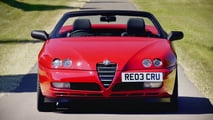
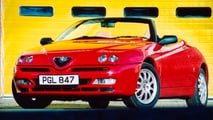
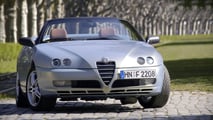
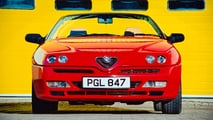
The Alfa Romeo Spider 916 debuted together with its sister model, the GTV, at the Paris Motor Show in October 1994. Series production began at the end of 1994 and lasted until 2004, during which time three series of the Tipo 916 were created, unofficially known as Phase 1 (1993-1998), Phase 2 (1998-2003) and Phase 3 (2003-2004). Phase 3 is the rarest model series. With a technical basis that was almost 20 years old when it was introduced, it is considered obsolete. Phase 3 is intended to bridge the time until a completely new Spider is ready for series production, which is known internally as the Tipo 939, is based on the 159 and will make its debut in summer 2006.
Alfa Romeo Spider (916, 1994)
The body of the Spider 916 is generally described as wedge-shaped. This impression is created primarily by a bead on the flanks of the car, which begins at the front wheel arch and rises sharply from there to the end of the roof. The corrugation is an idea that Pininfarina had already realised on the Quattro Quartz (and also the Alfa 164); there, however, it runs horizontally. The waistline of the Spider follows the course of the beading. The same applies to the joint between the rear wing and the rear bumper.
The large one-piece bonnet is made of plastic; this material was chosen primarily because it is easy to work with. It protrudes far into the flanks of the car. It leaves two circular openings for the headlights on each side at the front. The lights themselves are permanently mounted and do not swivel upwards when the bonnet is opened. Alfa Romeo's Scudetto is positioned in the centre of the bonnet, protruding into the bumper at the bottom or breaking through the bumper.
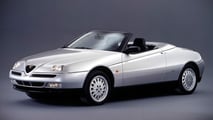
Alfa Romeo GTV (916, 1994)
Like the GTV, the Spider has no moulded door handles. Instead, there is a push button in the door for unlocking and a recess in the side bead into which a finger can be inserted to pull the unlocked door open.
Unlike the GTV, which has a tear-off edge, the boot lid of the Spider slopes down towards the rear. At the rear end there is a narrow light strip extending across the entire width of the car, which contains the indicators, brake lights, tail lights, reversing lights and rear fog lights. The Spider and the GTV both have the same light strip.
Controversial front-wheel drive
All versions of the Spider 916 have transverse-mounted engines at the front, which drive the front wheels via manual gearboxes. The front-wheel drive design of the Spider is a direct consequence of the Tipo 916 being derived from the Tipo-Due platform. It is a break with tradition; all previous Spiders as well as their predecessors Giulia and Giulietta had rear-wheel drive.
The reorientation was initially criticised in the contemporary press; some authors feared a loss of driving pleasure. However, the drive technology was generally regarded as a success. The chassis was described as well-balanced.
Alfa Romeo Spider and GTV (916, 1994-2004)
Alfa Romeo offers various petrol engines with four and six cylinders for the Spider. The basic engine is an in-line four-cylinder engine with twin ignition (Twin Spark) from Fiat's Pratola-Serra series. The cylinder head is an Alfa Romeo design. The engine has two overhead camshafts with variable intake valve timing.
A 2.0-litre version of this engine equipped with two balancer shafts was available throughout the entire production period (2.0 TS), with an output of 150 PS in the first series and 1155 PS in the cars built from May 1998. At the beginning of the second series, from 1998 to 2000, there was also a smaller version with a displacement of 1.8 litres and an output of 144 PS, which did not have balancer shafts (1.8 TS).
Alfa Romeo Spider (2003)
With the introduction of the third series of the Spider in 2003, a 2.0 litre in-line four-cylinder engine with direct petrol injection was added to the range (2.0 JTS). Unlike the twin-spark engines, it has only one spark plug per cylinder. The engine output is 166 PS.
Arese V6 as the highlight under the bonnet
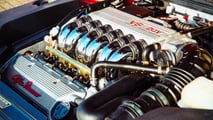
Various versions of Alfa Romeo's V6, which is based on a design by Giuseppe Busso, form the top-of-the-range engine. The Busso or Arese engine has a cylinder bank angle of 60 degrees and an aluminium cylinder block. In the first series and the first models of the second series, a version with 3.0 litres, one overhead camshaft per cylinder bank and two valves per cylinder was used, producing 192 PS.
From 2000, it was replaced by a version of the same size with two overhead camshafts per cylinder bank and four valves per cylinder (3.0 V6 24V), which has been the top-of-the-range engine in the Alfa Romeo 164 since 1993 and has been available in the Tipo-916-GTV since July 1996. The engine output of this variant is 218 PS.
The legendary Arese V6 from Alfa Romeo
With the introduction of the third model series in 2003, Alfa Romeo finally added a version of the six-cylinder engine with an increased capacity of 3.2 litres and 240 PS to the range, which replaced the 3.0-litre version in most markets; in some markets - including France - however, both six-cylinder engines were available in parallel.
Special turbo for Italy
The 2.0 V6 Turbo, which was primarily offered on the Italian market for the Spider from 1995 to 2000, occupies a special position. It is a version of the Busso six-cylinder engine with a reduced displacement of 1,996 cc, which is equipped with a turbocharger to increase performance. The output is 200 PS. Alfa Romeo also offers a corresponding engine in its contemporary saloons, which can be traced back to Italian tax legislation.
In most cases, power transmission is handled by a manual five-speed gearbox. Only the 3.0 V6 24 and the 3.2 V6 24 have a six-speed gearbox. By 2004, 38,891 Spider Tipo 916s had been built, all three model series combined.
More classics from Alfa Romeo:
What does the press say? When looking at the GTV in 1996, the ADAC found: "This is how trends are set", but criticised the large amount of plastic in the interior. In addition, the interior was rather cramped and the 110 litre boot of the 4.28 metre long car was a joke. However, the sound of the 2.0-litre four-cylinder engine with 150 PS in the GTV, which costs 45,450 marks, is praised.
RECOMMENDED FOR YOU
These Are The Most Spectacular Car Museums
Mitsubishi Goes Under The New Pajero To Show Its Truck Roots
Five Things You Probably Never Knew About Alfa Romeo
Nissan Salesman Takes Customer On Test Drive. He Wasn't Expecting To Break Down: ‘Bro Is NOT Making The SALE’
Alfa Romeo Teases New Crossover. No, Still Not The Stelvio
Toyota's Next-Gen Batteries For Hybrids Arrive In 2027
This Lovely Mercedes 190 Evo II Restomod Packs 765 Horsepower