Electric or hydrogen car? Technological neutrality explained at the Olympics
The unknowns of the future lead the Japanese manufacturer to insist on multiple engines: Gill Pratt explains
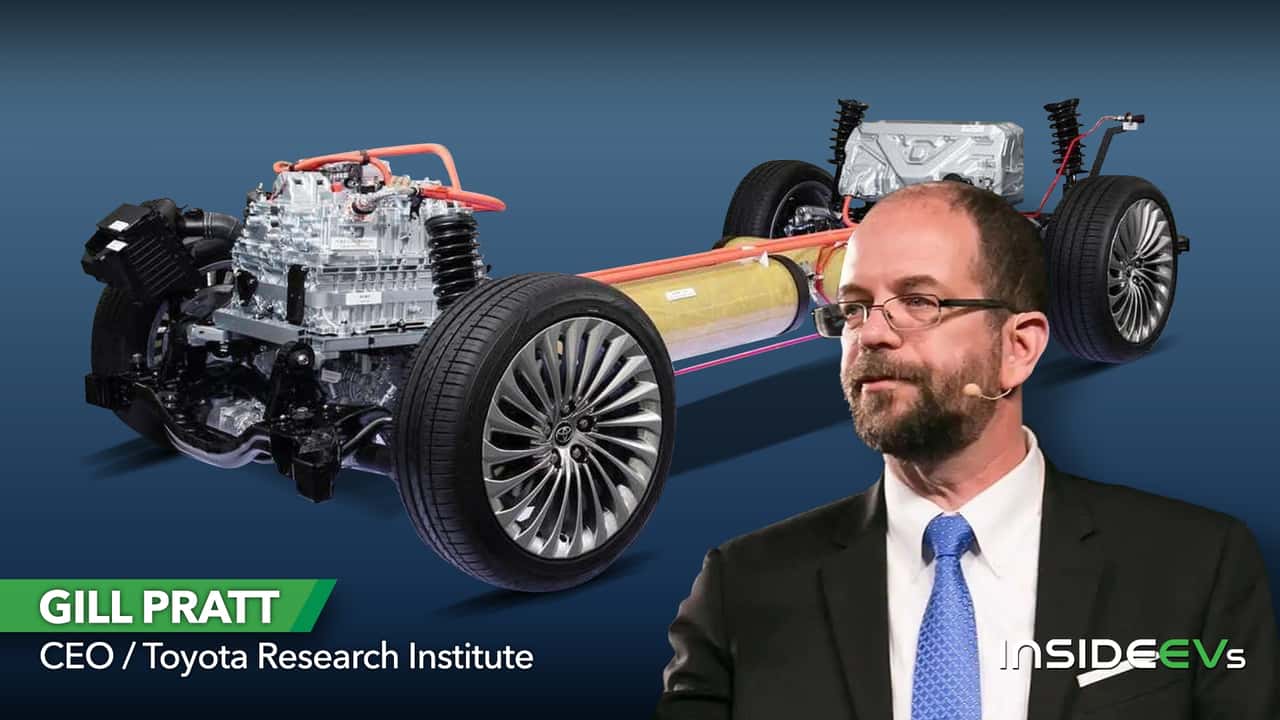

The future of the automobile is electric, but hydrogen and other alternatives will also be used to get around. It is the principle of 'technological neutrality', that those who conduct research and development should not rule out testing any technology from the outset.
Many people in the automotive industry are committed to this principle, but it does not convince everyone and only a few manufacturers actually manage to put it into practice, because it costs a lot of money.
Toyota is one of the pioneers of this approach, supporting the development of hydrogen propulsion. In reality, the Japanese giant's vision is far more sophisticated and complex, and the Paris Olympic Games, of which Toyota is a mobility partner, are representing this with a fleet of 3,000 vehicles of all types, shapes and propulsion technologies, available to Olympic delegations (we discuss this in this article on Motor1).
While the athletes are driving emission-free (or nearly emission-free), the public can see the vehicles live and hear explanations from the Japanese engineers who developed them.
But behind it lies a "scientific vision" whose creator is Gill Pratt, engineer and professor of computer science at MIT, CEO of the Toyota Research Institute, with whom I had the opportunity to exchange a few words at a press conference.
We have addressed various issues, starting with "technological neutrality", which is not shared by everyone, and with a premise: it is useless to make comparisons about the efficiency of different engines, because nature teaches us that this is not everything. The example is chlorophyll photosynthesis, which has a very low efficiency.
Professor Pratt, you say that we need to look in multiple directions, to keep more avenues open, but is that sustainable? Isn't it too complex, for example, to think about building a hydrogen refuelling infrastructure in addition to an electric charging infrastructure?
"Well, it all depends on where the bottleneck is. What is the limiting factor? Of course, we've all had the experience, whether we're running a business or just a family, that resources are limited. So we have to look at the budget and say, 'OK, I'm going to invest in this.' And now I don't have enough money to invest in this.

The Toyota Mirai hydrogen-powered sedan
But the truth is that there is an enormous amount of capital in the world in the area of technology, an enormous amount. And it turns out that capital is not the limiting resource here. There is a pace of technological improvement that for some reason - maybe human ingenuity, no matter how many billions of people there are in the world, is a bottleneck. Technology only improves at a certain pace.
There are bottlenecks in politics too. People in government need time to make decisions, but I don't think you can think of it as saying, "Well, we can only afford to make one decision." In fact, I think that's a big mistake. Because we really don't know how to predict in the future what the best solution will be. And not just for the reasons I've mentioned here, but because the future is very uncertain. And we don't know which of these technologies will end up being the best.
I'll give you an example from our history. Maybe 15 or 20 years ago, we didn't know that lithium-ion batteries would become so good and so cheap, that the performance would be excellent and the cost would be low. So back then, it didn't look like BEVs would become such a practical thing. But we started anyway. We made some partnerships with other companies. We started researching BEVs.
Until about 10 years ago, the use of electric cars was not feasible, but now it seems to be. So we have changed our strategy very much. And we will produce millions and millions of electric cars. But we are not sure yet. And we think that maybe in 10 years something will change and something different will happen. So we continue to explore these different things. If the world was static, you would be 100 percent right: we should choose the best. Choose, right? But the future is uncertain. That is the main reason."
What do you say to those who argue that discussing other technologies provides a platform for those who are already against the electric car or are sceptical about it for other reasons?
"I've heard this argument many times that it's a distraction or it's making people not act. I think the truth is that it's the customers who decide what the future of vehicles is going to be. It's not government policy. The government can change the tilt of the country a little bit by saying, 'OK, we'll give you a rebate. We'll give you a tax rebate. We'll create an incentive. We'll put some rules in place.' But ultimately, the customers decide. Even if there's a policy that goes one way or the other, it's the customers who choose the people who make the policy.
So in the short term, things can change. But in the long term, in most countries where these policies are made, people's wishes are taken into account. So I think it's our responsibility to say, 'OK, the customer will decide.' How can we make sure that the decision we make solves the problem? And that's why we invest in this diversity of ways to do that.
So I don't think that providing options is a distraction. I think it's a guarantee against unknowns that will change in the future. And it's also a very realistic way of saying that we're going to adapt to the customer. We're going to give the customer the choice. And it's actually a way of respecting every person. Every person who wants to contribute to carbon neutrality. We're offering them the best way to do that, regardless of their living situation anywhere in the world, instead of saying, "We're forcing you to do it one way or another."
We don't know how big the impact is. But we also fear that if we force customers to buy a vehicle they don't want, they will keep their old vehicle, which is much, much worse. So we believe it's right to save as much carbon as possible as quickly as possible, but not to try to tell the customer what to do.
The customer decides independently, but today's customer has very little confidence in the electric car. In your opinion, how can we convince people to switch to other technologies that will help save the planet and the world?
I think we need to make the technology attractive. That means we need to build out the infrastructure for BEVs to make charging simpler and easier. That's important not only on highways to charge quickly, but also in other parts of the world and in other cities.
A high-power charging station for electric cars
I'm not familiar with Europe. In the US, only 50 percent of cars have a garage and can be easily charged at night. And the other half? Where will they charge? You can say they will have a fast charging station. But where? We have to find a way. In a city like New York, for example, a lot of people park on the street. But every week or every day there is a different place. So we have to make sure there are charging stations everywhere so they can charge well.
To encourage people, I think it's right to make the decision easy for them, to encourage them to do it, not to force them to do it. And I think that's our job as car manufacturers, to try to produce cars that emit as little CO2 as possible if that's what they choose. And I think it's very useful when politicians try to build and improve the infrastructure to make that easier for customers."
How can artificial intelligence contribute to the development of new technologies or mobility solutions?
"That's a wonderful question. The biggest mobility problem facing the automotive industry is the ageing of society. Again, we tend not to think about it because we think the world is still the same. But in some parts of the world, people are getting older. And I had to take away the car keys from my mother and father. Many people have to do the same.
Why is this necessary? If a person is old and his reactions are not as good, his eyesight is not as good, his judgement is not as good, why can't the car protect him and make sure that even if he can't see well, he doesn't have an accident? Artificial intelligence can be a great help in this regard.
Toyota Prius interior
The reason is that artificial intelligence does not need to be as rationally intelligent as humans, because driving a car is not a matter of thinking. It is a matter of training, experience and movement that we can learn. And I am sure that all of you, when you drive a car, sometimes have the experience that you are suddenly home. How did I get here? I was just thinking about something else and suddenly I am home. It is the lower levels of our brain that learn to drive a car. And artificial intelligence can help enormously with that.
We published a video from the field of robotics that seems to have nothing to do with cars. It's about a human teaching a robot a specific task: cooking, folding laundry, rolling out a carpet in a factory, for example. But this way of teaching a machine, using the latest methods of artificial intelligence, can also be used to teach cars to drive safely.
So we believe that the competency in automated driving is going to increase very, very quickly. And it's not necessarily that the human is sitting there and driving the vehicle themselves. First of all, that's boring. But secondly, we don't think it's necessary. Instead, we believe that the system is able to monitor the person and tell them not to let me crash and that's a much more viable way to go."

Learn more about the hydrogen car:
Gallery: Toyota at the Paris 2024 Olympics


RECOMMENDED FOR YOU
Toyota Argues Reliability Gives It The Edge Over Chinese Rivals
Audi Will Put Its New Face On The Electric A4 In 2028
Toyota Camry Driver Finds Brakes And Rotors On Advance Auto Parts For $68.99. Then She Goes To RockAuto: ‘That's Insane'
Woman Gets Her Windshield Changed At Safelite. Then She Tries To Use Her Rearview Mirror: 'It's A Newer Car'
Most American-Made Cars Aren't Actually From American Brands
This Adorable Buggy Is Street-Legal But Costs More Than A Corolla
Man Goes To Toyota Dealership For 4Runner. Then He Calls His Insurance Company To See What His Rate Would Be: 'Don’t Do That'