Home
Honda
Features
How VTEC Works: An Explainer
A closer look at one of the most iconic names in engineering.

Victoria Scott 
By: Victoria Scott
Jul 1, 2024 at 10:00am ET
Add Motor1.com as a preferred source in Google
- (https://twitter.com/intent/tweet?url=https%3A%2F%2Fwww.motor1.com%2Ffeatures%2F724932%2Fhow-honda-vtec-works%2F&text=How%20VTEC%20Works%3A%20An%20Explainer&via=motor1com)
- copy
Share
Comment
There are few sounds in the automotive orchestra as distinct as the VTEC kick. Characterized by a sudden jump in tone (and volume) coming from a high-revving, naturally aspirated Honda engine, the VTEC whomp has scored some of the greatest sports cars of all time. And also the neighbor kid’s straight-piped Integra. (Sorry—that was probably me).
It’s one of the longest-lived—and most oft-meme’d—pieces of automotive technology. With naturally aspirated motors receiving a stay of execution, it’s time to take a look at what, exactly, keeps us so hooked on them. There’s no better place to start than VTEC.
Honda And The Naturally Aspirated Motor
Honda has long sought ways to improve the technology found in naturally aspirated engines. Its first runaway success in America came with the introduction of Compound Vortex Controlled Combustion (CVCC). Honda introduced CVCC with the Civic in 1974, at the height of the OPEC fuel crisis. The system used a pre-chamber in the head, allowing for more complete fuel burn. The pre-chamber’s auxiliary valve sent a richer air-fuel mixture nearer to the spark plug, while the standard inlet valve sent a leaner mixture throughout the rest of the combustion chamber.

CVCC cutaway.
Honda’s CVCC was the first engine design to pass the new Clean Air Act requirements for exhaust gas. It did so without a catalytic converter—a huge step in an era when leaded gas (which clogged catalytic converters) was still found at many pumps. This tech made Honda’s small-displacement motors not just more efficient than its larger American counterparts, but more practical.
VTEC stemmed from similar circumstances. In the mid-80s, forced induction slowly became more commonplace, and car manufacturers began to add turbochargers to their engines for better high-end power. These systems had tradeoffs of their own, however. Turbochargers naturally suffer from lag, as they require time to build pressure, and they were (in the early days) much less fuel-efficient. Honda wanted to stick with the direct response and predictable behavior of natural aspiration, but offer comparable performance to a forced-induction motor.
The Tradeoff
In a high-performance naturally aspirated motor, airflow is key. Airflow to the cylinder is regulated via the lobes on the camshaft, which coordinates the opening of both the exhaust and intake valves via the egg-shaped profiles of the camshaft’s lobes. These lobes press on the rocker arms, which open the valves. Lobes with longer profiles press on the rockers more aggressively, opening them longer, and increasing airflow to the combustion chamber.
For the best performance possible toward redline, the engine needs the most airflow possible. This calls for a camshaft with a very aggressive cam profile—more air, more fuel, creating more power. Unfortunately, this has massive downsides elsewhere in the motor’s rev range.
The engine will idle roughly (this is audible in some high-performance cars as a choppy sound). It negatively affects low-end performance, as when the valves are open too long at low piston speeds, adequate pressure cannot build in the cylinder, meaning the combustion cycle weakens. If the valves are open too wide, airflow is significantly slower, and air-fuel mixing is hampered. On top of all of that, an aggressive cam makes fuel consumption very high, as the motor needs large amounts of fuel to avoid stalling.
A smaller, more reasonable cam solves all these problems, but it does so at the loss of top-end power, which is where naturally aspirated engines possess their greatest appeal vs. turbocharged cars. In 1989, Honda released a motor meant to bridge the gap.

The Solution
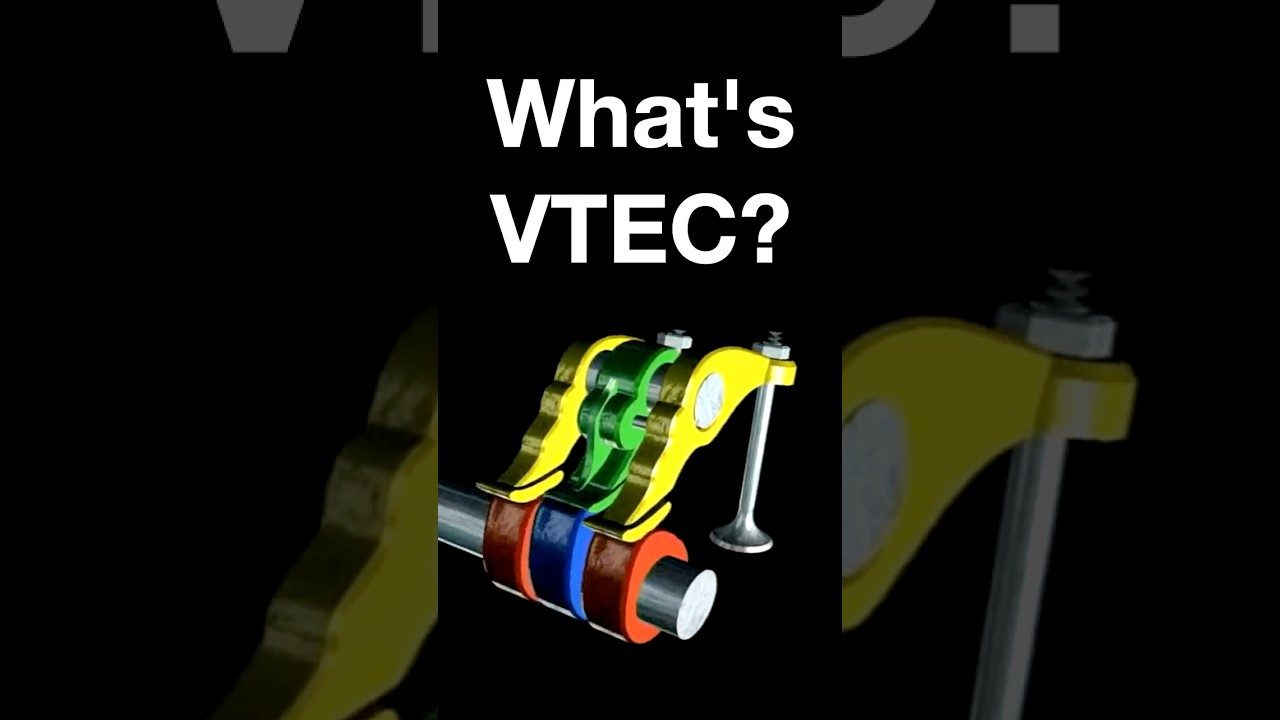
Honda’s solution, which debuted on the 1989 Honda Integra (in Japan), was ingenious and remarkably simple. The camshaft has two sets of lobes: one aggressive, one casual. At low RPMs during relaxed driving, only the unaggressive lobes actually press against the rockers. The larger lobe spins with the rest of the camshaft but does not press against anything.
At a pre-programmed (high!) RPM, an electronic solenoid releases, allowing oil to flood into a channel carved into the shaft connecting all the rocker arms. The oil pressure engages a pin that engages another rocker arm. This arm is locked into position beneath the aggressive cam. The aggressive cam (and its corresponding rocker) now dictate how long and deep the valves stay open. When revs drop, the solenoid closes, the rocker unpins, and the motor goes back to the less-aggressive profile.
The result is an engine with excellent around-town livability but a wicked top end. In practice, it ended up being wildly impressive: The Integra Type R launched in 1995 made 200 horsepower from a 1.8-liter engine. At the time, over 100 hp a liter from a naturally aspirated motor was the realm of the highest-end supercars. The added bonus, of course, is that characteristic bwaaa-WAAAA VTEC sound.
Compounding Reward
The beauty of VTEC is that it is so mechanically straightforward that it can be combined with other engine technologies for more control over an engine’s behavior. Honda has used this to create i-VTEC, which pairs variable valve timing with VTEC, allowing for further optimization of airflow. In 2006, Honda developed a motor that allowed for infinitely variable cam phasing while also incorporating VTEC. The company intended to put it into production by 2010, but shelved the concept.
What do you think?
View
Comments
Instead, last decade, Honda moved towards turbocharging as emissions regulations—and expected power outputs—continued to toughen. In Honda’s turbo VTEC motors, the extra lobes are found solely on the exhaust camshaft, as the turbo is fed by exhaust airflow. The more aggressive lobe engages under certain conditions where turbo lag is likely—such as partial throttle or low RPM acceleration—to help the turbo spool more rapidly.
Unfortunately, exhaust-only VTEC doesn’t have the characteristic bwwaaa–WAAAA sound—that comes from the intake. Still, Honda has used it well to its advantage, with the Civic Type R achieving rave reviews for its throttle response and lack of turbo lag. Whether naturally aspirated motors are here to stay for good is anyone’s guess, but it’s clear by now that as long as there are Honda engines, there will be VTEC.
How Things Work
 How Lamborghini Makes Lamborghinis Feel Like Lamborghinis
We want your opinion!
What would you like to see on Motor1.com?
Take our 3 minute survey.
- The Motor1.com Team
Share this Story
- (https://twitter.com/intent/tweet?url=https%3A%2F%2Fwww.motor1.com%2Ffeatures%2F724932%2Fhow-honda-vtec-works%2F&text=How%20VTEC%20Works%3A%20An%20Explainer&via=motor1com)
- copy
GO TO COMMENTS
(
)
Got a tip for us? Email: tips@motor1.com
View all comments ( )
Popular
Driven: The Revuelto SV Is All Bull, No BS
Toyota's Next Mid-Engined Coupe Is Going Racing This Weekend
Alfa Romeo Has Had It With Huge Screens
Subaru Teases A New Manual WRX, But Only For Japan
latest articles
- NASCAR's Coolest Stock Cars Were Too Good At Their Jobs Oct 24 - Motor101 -
- Woman Buys RAV4. Then She Realizes This Highly Sought-After Item Is Already Built-In: ‘They Did Not Tell Me This’ Oct 24 - Trending -
- Customer Tries To Do ‘Courtesy Lease Return’ For Mazda. There’s Just One Problem: ‘I’ve Not Seen Something Like That Before’ Oct 24 - Trending -
- Man Buys 2026 Ford Truck. Then The Salesman Gives Him A Sneaky Offer Usually Reserved For People With Bad Credit Oct 23 - Trending -
- The Legendary AMG Hammer Might Be Making a Comeback Oct 23 - Aftermarket / Tuning -
- The New Hyundai Tucson Could Be Its Most Popular Yet Oct 23 - Sales -
- How A Tire Company Created The World's Most Famous Blimp Oct 23 - Motor101 -
RECOMMENDED FOR YOU
Acura Just Trademarked Four New Names, Hinting At 3 New SUVs
Man Buys 2026 Ford Truck. Then The Salesman Gives Him A Sneaky Offer Usually Reserved For People With Bad Credit
Honda Is Finally Bringing Race-Inspired Parts To Its Road Cars
The Legendary AMG Hammer Might Be Making a Comeback
Honda's Mitsubishi-Based Truck Is Official, Coming In 2028
The New Hyundai Tucson Could Be Its Most Popular Yet
Honda Wants To Take On The Tahoe With An Even Bigger SUV. Here's What We Know