Home
News
Trending
'Believe Me We Have Our Tricks:' Northern Mechanics Say Southerners Can’t Do the Job In Their Climate. What Do They Mean?
"We call the south the taters of the gravy."
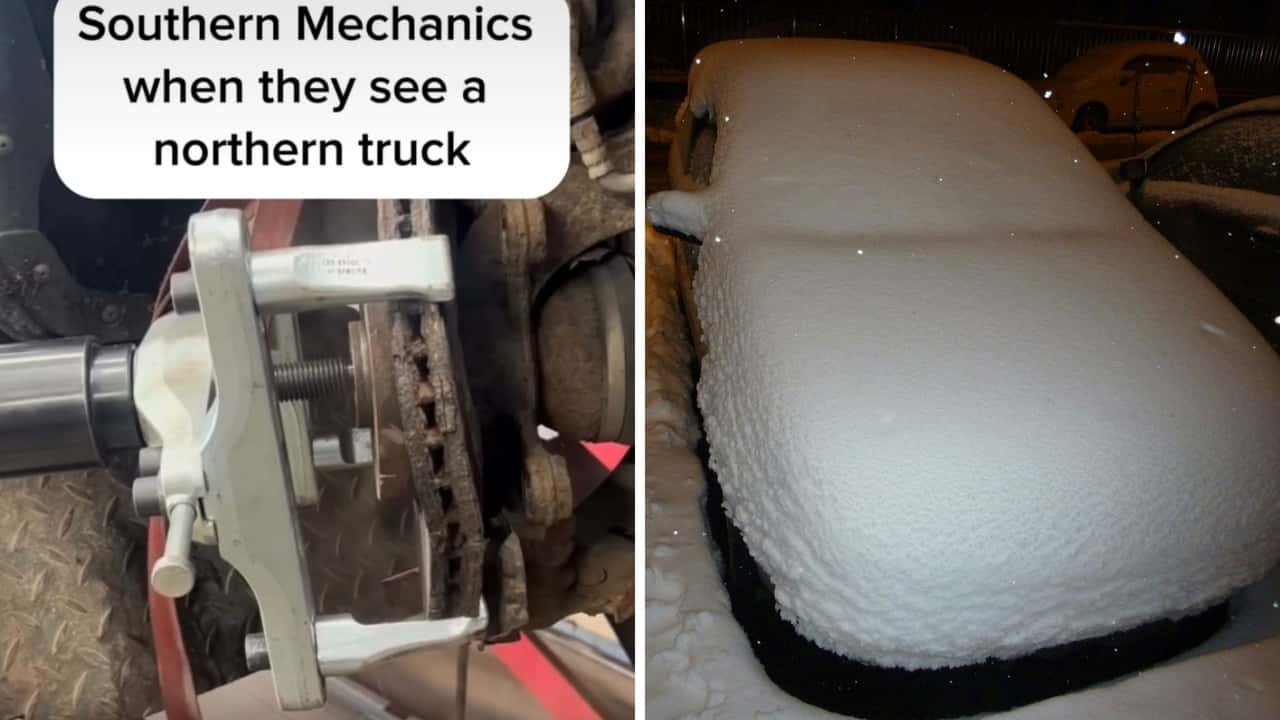
Photo by: My mobile mechanic & Michael
Chad Swiatecki 
By: Chad Swiatecki
Aug 26, 2025 at 9:00pm ET
Add Motor1.com as a preferred source in Google
- (https://twitter.com/intent/tweet?url=https%3A%2F%2Fwww.motor1.com%2Fnews%2F769828%2Fsouthern-vs-northern-mechanics%2F&text=%27Believe%20Me%20We%20Have%20Our%20Tricks%3A%27%20Northern%20Mechanics%20Say%20Southerners%20Can%E2%80%99t%20Do%20the%20Job%20In%20Their%20Climate.%20What%20Do%20They%20Mean%3F&via=motor1com)
- copy
Share
Comment
The difference between how trucks age in northern versus southern climates is well known among auto professionals, but a viral video has brought that contrast into the spotlight for a wider audience. The clip shows a corroded undercarriage paired with edited movie footage of religious figures reacting in horror, illustrating the shock some southern mechanics experience when encountering vehicles from salt-heavy regions.
Facebook creator MyMobileMechanic doesn’t give away many details about what climate region he operates from. Still, it’s clear from the viral clip that he’s got plenty of respect for mechanics who face vehicles that spend four or more months a year driving through heavily salted roads.
“Southern mechanics hit the Rust Belt, see the first rust demon… and vanish like holy water on hot steel,” he offers in the clip's caption.
Road salt is the central culprit behind the northern U.S.’s notorious corrosion problem. Departments of transportation in cold-weather states apply millions of tons of salt each winter, over 20 million tons annually. While effective at melting snow and ice, salt creates a highly corrosive environment that eats away at a vehicle’s metal components.
Rust begins to form when moisture, oxygen, and salt interact with exposed steel or iron. Over time, this process damages frames, brake lines, fuel systems, suspension parts, and more. A 2020 study from the Federal Highway Administration found that corrosion-related vehicle repairs cost U.S. drivers roughly $3 billion per year.
Mechanics Know the Signs of Salt
To seasoned mechanics in northern states like Michigan, New York, or Pennsylvania, rusted bolts and flaky frames are par for the course. But for technicians used to working on vehicles in drier, warmer climates—such as Texas, Arizona, or Florida—the first time seeing a frame half-eaten by corrosion can be jarring.
Auto forums and social media are filled with firsthand accounts that echo the sentiment behind the viral video. One thread on Reddit recounts the many methods northern cities and counties use to melt snow and ice, and the impacts on cars and trucks forced to brave the weather.
This geographic disparity also affects the used truck market. “Southern trucks” are often advertised as premium listings due to their clean underbodies and lower long-term corrosion risk. On automotive platforms, listings frequently mention “no rust” or “southern vehicle” as a selling point, indicating that buyers are willing to pay more for vehicles from dry or salt-free regions.
Vehicle history reports from providers like Carfax and AutoCheck can help identify a vehicle’s regional history. Experts recommend checking the undercarriage for rust during any used car inspection and being especially cautious when purchasing trucks that originated in northern states.
Fighting the Rust Demon
While it’s difficult to undo years of corrosion, there are steps drivers can take to slow the corrosion process. Routine undercarriage washes, especially after driving on salted roads, can significantly reduce buildup. Rust inhibitors and oil-based undercoatings can be applied annually to help protect vulnerable components.
Companies like Fluid Film and NH Oil Undercoating offer products designed to repel moisture and resist salt penetration. Some automakers, like Toyota and Ford, have incorporated additional rustproofing into their manufacturing processes in recent years, but the results vary by model and region. In extreme cases, severely rusted frames have triggered safety recalls, such as Toyota’s Tacoma, Tundra, and Sequoia frame replacement campaign that ran for several years.
Are Some Vehicles More Rust-Prone Than Others?
Rust doesn’t affect all vehicles equally. Design choices, manufacturing materials, and even brand-specific corrosion protection practices can determine how quickly a vehicle starts to deteriorate underneath.
Trucks and SUVs with poor underbody drainage, exposed weld seams, or uncoated steel components are particularly vulnerable. For example, certain models of the Toyota Tacoma (2005-2010), Toyota Tundra, and Sequoia became notorious for premature frame rust, leading to a massive warranty extension and frame replacement program after owner complaints and a class-action lawsuit. Toyota ultimately covered inspections and full frame replacements in many cases, with reported repair costs reaching $3,500 to $15,000 per vehicle.
Other vehicles like the Ford Super Duty (F-250/F-350) and older Chevrolet Silverado models have also faced widespread criticism for frame and body panel rust. In some cases, corrosion occurs faster than expected due to the combination of poor protective coatings and aggressive road salt exposure in cold-climate states. Auto enthusiasts have identified Mazda, Nissan, and Subaru among the brands with higher-than-average rust complaints, particularly for suspension and underbody components.
On the flip side, many modern trucks now feature galvanized steel, wax-based cavity coatings, or factory-applied undercoatings that dramatically slow rust formation. Ram began fully galvanizing its truck frames in the early 2000s. Ford, as of the 2015 F-150 redesign, uses a military-grade aluminum alloy body to eliminate some of the most common body panel corrosion issues, although the frame remains steel.
What do you think?
View
Comments
However, even aluminum isn’t immune since it can corrode under the right conditions, especially when paired with dissimilar metals or exposed to road salt over time.
Motor1 reached out to the creator via direct message.
Now Trending
 'Who Needs A Pedal?:' Car’s Gas Pedal Comes Off. Then The Driver Takes It For A Spin

Stay informed with our newsletter every weekday
back
Subscribe For more info, read our Privacy Policy & Terms of Use.
We want your opinion!
What would you like to see on Motor1.com?
Take our 3 minute survey.
- The Motor1.com Team
Share this Story
- (https://twitter.com/intent/tweet?url=https%3A%2F%2Fwww.motor1.com%2Fnews%2F769828%2Fsouthern-vs-northern-mechanics%2F&text=%27Believe%20Me%20We%20Have%20Our%20Tricks%3A%27%20Northern%20Mechanics%20Say%20Southerners%20Can%E2%80%99t%20Do%20the%20Job%20In%20Their%20Climate.%20What%20Do%20They%20Mean%3F&via=motor1com)
- copy
GO TO COMMENTS
(
)
Got a tip for us? Email: tips@motor1.com
View all comments ( )
Popular
Bugatti Restores One-Off Veyron With A Mirror-Like Aluminum Body
BMW Kept This Hatchback A Secret For Decades
Skoda Wants You To 3D Print Pieces Of Your Car At Home
The Gas BMW M3 Isn't Dead: Next-Gen Prototype Roars
latest articles
- The Ford Ranger Is Getting A Bigger V6 For 2027: Report Oct 20 - Rumors -
- BMW Already Has A Deal On The New i3. But It's Not Cheap Oct 20 - Pricing -
- Remember The Ford Flex? This Weird SUV Is Now A Great Used Buy Oct 20 - Why Buy? -
- Mercedes Isn't Sold On Extended-Range EVs: 'Would You Really Switch?' Oct 20 - Interview -
- Cadillac Driver Is Fed Up With Auto Stop. Then She Buys A $9 Item On Amazon To Disable It Oct 20 - Trending -
- Bugatti Restores One-Off Veyron With A Mirror-Like Aluminum Body Oct 20 - Supercars -
- Lexus NX Goes Hybrid Only For 2027 Oct 20 - Official -
RECOMMENDED FOR YOU
Cadillac Driver Is Fed Up With Auto Stop. Then She Buys A $9 Item On Amazon To Disable It
Remember The Ford Flex? This Weird SUV Is Now A Great Used Buy
Woman Buys A Tahoe. Then Her Chevrolet Dealer Calls Her A Week Later And Says She Owes $4,200
Mercedes Isn't Sold On Extended-Range EVs: 'Would You Really Switch?'
Man Gets Into New Car. Then He Tries To Shift Into Drive—And Crashes Out: 'Who Is Telling Car Manufacturers That?'
Bugatti Restores One-Off Veyron With A Mirror-Like Aluminum Body
Man Buys Ferrari. Then His Fiance Takes It For A Spin: 'I Don't Know If He's Gonna Be Mad...'