Home
Features
What Porsche's Active Suspension Does (And Doesn’t) Do
Porsche’s $7,000-plus Active Ride system is transformative. And it isn’t. Allow us to explain.
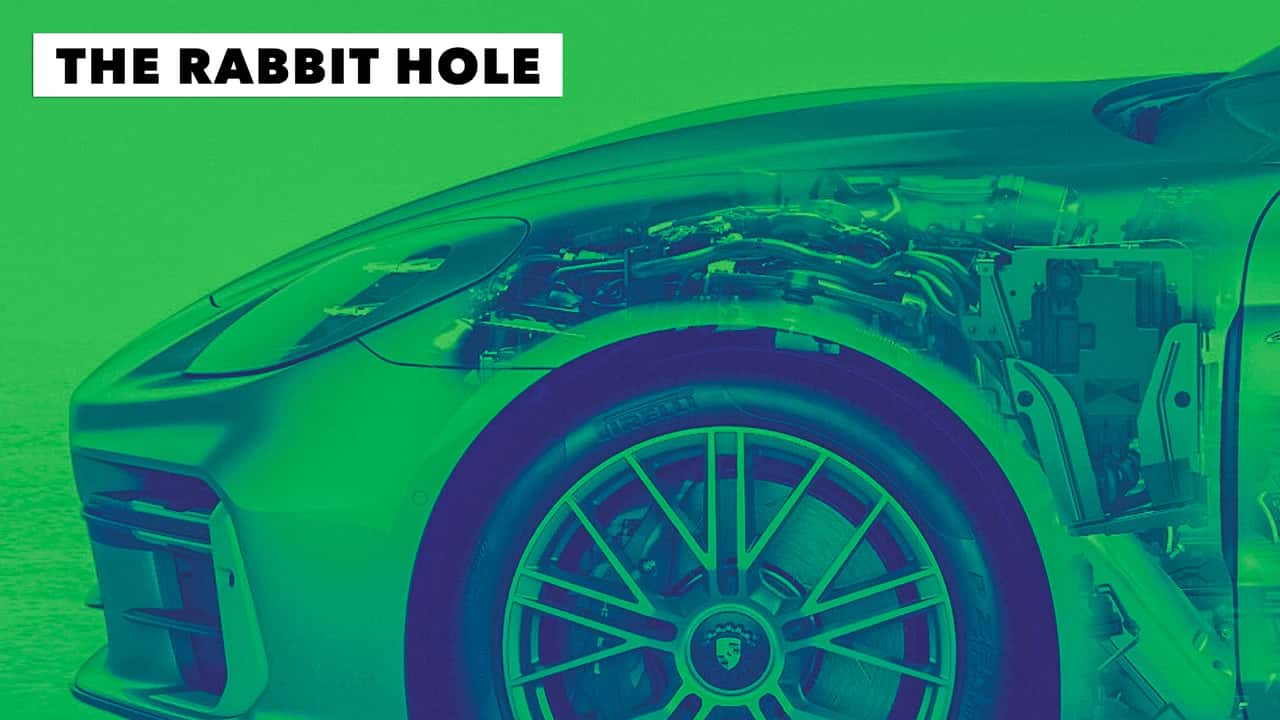
Photo by: Porsche
Chris Perkins 
By: Chris Perkins
Sep 12, 2025 at 9:30am ET
Add Motor1.com as a preferred source in Google
- (https://twitter.com/intent/tweet?url=https%3A%2F%2Fwww.motor1.com%2Ffeatures%2F772029%2Fporsche-active-ride-test%2F&text=What%20Porsche%27s%20Active%20Suspension%20Does%20%28And%20Doesn%E2%80%99t%29%20Do&via=motor1com)
- copy
Share
Comment
Like a lot of people interested in vehicle dynamics, I’m fascinated by active suspension. That is, an automotive suspension capable of generating its own force, regardless of external (road) input. It gives engineers total control over how a car moves, and the implications for ride and handling are profound.
Last year, Porsche introduced Active Ride, arguably the most powerful active-suspension system on the market.
The technology takes a while to wrap your head around. I first got to experience it across a handful of Porsche press events over the last few years, but on smooth roads and a race track. This year, I finally got to put real miles on a Panamera 4S E-Hybrid and a Taycan 4S Cross Turismo, both with Active Ride, on the roads I know best.
It was an illuminating experience.
The Rabbit Hole
Welcome to The Rabbit Hole, a bi-weekly column where Deputy Editor Chris Perkins explores his latest obsession with automotive technology. He speaks to the best in the business to understand how cars work and what the future of the automobile looks like.
Porsche Active Ride uses two-valve dampers, which have separate compression and rebound valves. Hence the name. Two-valve dampers aren’t unique to Active Ride, but here, each damper valve is connected to an electro-hydraulic motor-pump unit that regulates the pressure of the damper fluid.
In the Panamera hybrid (it’s not available on non-hybrid cars), it’s powered by the car’s 400-volt electrical system, or via a step-down transformer with the Taycan’s 800-volt battery. All four dampers work independently of one another, and each pump can put in a maximum of 2,248 pounds of force into each corner of the car.
Active Ride cars use very soft single-chamber air springs—around 120 pounds/inch—whose only function is to essentially hold the car up when it’s turned off. These cars also eschew anti-roll bars because the dampers manage body roll without bringing any of the associated compromise of having what is effectively a torsion spring connecting the left and right sides of a car.
In practice, it means you can make the car do whatever the hell you want.

Photos by: Porsche
Both the Taycan and Panamera have functions in Normal mode that actually counteract natural body motions. Active Pitch Control actually pitches the car upward under braking and pushes it downward under acceleration, in an attempt to keep the occupant's body level. Active Tilt Control Leans the car into a corner, again with the same aim in mind, and counteracts the car’s natural body motion.
From my prior experiences, I wasn’t convinced of the need to actively counteract regular body motions. It seemed like a gimmick to me, something someone in marketing pushed just to show what the system could do, if not what it should do. In harder driving, these functions can also make the car feel disconnected, unnatural.
But when you’re driving around normally, you almost don’t notice Active Tilt or Pitch Control at work. The effect is pretty subtle until you do something like take a corner hard, get on the throttle aggressively, or brake abruptly.
It’s especially subtle in the Taycan, which is tuned differently from the Panamera. Porsche considers the Panamera a true luxury sedan, whereas the Taycan is more of a four-door sports car. The Taycan is actually the smaller car, and when compared with Panamera hybrid models, lighter. Porsche deploys the Active Tilt and Pitch Control systems to a greater degree (literally) in the Panamera, and over a broader speed range than in the Taycan.
Photo by: Porsche
If you turn these systems off or switch to Sport or Sport Plus, Porsche Active Ride just keeps the car flat. And I mean flat. Not “flat” as in minimal body roll—flat as in no body roll whatsoever. The only thing it doesn’t do is compensate for tire deflection.
Porsche says Active Ride offers unprecedented insulation from road-surface imperfections. Out on the road, neither the Active Ride-equipped Panamera nor Taycan has a magic-carpet ride. You’re aware of road imperfections, with the wheels and tires transmitting vibrations into the cabin. But the car does an uncanny job of making any imperfections simply irrelevant. You’re aware of the road surface below you, but the car renders bumps small and insignificant.
You can fly down a cobblestone street, and the car stays level. Or, you can fly down a frost-heave-filled country road, and the car generates astounding pace.
Photo by: Porsche
In Sport and Sport Plus drive modes, Active Ride alters ride height, but not in a simple way. The car doesn’t just drop a certain height; as you brake for a corner, the Taycan and Panamera lower by 30 millimeters, which, yes, helps reduce the center of gravity, but also helps increase negative camber on the front axle, improving grip potential. The Panamera lowers an additional 5 mm as you trail off the brakes toward the apex.
Also helping grip enormously is what Porsche calls dynamic wheel load balance. In a typical car, weight shifts around as the car moves, increasing the load on certain tires. For example, in a left-hand turn, weight shifts to the right as the body rolls, increasing the load and grip potential of the right-hand side tires. Weight transfer increases grip at certain tires while decreasing it at others; with Active Ride, the system can spread out the loads on all four tires evenly, generating huge grip.
And if one tire starts to run out of grip, Active Ride can shift the load distribution around to the other tires. The result is an incredibly neutral handling balance, as all four tires evenly distribute the workload.
What you feel out on the road is incredible grip in all scenarios. A grip that would normally come at the expense of ride comfort, with ultra-stiff springs, shocks, and dampers to try and limit body motion as much as possible. But here, even if you don’t get a magic-carpet ride, you get excellent ride quality and grip that seems supernatural.
Photo by: Porsche
It feels natural, too, thanks to the very careful calibration work of Porsche engineers. Last year, an engineer tried to explain to me how they’re using virtual springing forces into the body to give the driver some much-needed road feel through the seat, and the concept still blows me away.
But, as I said in my review of the Taycan, this is a system for the True Believers. Active Ride is a $7,650 option—though standard on Turbo S and GT models—and Porsche will happily show you a spider chart showing how much of an improvement it represents against its standard suspension systems. Except, its standard suspension systems are great. A Panamera or Taycan without Active Ride still drives very well.
What do you think?
View
Comments
You have to really appreciate the finer details of vehicle dynamics to justify Active Ride. Which, if you’re spending well over $100,000 on a Porsche, you very well might! But, while the system has a huge impact on vehicle dynamics, I wouldn’t say it makes the Taycan or Panamera feel like fundamentally different cars.
That in and of itself is a credit to Porsche. It perhaps could’ve done more, but it has a clear idea of what its cars should feel like, and just because Active Ride gives it the possibility to push boundaries, it takes some restraint to use it in a way that simply makes these cars feel like better versions of themselves.
More From the Rabbit Hole
Car Companies Want One Thing From Your Tires—Drivers Want Another
The Frustrating Pseudoscience of Nürburgring Lap Times
The Limited-Slip Differential Does So Much More Than You Think
Why You Can't Beat Light Weight

Stay informed with our newsletter every weekday
back
Subscribe For more info, read our Privacy Policy & Terms of Use.
We want your opinion!
What would you like to see on Motor1.com?
Take our 3 minute survey.
- The Motor1.com Team
Share this Story
- (https://twitter.com/intent/tweet?url=https%3A%2F%2Fwww.motor1.com%2Ffeatures%2F772029%2Fporsche-active-ride-test%2F&text=What%20Porsche%27s%20Active%20Suspension%20Does%20%28And%20Doesn%E2%80%99t%29%20Do&via=motor1com)
- copy
GO TO COMMENTS
(
)
Got a tip for us? Email: tips@motor1.com
View all comments ( )
Popular
Ferrari's New 296 Challenge Stradale Is A 670-HP Race Car You Can Drive Home
BYD's Boxy SUV Banned In The EU After Land Rover Defender Copycat Ruling
What If Koenigsegg Had A Sterrato Fighter? Meet The Jesko Terrang
Audi Has 7 New Models Coming In 2027. Here's All Of Them
Latest Stories
- Ferrari's New 296 Challenge Stradale Is A 670-HP Race Car You Can Drive Home Nov 21 - First Look -
- Who Invented The Car Radio? Nov 21 - Motor101 -
- Why Do Some Countries Drive On The Left Side Of The Road? Nov 21 - Motor101 -
- I Bought This Skoda 10 Years Ago. I Don't Think I'll Ever Sell It Nov 21 - Opinion -
- This Chevy Engine's Timing Belt Should Last 150,000 Miles. A Teardown Says Otherwise Nov 21 - Engines -
- Most Drivers Have No Idea What The Little Switch Under Their Rearview Mirror Does Nov 21 - Motor101 -
- BYD's Boxy SUV Banned In The EU After Land Rover Defender Copycat Ruling Nov 21 - Corporate / Financial -
RECOMMENDED FOR YOU
Porsche's Legendary 550 Spyder Gets A Tiny Electric Reboot. It Costs $92,000
Ferrari's New 296 Challenge Stradale Is A 670-HP Race Car You Can Drive Home
These Retro-Inspired Sports Cars Keep The Air-Cooled Porsche Spirit Alive
Who Invented The Car Radio?
Porsche Revisits Its Strange Car Designed To Last 20 Years
Why Do Some Countries Drive On The Left Side Of The Road?
Porsche’s New Supercar Already Spotted At The Nürburgring