Home
Features
The Rabbit Hole
Car Companies Want One Thing From Your Tires—Drivers Want Another
A Michelin engineer explains just how different the tires that might come on your car from the factory are from the tires you buy further down the road.
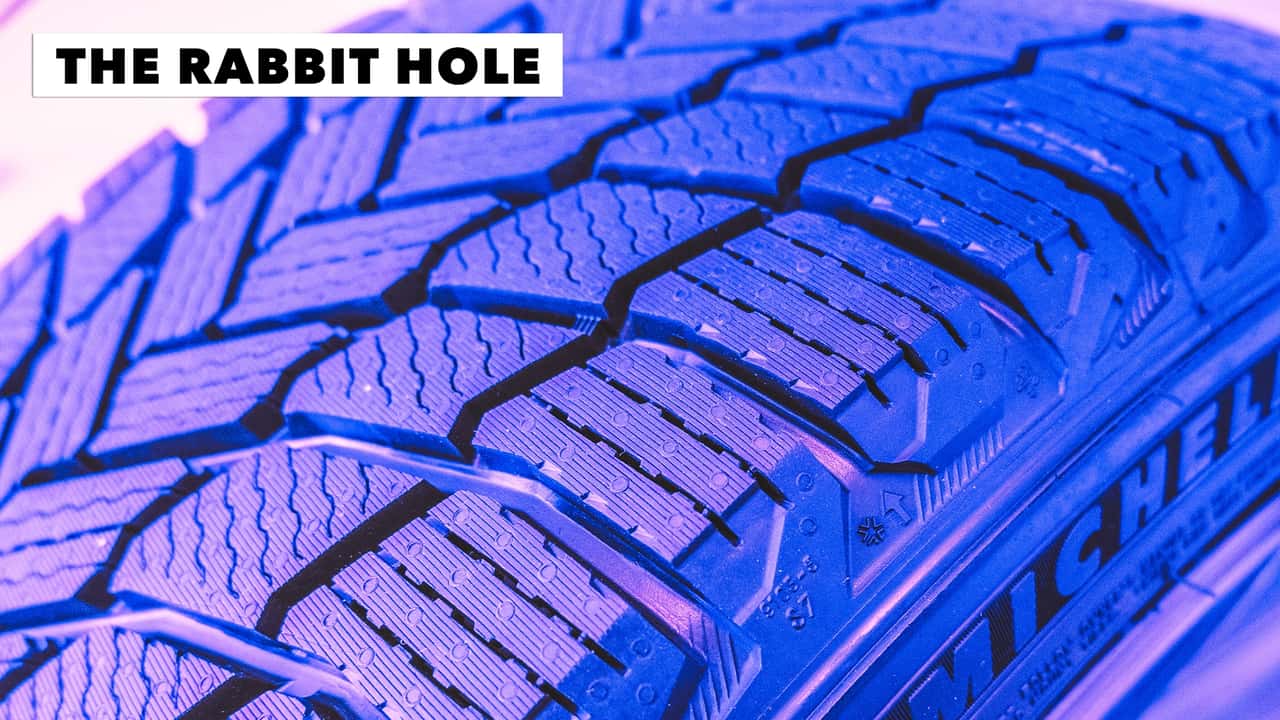
Photo by: Chris Perkins / Motor1
Chris Perkins 
By: Chris Perkins
Aug 29, 2025 at 9:30am ET
Add Motor1.com as a preferred source in Google
- (https://twitter.com/intent/tweet?url=https%3A%2F%2Fwww.motor1.com%2Ffeatures%2F770499%2Foe-vs-replacement-tires%2F&text=Car%20Companies%20Want%20One%20Thing%20From%20Your%20Tires%E2%80%94Drivers%20Want%20Another&via=motor1com)
- copy
Share
Comment
A tire like the Michelin Pilot Sport 4S is not a single entity. There’s the version that Michelin sells to you, and the many versions Michelin develops specifically for automakers. These are wildly different, and it’s because what automakers want and what individual buyers want are not the same.
Michelin invited us out to an event at Road Atlanta to teach a bit more about its “replacement” tires—the rubber it sells to private buyers as aftermarket. We got to sample some great tires, as you’d expect from Michelin, but more interesting was what we learned about automakers and car owners.
Welcome to The Rabbit Hole, a bi-weekly column where Senior Editor Chris Perkins explores his latest obsession with automotive technology. He speaks to the best in the business to understand how cars work and what the future of the automobile looks like.
“The big tension—and it’s been this way for several years now and I don’t foresee it changing in the near future—is between what original-equipment manufacturers are asking for in terms of tire performance and what replacement-market consumers are asking for in terms of performance,” explains Steve Calder, an engineer and the head of marketing for Michelin’s Pilot line. “And the performances that are being asked are directly opposite of one another.”
More than anything, car owners in North America want tread life, explains Steve Calder, an engineer and the head of marketing for Michelin’s Pilot line of performance tires. No one wants to be replacing tires every year or two.
“The more wear we can deliver the better,” he explains, “and then traction, wet traction, and snow traction particularly are important.”

The Defender LTX Platinum is one of Michelin's newest replacement tires.
Photo by: Chris Perkins / Motor1
In much of the US, car owners run the same tires year-round, which is why all-season tires are so popular. Only deep into the snow belt will you see customers switching over to a dedicated winter tire, which is designed for both snow and ice, as well as cold, dry conditions.
Generally, replacement-tire buyers aren’t looking at rolling resistance, but that’s changing with the rise of EVs. Lowering rolling resistance helps with efficiency, and thus range, so some EV customers are seeking out this quality. But, not nearly as much as automakers.
In EVs, where shoppers really value range, and in internal-combustion vehicles, where automakers have to meet strict fuel economy targets (well, everywhere but the US now), low rolling resistance is huge. An automaker will try to eke out efficiency gains wherever it can, so it’ll pile on the pressure to tire companies like Michelin to help its cause.
The problem, Calder explains, is that rolling resistance and treadwear compete with one another. So too do rolling resistance and wet/winter traction. Through good engineering, Michelin has been able to minimize those compromises, but it’s still there—in cars, you can never fully have the best of both worlds. And it’s another reason why OE tires are so different from their aftermarket counterparts.
A Porsche-spec Michelin Pilot Sport S 5. The N0 marking on the sidewall indicates this is a Porsche tire.
Photo by: Porsche
The next thing a lot of automakers ask for is dry-braking performance. “That doesn’t initially make a lot of sense, but that’s tied to how Consumer Reports tests their vehicles,” Calder says.
Consumer Reports incorporates dry-braking numbers as part of its overall vehicle rankings, so automakers want to maximize those scores. And no matter what you have for brakes, a car’s braking performance is only as good as its tires.
Then, it comes down to individual automaker preferences. One engineer who moved to the US after a long spell in France tells me Porsche wants “everything,” good dry performance, rolling resistance, and it’s even very concerned with aerodynamics.
'The big tension ... is between what original-equipment manufacturers are asking for in terms of tire performance and what replacement-market consumers are asking for in terms of performance.'
Tire Rack recently published an interesting test of Ultra High-Performance versus Max Performance summer tires, and as part of it, it compared a replacement Michelin Pilot Sport 4S to the version that comes standard on a BMW M2. Using an M2 as the test vehicle, Tire Rack found that the OE version of the PS4S had a firmer ride and more tread noise, but was sharper handling in both dry and wet conditions, and posted better numbers on track.
That’s obviously just one example, and Tire Rack didn’t measure tread life or fuel economy for this test either. (Though both of these PS4S variants have the same 300-treadwear rating and 30,000-mile warranty.) But, BMW clearly wanted a bit more dry and wet grip at the expense of ride quality and noise.
Calder explains that, ideally, Michelin develops its aftermarket replacement model before OE-specific versions because it serves as a useful benchmark. We don’t live in an ideal world, however, and sometimes these tires are developed in parallel.
The replacement version of the Michelin Pilot Sport All Season 4.
Photo by: Michelin
The Pilot Sport All-Season 4, for example, debuted with the C8 Corvette Stingray well before the replacement version. Consequently, the Corvette tire has a tread pattern that’s a sort of hybrid of the Pilot Sport All-Season 4 replacement tire and the older Pilot Sport A/S 3+.
More often, though, the OE and replacement-spec tires look almost, if not 100-percent identical. The difference comes in compound and construction, both of which have a huge effect on tire performance.
What you often end up with are two tires that look the same, and have the same name, but are almost completely different. Oftentimes, cars with an OE tire (or tires) work best on that specific tire (or tires). The automaker and the tire manufacturer work for years to ensure that the tire suits the vehicle’s needs down to a tee.
The wide range of replacement tires means that car owners can go for something that might suit their needs better. An automaker legally has to care about fuel economy; a private customer doesn’t.
What do you think?
View
Comments
But what does Michelin itself want? Other than the business of both OEMs and car owners, it’s just trying to make tires that excel in every metric.
“We have to balance what we deliver, how we deliver it to OE, and what we deliver to replacement [customers], and then internally, we’re always trying to break that compromise.”
More From the Rabbit Hole
The Frustrating Pseudoscience of Nürburgring Lap Times
Why You Can't Beat Light Weight
The Limited-Slip Differential Does So Much More Than You Think
Subaru Made the World's Only Twin-Turbo Flat-Four. It Was Madness

Stay informed with our newsletter every weekday
back
Subscribe For more info, read our Privacy Policy & Terms of Use.
We want your opinion!
What would you like to see on Motor1.com?
Take our 3 minute survey.
- The Motor1.com Team
Share this Story
- (https://twitter.com/intent/tweet?url=https%3A%2F%2Fwww.motor1.com%2Ffeatures%2F770499%2Foe-vs-replacement-tires%2F&text=Car%20Companies%20Want%20One%20Thing%20From%20Your%20Tires%E2%80%94Drivers%20Want%20Another&via=motor1com)
- copy
GO TO COMMENTS
(
)
Got a tip for us? Email: tips@motor1.com
View all comments ( )
Popular
12 Crossovers That Are Surprisingly Good At Off-Roading
The Audi Nuvolari Costs $700,000. And It Will Be Rare In America
They Spent Eight Years Building A Lancia Stratos. Now They Can Finally Drive It
Lamborghini Temerario Gets Even Louder With Official Titanium Akrapovič Exhaust
Lucid's Sub-$50,000 SUV Comes Into Focus In New Teaser
latest articles
- Dodge Is Back In NASCAR After 14 Years. Here's Everything We Know Nov 11 - Features -
- The Audi Nuvolari Costs $700,000. And It Will Be Rare In America Nov 11 - Official -
- Want To Drive A Rally Car? DirtFish Is Heading To Willow Springs Nov 11 - Motorsport -
- Two Nearly Identical Ferraris Sold On The Same Day. One Fetched $7.6 Million More Nov 11 - Supercars -
- The Lucid Gravity Grand Touring Is a Minivan-Shaped Supercar: Driven Nov 11 - New Car Reviews -
- Lucid's Sub-$50,000 SUV Comes Into Focus In New Teaser Nov 11 - Teasers -
- Your Car Has Airbags In Places You Probably Didn't Even Know Nov 11 - Motor101 -
RECOMMENDED FOR YOU
Why BMW's 'Heart of Joy' Is the Next Big Step in Vehicle Dynamics
Dodge Is Back In NASCAR After 14 Years. Here's Everything We Know
What Porsche's Active Suspension Does (And Doesn’t) Do
The Audi Nuvolari Costs $700,000. And It Will Be Rare In America
The Frustrating Pseudoscience of Nürburgring Lap Times
Want To Drive A Rally Car? DirtFish Is Heading To Willow Springs
The Limited-Slip Differential Does So Much More Than You Think