Home
Volvo
Features
Volvo Invented The Modern Seatbelt. Then Gave Away The Idea For Free
A Volvo engineer created the modern three-point seatbelt, and the automaker's decision to share it changed automotive safety forever.
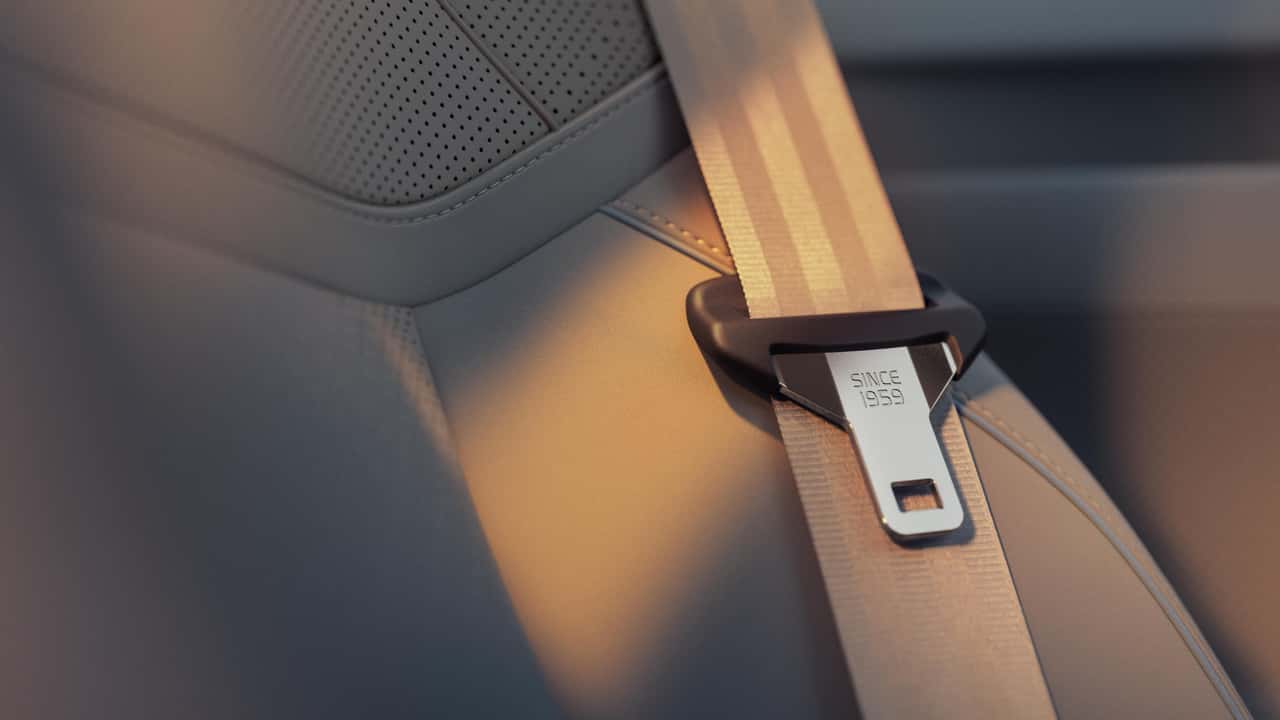
Photo by: Volvo
Dan Mihalascu 
By: Dan Mihalascu
Nov 25, at 9:30am ET
Add Motor1.com as a preferred source in Google
- (https://twitter.com/intent/tweet?url=https%3A%2F%2Fwww.motor1.com%2Ffeatures%2F816704%2Fwho-invented-three-point-seatbelt-nils-bohlin%2F&text=Volvo%20Invented%20The%20Modern%20Seatbelt.%20Then%20Gave%20Away%20The%20Idea%20For%20Free&via=motor1com)
- copy
Share
Comment
Few automotive inventions have had a bigger impact on road safety than the three-point seatbelt. It's a feature that most drivers use every day without giving it a second thought, yet its introduction fundamentally changed how automakers protect occupants in a crash. Today, it's fitted to virtually every passenger car on the road, but the story behind its invention is just as remarkable as the technology itself.
The modern three-point seatbelt was invented by Swedish engineer Nils Bohlin in 1958 while working for Volvo. However, there's more to the story than a clever engineering breakthrough. The automaker made a decision that helped turn the invention into a global safety standard, potentially saving millions of lives along the way.
Who Invented The Three-Point Seatbelt?
The man responsible for the modern three-point seatbelt was Nils Bohlin, a Swedish engineer who joined Volvo in 1958. Before arriving at the automaker, Bohlin had worked in the aviation industry, where he gained experience developing aircraft ejection seats and safety restraint systems.
Volvo hired him to improve occupant protection in its passenger cars. At the time, seatbelts were nothing new, but existing designs had significant shortcomings. Some vehicles featured simple lap belts, while others used diagonal shoulder restraints. Neither arrangement offered the same level of protection as a properly designed three-point system.
Bohlin's breakthrough was combining the two into a single, practical restraint that secured both the upper and lower body. His design was comfortable, easy to operate, and capable of distributing crash forces across stronger areas of the body.
How Does The Three-Point Seatbelt Work?
The principle behind Bohlin's invention is surprisingly straightforward. The three-point seatbelt uses a lap strap and a diagonal shoulder strap that meet at a single buckle positioned beside the occupant's hip. Each part has a specific purpose:
- Lap belt: Holds the occupant's pelvis in place and helps prevent them from sliding forward beneath the belt.
- Shoulder belt: Restrains the upper body, reducing the risk of striking the steering wheel, dashboard, or windshield.
- Buckle and anchor points: Keep the restraint securely positioned and allow the system to distribute crash forces across the body.
Bohlin also paid close attention to usability. His design could be fastened with one hand, making it practical for everyday motorists. This was an important consideration because even the most effective safety equipment is useless if drivers and passengers don't want to use it.
The basic arrangement remains largely unchanged today, although modern systems incorporate additional technologies to improve protection.
When Did Volvo Introduce The Three-Point Seatbelt?
Volvo introduced the three-point seatbelt in 1959, initially offering it in the PV544 and Amazon models. Bohlin subsequently received US Patent No. 3,043,625 on July 10, 1962, officially securing the patent for his groundbreaking design.
The company became the first automaker to install the modern three-point design as standard equipment in the front seats of its production cars. The introduction marked a significant moment in automotive history. While some motorists initially questioned the need for seatbelts, Volvo recognized that preventing injuries and saving lives should be a priority.
The automaker continued developing its safety technology and promoting seatbelt use, helping establish the three-point design as an essential part of vehicle safety.
Why Did Volvo Give Away The Seatbelt Patent?
Perhaps the most remarkable part of the invention's history is what Volvo did next. Rather than keeping the technology exclusive to its own vehicles, the company made the patent available to other automakers without licensing fees.
Volvo understood that the three-point seatbelt could save lives regardless of which manufacturer's badge was attached to the car. Sharing the technology allowed competitors to adopt the design and helped accelerate its adoption across the automotive industry.
It was an unusual decision in an industry built around competition and proprietary technology. However, it demonstrated that some innovations are simply too important to keep to yourself.
Today, Volvo's decision is widely regarded as one of the most significant examples of an automaker prioritizing public safety over commercial advantage.
What Do Drivers Think About Volvo's Three-Point Seatbelt Invention?
Volvo's decision to share its three-point seatbelt technology continues to earn praise on Reddit. In discussions on r/OldSchoolCool, users highlighted the automaker's decision to put road safety ahead of potential profits. However, some commenters questioned whether keeping the patent exclusive would have been particularly profitable in an era when seatbelts weren't widely appreciated.
Another recurring topic is how long it took motorists to embrace the invention. In a discussion on r/Autos, Redditors pointed out that widespread seatbelt use took decades, with some drivers still reluctant to buckle up. The discussion also highlighted how attitudes toward automotive safety have changed over time.
The patent itself also generated debate, with users discussing the distinction between inventor Nils Bohlin and Volvo, which owned the rights to the technology. A separate conversation on r/Polestar revisited the invention's legacy in modern cars. Overall, Reddit's reaction reflects widespread appreciation for an innovation whose impact extends far beyond Volvo.
How Many Lives Has The Three-Point Seatbelt Saved?
Volvo estimates that its three-point seatbelt invention has saved more than one million lives since its introduction. Although calculating the exact worldwide figure is difficult, there's little doubt that the technology has dramatically reduced the number of serious and fatal injuries in road crashes.
According to the US National Highway Traffic Safety Administration (NHTSA), seatbelts reduce the risk of fatal injury to front-seat passenger car occupants by approximately 45 percent.
Modern systems have also become considerably more sophisticated. Today's seatbelts can feature pretensioners, load limiters, adjustable shoulder anchors, and electronic controls that work alongside airbags to improve occupant protection. However, the fundamental principle remains the same as the one Bohlin developed in the late 1950s.
What do you think?
View
Comments
It's easy to overlook the seatbelt when discussing automotive innovation. It doesn't increase horsepower, improve acceleration, or make a car look more attractive. Yet few automotive inventions have had a greater impact on people's lives.
More than six decades after its introduction, the three-point seatbelt remains one of the most important safety technologies ever fitted to a passenger car. And every time motorists hear that familiar click, they're benefiting from an invention that changed the automotive world.
More From Motor101
 How Does A Turbocharger Actually Make More Power?
Your Engine Can't Do Its Job Without A Transmission
No, BMW's Logo Isn't Actually An Airplane Propeller
All-Season Vs All-Weather Tires: What’s The Difference?
We want your opinion!
What would you like to see on Motor1.com?
Take our 3 minute survey.
- The Motor1.com Team
Share this Story
- (https://twitter.com/intent/tweet?url=https%3A%2F%2Fwww.motor1.com%2Ffeatures%2F816704%2Fwho-invented-three-point-seatbelt-nils-bohlin%2F&text=Volvo%20Invented%20The%20Modern%20Seatbelt.%20Then%20Gave%20Away%20The%20Idea%20For%20Free&via=motor1com)
- copy
GO TO COMMENTS
(
)
Got a tip for us? Email: tips@motor1.com
View all comments ( )
Popular
12 Underrated Performance Cars That Nobody Bought
Toyota's Baby Land Cruiser Goes Full Off-Road Mode
Hyundai's New Tucson Finally Gets A Hybrid Off-Road Trim
I Drove Porsche's Electric Boxster Prototype. It's Still A Driver's Car
Slate Is Betting You Don't Need More Than 205 Miles Of Range
Latest Stories
- Volvo Invented The Modern Seatbelt. Then Gave Away The Idea For Free Nov 25 - Motor101 -
- Hyundai's New Tucson Finally Gets A Hybrid Off-Road Trim Nov 25 - First Look -
- Volkswagen Adds Sporty R-Line Treatment To ID. Cross Nov 25 - First Look -
- Why The 24 Hours Of Le Mans Is Exactly 24 Hours Long Nov 25 - Motor101 -
- The New Suzuki Ignis Is Another Cheap EV For Europe That America Isn't Getting Nov 25 - Green -
- Genesis GV90 Uses Two Different Infotainment Systems At Once Nov 25 - Technology -
- Toyota's Wild Hilux One-Off Is A Pickup That Forgot To Be A Truck Nov 25 - Concept Cars -
RECOMMENDED FOR YOU
One Engine, Two Boosters: Why Some Automakers Opt For Twin-Charging
Hyundai's New Tucson Finally Gets A Hybrid Off-Road Trim
Why The 24 Hours Of Le Mans Is Exactly 24 Hours Long
Volkswagen Adds Sporty R-Line Treatment To ID. Cross
How Does A Turbocharger Actually Make More Power?
The New Suzuki Ignis Is Another Cheap EV For Europe That America Isn't Getting
Your Engine Can't Do Its Job Without A Transmission