Home
Scout Motors
Features
Scout Still Has Plenty To Prove. But Its Comeback Is Starting To Feel Very Real
We visited Scout's nearly finished $2 billion factory in South Carolina to see how the company plans to turn promises into production vehicles.
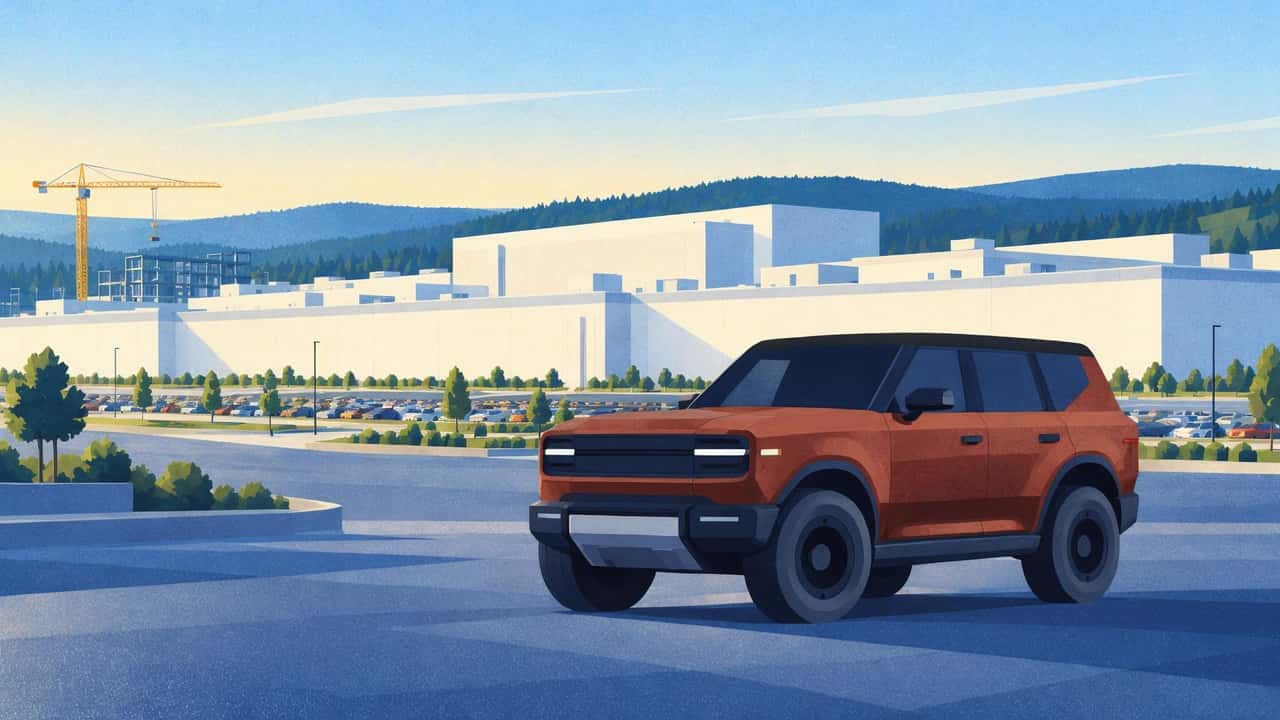
Photo by: Lorenzo Fei | Motor1
Jeff Perez 
By: Jeff Perez
Nov 19, at 9:00am ET
Add Motor1.com as a preferred source in Google
- (https://twitter.com/intent/tweet?url=https%3A%2F%2Fwww.motor1.com%2Ffeatures%2F815954%2Fscout-factory-tour-comeback%2F&text=Scout%20Still%20Has%20Plenty%20To%20Prove.%20But%20Its%20Comeback%20Is%20Starting%20To%20Feel%20Very%20Real&via=motor1com)
- copy
Share
Comment
It's entirely fair to still be skeptical of Scout Motors at this point. Since the company announced its return in 2023, much of what we've heard and covered has been minor setbacks and shifting ideals, all set against the backdrop of an ever-changing US automotive market.
But a quick trip to Blythewood, South Carolina, might convince you otherwise.

Photo by: Scout Motors
Less than an hour outside Columbia sits a sprawling, 1,600-acre campus that will soon house all of Scout's manufacturing operations. The facility is currently about 90 percent complete, with much of the current activity focused on the body shop and paint shop. But there's plenty more to come.
The company has already built its first few validation prototypes. By 2027, Scout aims to have its first customer vehicles in production. And if we're to believe what company executives tell us on site, those vehicles should start making their way into driveways by 2028. Right on schedule.
All told, Volkswagen Group has invested roughly $2 billion in the project—a big commitment, even for one of the world's largest automakers.
Photos by: Jeff Perez / Motor1
Photos by: Jeff Perez / Motor1
With that much money already on the table, it's hard to imagine VW would simply walk away from the project now. Scout's success in the US is clearly a priority for the Group, especially as it works through its own financial challenges and attempts to navigate Trump’s tricky tariff situation.
For Scout CEO Scott Keogh, though, it’s mostly outside noise.
Since taking over the role in 2022, his mission, first and foremost, has been to turn that investment into real infrastructure capable of building actual vehicles customers can buy. And despite the difficulties currently facing the industry at large, he's still convinced the company is making all the right moves.
"I am not naive to the challenges both in the industry and in the Volkswagen Group," Keogh tells Motor1. "My job is to hit milestones, hit the targets, and deliver the promise."
Scout CEO Scott Keogh (Left); Scout Chief Design Officer Chris Benjamin (Right)
Photo by: Scout Motors
'I am not naive to the challenges both in the industry and in the Volkswagen Group.'
Keogh points to Volkswagen Group's manufacturing experience as one of Scout's biggest advantages. Unlike rival startups such as Rivian or Tesla, which had to build much of their manufacturing infrastructure and expertise from scratch, Scout has nearly a century’s worth of knowledge to work from.
"The Group runs 150 plants around the world; they do have some people that know how to ramp up and go get things done," he said. "You could say, 'Yeah, just hire some dudes and go build a factory.' I think you'll find out that hiring some dudes and building a factory is not so easy."
"You have toolkits that do not exist in startups at all," Keogh explained. "You've got to align all of these parts in the exact phase to go build the car with the right quality with the right alignment, and you need the systems to do that."
That Group know-how will also extend to the vehicles themselves. Scout's range-extender powertrain, for example, will use a modified Volkswagen four-cylinder engine rather than requiring the company to develop an entirely new architecture from the ground up.
"The four-cylinder engine that we're using for the range extender is a modified Group engine," Keogh said. "Now, imagine trying to go get an engine if you're a startup, integrating it with software, homologating it—I would say next to impossible. Never mind, scaling the manufacturing."
Scout's Blythewood, South Carolina, Factory
Photo by: Jeff Perez / Motor1
That doesn't mean the hard work is finished, though. Scout's validation prototypes still need to become production-ready vehicles, and the factory needs to prove it can operate at the scale the company envisions.
A full-capacity Scout says the factory is capable of building up to 200,000 vehicles per year. That’s a vehicle every 88 seconds, or up to 40 per hour—right on par with its neighbors, BMW and Volvo, just down the street.
The body shop alone boasts 1.3 million square feet of working space, 753 robots assembling vehicle bodies, a largely autonomous paint shop, and some clever AI technologies checking things like quality and tolerance. It’s no doubt an impressive operation.
Unlike some of the more abstract promises surrounding the company's return, this is progress that is very clearly happening in real time. People are being hired, equipment is being installed, and teams are beginning to build vehicles.
"We're hiring, building the factory scene. We're making the vehicles, and a company that is hesitating would not be doing what we're doing," Keogh said. "Those are the facts."
A full-capacity Scout says the factory is capable of building up to 200,000 vehicles per year. That’s a vehicle every 88 seconds, or up to 40 per hour
Thus far, Scout currently employs around 900 people, with plans to eventually bring 4,000 workers to its operations in Blythewood and Charlotte. Roughly 2,000 of those employees will work directly on the assembly line.
Finding that many qualified workers, Keogh admits, won't necessarily be easy. "There is no doubt that in this country, there is a binding skills gap," he notes.
Scout is working to address that challenge through its hiring and workforce efforts local to South Carolina, and elsewhere in the US. It needs people who can operate a modern automotive plant while helping build the institutional knowledge that will allow the facility to grow and improve over time.
And Scout is proud of its American roots; it aims to hire a largely American workforce, while the Traveler and Terra draw on the distinctly American tradition of rugged, body-on-frame SUVs and pickups.
"These vehicles were designed for America... They were engineered by Americans, and they're being built here in an environment of tariffs and everything else," Keogh said.
Photo by: Jeff Perez / Motor1
Even with a factory taking shape and vehicles starting to come together, Scout still faces a major uphill battle. One of the biggest questions surrounding the company is still: Will people actually buy them?
As we know, EV demand has been shaky in the US lately, forcing some automakers to rethink their investments and adjust their strategies entirely. Keogh isn't pretending otherwise.
"No one believes there is infinite growth to be had all over the place," he said. "As we've all noted, the market is quite flat, so there's no debate, and it's the decision you're gonna have to make—there's gonna be winners and losers, and that's clear."
'These vehicles were designed for America... They were engineered by Americans, and they're being built here in an environment of tariffs and everything else.'
Scout will offer both fully electric and extended-range (EREV) options for both its models. Currently, around 87 percent of Scout’s initial reservations are for the latter. Scout says its two models are designed for buyers who want traditional SUV and pickup proportions, serious off-road capability, and modern technology. The powertrain is just another way to deliver on that promise.
All told, Keogh believes the company has three important advantages: a recognizable brand with an existing following, products that can compete on technology and profitability, and a retail strategy designed to offer customers a different buying experience.
"I think we've got a brand people are rooting for. We've got a product that has cool tech and is competitive and has good margins," he said. "And then I think we've got a go-to-market proposition that allows us to best take advantage of the market, customer satisfaction, all of that."
As Keogh puts it, "We crafted [Scout] to go attack the upside."
Photo by: Jeff Perez / Motor1
It's tempting to look at the progress in Blythewood and assume Scout has already cleared its biggest hurdles. It hasn't. Building validation vehicles is still a long way from starting full-scale production, and a nearly completed factory doesn't guarantee the company can deliver vehicles on time.
Keogh seems comfortable with that reality. He knows Volkswagen's backing doesn't make Scout immune to the same pressures affecting every other automaker currently. But he also doesn't believe waiting for the industry to become more predictable is a particularly useful strategy.
“You can say the world is tough, and let's go into a cave and hope the world gets less tough; it’s certainly an option,” he jokes. “We just say: let’s make something that can win.”
What do you think?
View
Comments
Scout still has plenty to prove, starting, most importantly, with getting its vehicles into customers’ hands. But with a massive factory taking shape and hundreds of people working to bring those vehicles to life, it's becoming harder to dismiss the company as just another brand that won't make it.
The hard part is far from over. But for the first time, Scout has something real to show for all its promises.
We want your opinion!
What would you like to see on Motor1.com?
Take our 3 minute survey.
- The Motor1.com Team
Share this Story
- (https://twitter.com/intent/tweet?url=https%3A%2F%2Fwww.motor1.com%2Ffeatures%2F815954%2Fscout-factory-tour-comeback%2F&text=Scout%20Still%20Has%20Plenty%20To%20Prove.%20But%20Its%20Comeback%20Is%20Starting%20To%20Feel%20Very%20Real&via=motor1com)
- copy
GO TO COMMENTS
(
)
Got a tip for us? Email: tips@motor1.com
View all comments ( )
Popular
12 Cars That Should Easily Make It To 250,000 Miles
Scout Still Has Plenty To Prove. But Its Comeback Is Starting To Feel Very Real
The Volkswagen T-Roc R Is Officially Back, And It's More Than A Golf R On Stilts
BMW Reveals A Secret Extra-Long V12 7 Series That Never Happened
Lamborghini's New 907-HP Spyder Has A Roof That Actually Improves Handling
Latest Stories
- Scout Still Has Plenty To Prove. But Its Comeback Is Starting To Feel Very Real Nov 19 - State of Motion -
- This Eight-Wheeled Off-Roader Drives On Land And Water. And You Can Buy It Nov 19 - For Sale -
- These Retro-Inspired Sports Cars Keep The Air-Cooled Porsche Spirit Alive Nov 19 - Aftermarket / Tuning -
- Jeremy Clarkson's Ferrari F355 GTS Just Shattered Expectations And Set An Auction Record Nov 19 - For Sale -
- This Abandoned Range Rover Sat For 5 Years. Then They Brought It Back To Life Nov 19 - Aftermarket / Tuning -
- Bentley Torcal Gets A Streetwear-Inspired Makeover From Hiroshi Fujiwara Nov 19 - Design -
- BMW Reveals A Secret Extra-Long V12 7 Series That Never Happened Nov 19 - Concept Cars -
RECOMMENDED FOR YOU
A Fully Loaded Scout Traveler SUV Won't Hit $100,000
This Eight-Wheeled Off-Roader Drives On Land And Water. And You Can Buy It
Scout's New Factory Can Build A Truck Every 88 Seconds
These Retro-Inspired Sports Cars Keep The Air-Cooled Porsche Spirit Alive
Scout Has 212,000 Reservations. Here's What Those Drivers Own
Jeremy Clarkson's Ferrari F355 GTS Just Shattered Expectations And Set An Auction Record
Scout Is Finally Building Real Vehicles At Its $2-Billion Factory