Home
Features
Motor101
F1 Cars Have A Bunch Of Steering Wheel Buttons. What Do They All Do?
F1 steering wheels look like gaming controllers for a reason. Here's what all those buttons do at 200 mph.
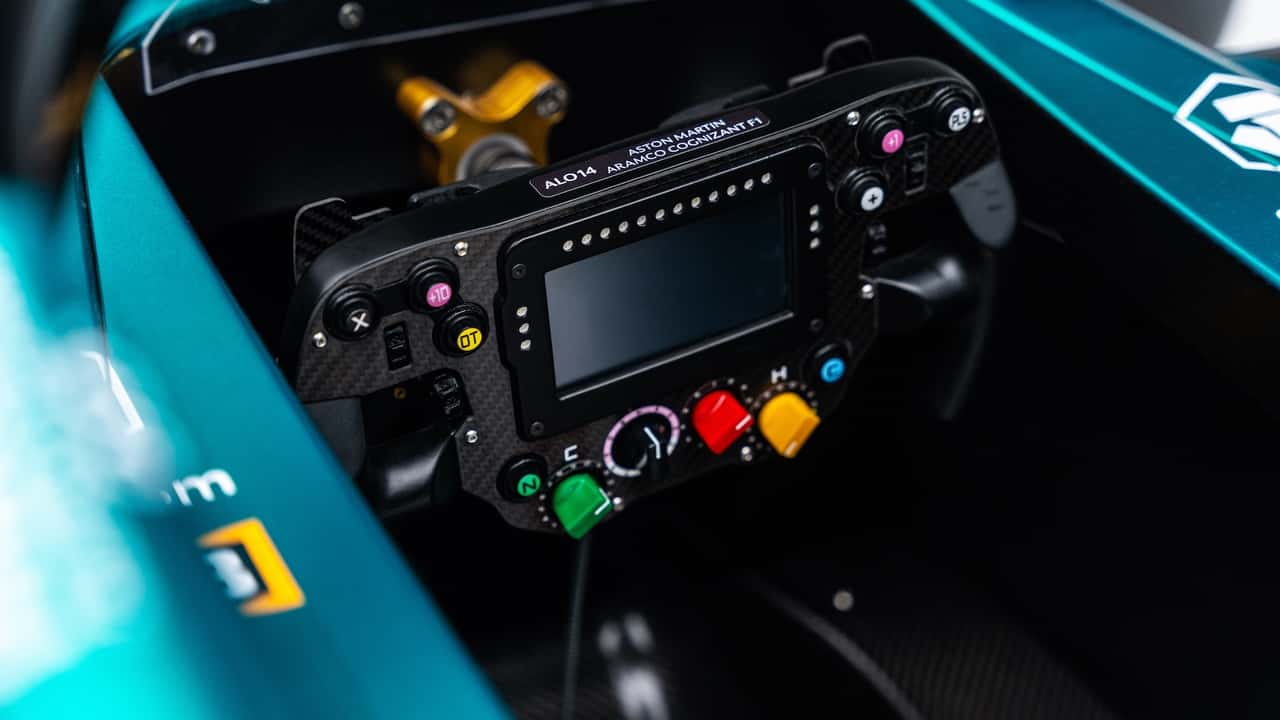
Photo by: Aston Martin
Dan Mihalascu 
By: Dan Mihalascu
Oct 27, at 4:00pm ET
Add Motor1.com as a preferred source in Google
- (https://twitter.com/intent/tweet?url=https%3A%2F%2Fwww.motor1.com%2Ffeatures%2F813368%2Fwhy-f1-cars-have-so-many-buttons-on-the-steering-wheel%2F&text=F1%20Cars%20Have%20A%20Bunch%20Of%20Steering%20Wheel%20Buttons.%20What%20Do%20They%20All%20Do%3F&via=motor1com)
- copy
Share
Comment
Formula 1 steering wheels look more like video game controllers than anything you'd find in a road car. Packed with colorful buttons, rotary dials, shift paddles, and a digital display, they're designed to help drivers control some of the most sophisticated racing machines on the planet.
But with so many controls squeezed into such a small space, what does everything actually do?
The answer goes far beyond changing gears. F1 drivers use their steering wheels to adjust braking behavior, manage electrical energy, fine-tune handling, and communicate with their engineers, all while traveling at speeds exceeding 200 mph. In a sport where milliseconds matter, these controls make a major difference.

Mercedes-AMG F1 W13 Steering Wheel
Photo by: Petronas
An F1 Steering Wheel Is A Control Center
Unlike the steering wheel in a conventional road car, an F1 steering wheel serves as the driver's primary interface with numerous vehicle systems. Every button, switch, and dial has a specific function, allowing drivers to make adjustments without taking their hands far from the grips.
The precise layout varies between teams, and steering wheels are often customized to suit individual drivers. Buttons are distinguished by their colors, labels, and positions, while rotary switches provide access to settings that may need to be adjusted repeatedly throughout a lap.
The complexity reflects the demands of modern Formula 1. Drivers must manage tire performance, braking, power delivery, and race strategy while navigating corners at extraordinary speeds. Putting essential controls directly on the steering wheel allows them to make adjustments quickly without returning to the garage.
What Do All Those Buttons Actually Do?
Although each team has its own design, many steering wheels share several important functions. These controls allow drivers to respond to changing conditions and manage the car throughout a race. Some of the most important include:
- Brake balance: Adjusts the distribution of braking force between the front and rear wheels to help manage stability and prevent tire lock-ups.
- Differential settings: Changes how the rear wheels respond to torque, influencing corner entry, rotation and traction on corner exit.
- Energy management: Helps drivers manage electrical energy deployment and other permitted power-unit settings, depending on the car and regulations.
- Team radio: Allows drivers to communicate with engineers about strategy, car behavior, tire condition and changing track conditions.
- Pit-lane speed limiter: Helps keep the car within the permitted speed limit while traveling through the pit lane.
- Display and menu controls: Give drivers access to vehicle information, warning messages and different control settings.
The key is that these functions aren't necessarily used constantly. Drivers select the adjustments they need for a particular corner, straight or race situation. Learning which control to use, and when, is an essential part of becoming a successful F1 driver.

Why Drivers Need To Adjust Their Cars Mid-Race
An F1 car's behavior changes throughout a race. Tires gradually lose performance, fuel loads decrease, temperatures fluctuate, and track conditions can evolve as more rubber is laid down or rain begins to fall.
A brake balance setting that works well at the beginning of a stint might not be ideal several laps later. Similarly, differential adjustments can help a driver manage how the car turns into a corner or puts its power down on the exit.
Energy management is another crucial consideration. Modern F1 power units combine an internal-combustion engine with electrical systems, and drivers must use the available energy strategically. Deploying more electrical power at one point can affect what remains available later, making energy management an important part of overtaking and defending.
These adjustments are subject to technical regulations, and drivers cannot simply change every aspect of the car whenever they want. However, having access to permitted settings on the steering wheel allows them to respond immediately to changing circumstances rather than waiting for a pit stop.
What Happens If An F1 Driver Presses The Wrong Button?
With so many controls packed into a compact space, selecting the wrong setting can have serious consequences. Drivers learn their steering-wheel layouts through extensive practice, but operating the controls under pressure is still a challenge.
Lewis Hamilton experienced this at the 2021 Azerbaijan Grand Prix. During the restart following a red flag, he accidentally activated a brake-related setting that affected the car's braking behavior. When the race resumed, he locked up heavily into Turn 1 and went down the escape road, losing the opportunity to fight for victory.
The incident illustrated how a small input can have a major effect when everything is happening at racing speed. Teams try to reduce the risk by using distinctive colors, carefully positioning buttons and tailoring the layout to each driver's preferences.
Muscle memory also plays an important role. Drivers repeatedly practice operating the controls until they can make many adjustments without needing to look down at the steering wheel. Even then, they must divide their attention between driving at the limit, monitoring information, and selecting the correct settings.
Williams F1 Cockpit
Photo by: Williams F1
What F1 Fans Say About All Those Buttons
Formula 1 fans have discussed the complexity of steering-wheel controls on Reddit, including in this r/formula1 thread explaining the different buttons. The discussion highlights how the controls allow drivers to manage multiple car systems without taking their hands off the wheel, although layouts and functions vary between teams.
In a discussion on r/F1Technical, fans explored how drivers adjust settings such as brake bias and differential throughout a lap. These changes help drivers respond to different corners and changing car behavior, illustrating why the steering wheel is more than just a device for steering and shifting gears.
Another r/formula1 discussion about steering-wheel controls highlights the engineering behind these designs, while another thread on the subreddit touches on the complexity of operating the controls at racing speed. These discussions underscore the concentration and muscle memory required to manage an F1 car while competing at the limit.
Why F1 Steering Wheels Are So Complex And Expensive
An F1 steering wheel is a highly specialized piece of engineering that must combine electronics, mechanical controls, and a digital display in a lightweight, durable package. It also needs to withstand vibration, heat, and the physical forces experienced during a race.
The design is about more than adding as many buttons as possible. Each control must be easy to reach while the driver is wearing gloves, and its position needs to make sense during high-pressure situations. A poorly placed button could make an adjustment unnecessarily difficult or increase the chance of a mistake.
What do you think?
View
Comments
Teams invest significant effort in refining their steering wheels, with layouts that reflect the driver's preferences and the car's systems. The result is a compact control center that helps drivers manage everything from braking and handling to communication and energy use.
F1 cars have so many steering-wheel buttons because driving at the highest level of motorsport requires constant decision-making. Every adjustment is another opportunity to gain an advantage, protect the tires, or respond to an opponent. The steering wheel is not just how an F1 driver points the car in the right direction; it's one of the most important performance tools they have.
More From Motor101
Why So Many Sports Cars Have Fake Vents
Yes, Your Car Needs Software Updates. Even After You Buy It
These Automakers Have The Strangest Headquarters
How Far Can You Really Drive Without Your Key Fob?
We want your opinion!
What would you like to see on Motor1.com?
Take our 3 minute survey.
- The Motor1.com Team
Share this Story
- (https://twitter.com/intent/tweet?url=https%3A%2F%2Fwww.motor1.com%2Ffeatures%2F813368%2Fwhy-f1-cars-have-so-many-buttons-on-the-steering-wheel%2F&text=F1%20Cars%20Have%20A%20Bunch%20Of%20Steering%20Wheel%20Buttons.%20What%20Do%20They%20All%20Do%3F&via=motor1com)
- copy
GO TO COMMENTS
(
)
Got a tip for us? Email: tips@motor1.com
View all comments ( )
Popular
Audi's Full-Size SUV Was Worth The Wait: Driven
Audi Reveals Which Models It Plans To Build In America
The 15 Best Movie Cars of All Time, Ranked
Mazda Drops The CX-70 For A Two-Row CX-90
latest articles
- F1 Cars Have A Bunch Of Steering Wheel Buttons. What Do They All Do? Oct 27 - Motor101 -
- Koenigsegg Recalled Every CC850 In America. All Seven Of Them Oct 27 - Supercars -
- KTM's Lightweight Supercar Is Finally Coming To America Oct 27 - Supercars -
- How Porsche's US Headquarters Became Home To Marvel's Avengers Oct 27 - Motor101 -
- You Might Finally Be Able To Afford An Aston Martin Vanquish Oct 27 - Why Buy? -
- Turo Now Lets You Rent A Tesla With Full Self-Driving Oct 27 - Autonomous Vehicles -
- Audi's Full-Size SUV Was Worth The Wait: Driven Oct 27 - First Drives -
RECOMMENDED FOR YOU
How Porsche's US Headquarters Became Home To Marvel's Avengers
Koenigsegg Recalled Every CC850 In America. All Seven Of Them
Why So Many Sports Cars Have Fake Vents
KTM's Lightweight Supercar Is Finally Coming To America
Yes, Your Car Needs Software Updates. Even After You Buy It
You Might Finally Be Able To Afford An Aston Martin Vanquish
These Automakers Have The Strangest Headquarters