Home
Lexus
IS
Features
There's No Camera Above Your Car. So How Does Bird's-Eye View Work?
There is no camera hovering over your car. Here's how several tiny cameras create that seemingly impossible bird's-eye view.
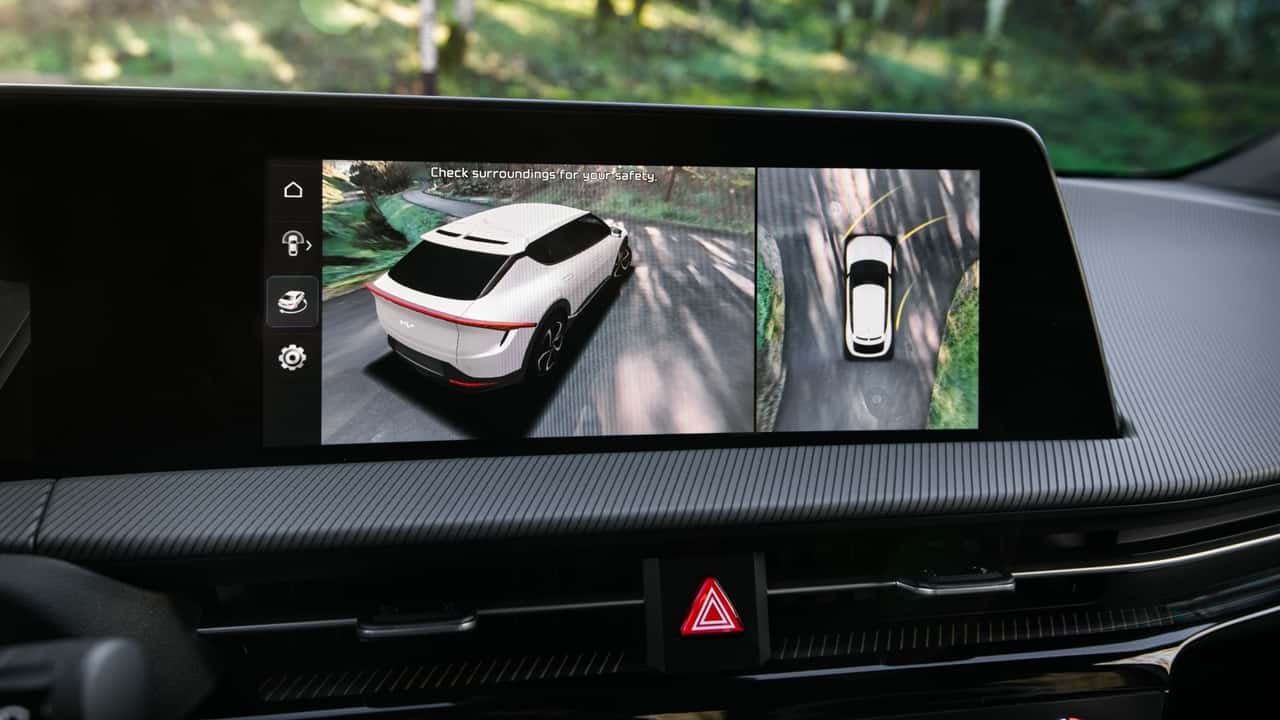
Photo by: Kia
Dan Mihalascu 
By: Dan Mihalascu
Sep 26, at 12:00pm ET
Add Motor1.com as a preferred source in Google
- (https://twitter.com/intent/tweet?url=https%3A%2F%2Fwww.motor1.com%2Ffeatures%2F809550%2Fhow-car-creates-birds-eye-view%2F&text=There%27s%20No%20Camera%20Above%20Your%20Car.%20So%20How%20Does%20Bird%27s-Eye%20View%20Work%3F&via=motor1com)
- copy
Share
Comment
That bird's-eye camera view on your car's infotainment screen can look almost like someone is flying a drone directly above the vehicle. You can see the roof, parking lines, and obstacles surrounding the car as if there were a camera hovering several feet in the air.
But there's no such thing.
The image is created by combining feeds from multiple wide-angle cameras mounted around the vehicle. Software then corrects the distortion, maps the camera images into a common perspective, and stitches them together into the overhead-looking view. It's not magic but a clever combination of tech and software.
No, Your Car Is Not Actually Being Filmed From Above
The first trick is camera placement. A typical surround-view system uses several cameras positioned around the vehicle, often at the front, rear, and underneath the exterior mirrors. Those cameras have wide-angle lenses so they can capture a large portion of the area around the vehicle.
Toyota describes its system as feeding each camera's view into a computer that stitches the images into a single panoramic picture.
Audi's technical documentation, for example, describes four surround cameras mounted around the vehicle and explains that their images are sent to a control module that generates the desired vehicle view. Renault uses a similar approach. Its owner's information describes a bird's-eye view created from cameras mounted in the front bumper, door mirrors and tailgate.
So when you see what looks like a perfectly centered view of the entire car, you're actually looking at a computer-generated perspective assembled from several cameras that are much lower than the viewpoint on the screen suggests.
The Software Does The Magic
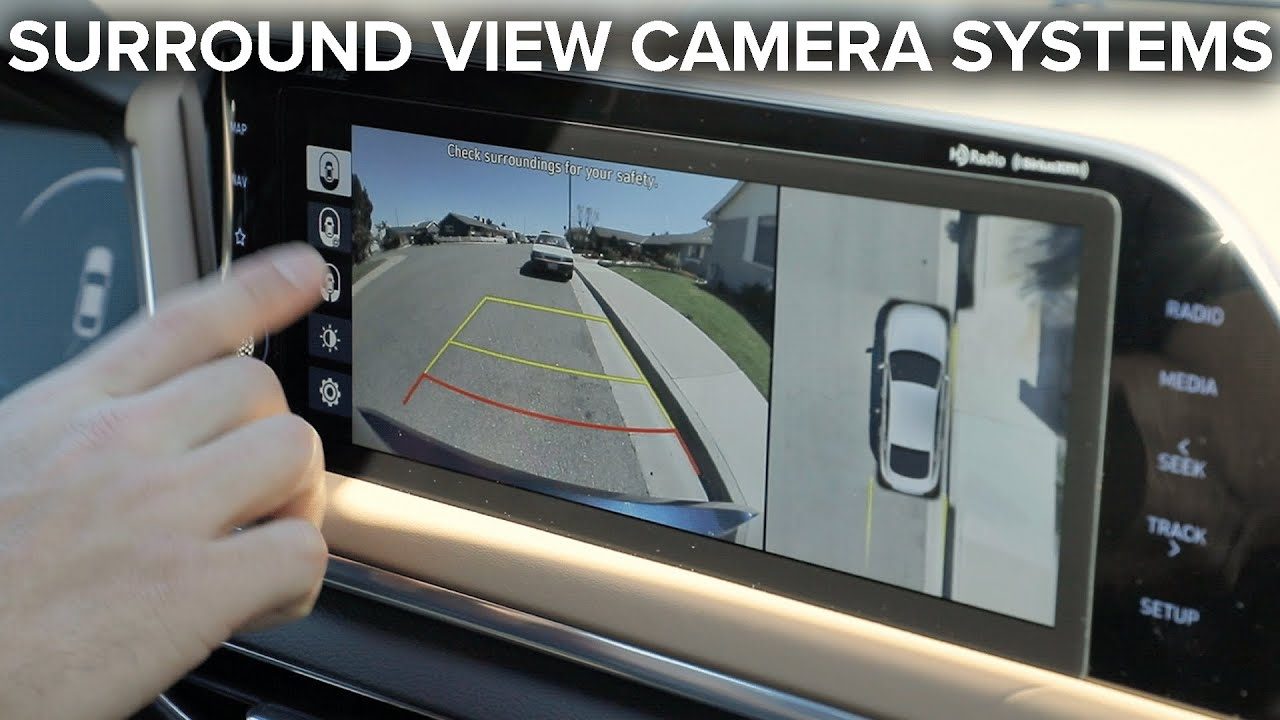
Simply placing four cameras around a car wouldn't produce that seamless overhead image. Each camera sees the world from a different position and angle, and wide-angle lenses introduce significant distortion. That's where image processing comes in.
The system knows the precise position and orientation of each camera. It can transform the individual images into a common coordinate system, correct their distortion and align overlapping portions of the feeds. The resulting images are then stitched together to create the impression of one continuous view.
GM recently explained how its newer camera systems handle this process, describing a combination of camera calibration, computer vision, 3D geometry and real-time processing. GM says its Top-Down View projects live camera data into a shared world coordinate system before overlapping areas are stitched together and visually blended.
That's also why the image can sometimes look a little strange around the edges. The system is not looking down from an actual camera. It's mathematically transforming several perspectives into something that resembles a top-down view.
Here's What Your Car Is Actually Doing
The bird's-eye image looks simple on the screen, but several things are happening behind the scenes:
- Multiple cameras capture the surroundings: Wide-angle cameras around the vehicle provide overlapping views.
- The system corrects lens distortion: Fisheye-like images need to be transformed before they can be combined cleanly.
- Camera positions are calibrated: The computer needs to know exactly where each camera is mounted and which direction it faces.
- Images are projected into a common perspective: The individual camera feeds are transformed so they line up spatially.
- Overlapping images are stitched: Software combines the feeds into one continuous representation.
- The vehicle itself is inserted into the display: The familiar car graphic or overhead vehicle image helps create the impression that you're looking straight down at your actual car.
- Guidelines and warnings can be added: Parking lines, steering trajectories and proximity graphics can be rendered over the camera image.
Toyota says its Bird's Eye View system can also provide different views, including a conventional backup-camera perspective and a curb view designed to help drivers avoid scraping wheels.
It's Not A Perfect View Of Everything Around You
There's one important catch: the bird's-eye view is not literally seeing everything.
The cameras have blind spots, objects can be distorted by the perspective transformation and anything that is not visible to the cameras can't magically appear on the screen. Renault specifically warns that objects above the cameras may not be displayed and that objects in the bird's-eye view can appear farther away than they really are.
NHTSA has also discussed the limitations of surround-camera systems, noting that these systems provide a near-360-degree view using multiple cameras but should be considered an aid rather than a replacement for the driver's own observation.
That's why automakers generally describe the feature as a parking or maneuvering aid. It can make it much easier to spot curbs, parking lines, and nearby obstacles, but drivers still need to look around the vehicle themselves.
Owners Are Fascinated By How A 360-Degree Camera Works
Owners have asked the same question for years: how can a car show a view from directly above when there is no camera on the roof? In a popular r/explainlikeimfive discussion, commenters explained that cameras mounted around the vehicle—often underneath the side mirrors along with front and rear cameras—capture overlapping views that software stitches together into the overhead-looking image.
A more technical 2024 discussion in r/computervision shows just how complicated that stitching can be. One user was experimenting with four fisheye cameras mounted around a car and trying to create a surround view, with commenters discussing lens distortion, calibration, and how the camera images need to be transformed before they can be stitched together cleanly.
Your Car Is Basically Building A Virtual Camera In Real Time
The coolest part of a 360-degree camera system is that the car is not simply showing you four camera feeds; it's reconstructing a new viewpoint from those feeds.
Think of it like taking four photographs from different corners of a room and using software to flatten and combine them into one overhead map. Your car does something considerably more sophisticated, continuously processing live images while the vehicle moves.
What do you think?
View
Comments
Modern systems can go even further. GM says its camera architecture can generate top-down views and other perspective-based displays using a shared geometric model, while Audi has offered systems with selectable viewing angles and even 3D representations.
So the next time your car gives you that seemingly impossible view from directly above, remember: there's no tiny camera hiding on the roof. Your car is doing some clever geometry and image processing to make several cameras look like one camera that is not actually there.
More From Motor101
 Why A Bigger Engine Doesn't Always Make More Power
Your Car Knows When You're Getting Tired
The Clever Technology That Makes Your Windshield Wipers Start By Themselves
Your Old Car Battery Doesn't Get Thrown Away At O'Reilly
We want your opinion!
What would you like to see on Motor1.com?
Take our 3 minute survey.
- The Motor1.com Team
Share this Story
- (https://twitter.com/intent/tweet?url=https%3A%2F%2Fwww.motor1.com%2Ffeatures%2F809550%2Fhow-car-creates-birds-eye-view%2F&text=There%27s%20No%20Camera%20Above%20Your%20Car.%20So%20How%20Does%20Bird%27s-Eye%20View%20Work%3F&via=motor1com)
- copy
GO TO COMMENTS
(
)
Got a tip for us? Email: tips@motor1.com
View all comments ( )
Popular
The Corvette Spent 70 Years Building Its Legacy. There's No Reason To Dilute It Now
Scout Has 212,000 Reservations. Here's What Those Drivers Own
Subaru Wants To Save The Gas Engine With A More Efficient Boxer
Honda Secretly Showed Dealers Its Future Models, Including The Element. Here's What They Said
Scout Is Finally Building Real Vehicles At Its $2-Billion Factory
Latest Stories
- Dodge Gets A New CEO While Tim Kuniskis Gets A Promotion Nov 12 - Industry -
- Scout's New Factory Can Build A Truck Every 88 Seconds Nov 12 - Manufacturing / Production -
- Not All Gas Engines Work The Same. Here's What Makes Them Different Nov 12 - Motor101 -
- Scout Has 212,000 Reservations. Here's What Those Drivers Own Nov 12 - Manufacturing / Production -
- Want A New Pickup With A Manual? There's Still Only One Choice Nov 12 - Manufacturing / Production -
- The Corvette Spent 70 Years Building Its Legacy. There's No Reason To Dilute It Now Nov 12 - State of Motion -
- Don't Buy A Blackwing. This 640-HP Cadillac Costs Thousands Less Nov 12 - Why Buy? -
RECOMMENDED FOR YOU
16 Cars You Can Still Buy With A Naturally Aspirated V6
Dodge Gets A New CEO While Tim Kuniskis Gets A Promotion
Is Body-On-Frame Really Better For Off-Roading?
Scout's New Factory Can Build A Truck Every 88 Seconds
Used EV Prices Were Plummeting. Now They're More Expensive Than Gas Cars
Not All Gas Engines Work The Same. Here's What Makes Them Different
The New Lexus LFA Inches Closer To Production With Fresh Spy Photos