Home
Volkswagen
News
Volkswagen Fusca Safari (1972): The Beetle granddaddy of the Polo Robust
The background to the off-road crawler was the construction of the Transamazonica motorway


By: Jason Vogel
Published by: Brian Potter
Mar 9, 2024 at 6:55am ET
Add Motor1.com as a preferred source in Google
- (https://twitter.com/intent/tweet?url=https%3A%2F%2Fwww.motor1.com%2Fnews%2F711792%2Fvolkswagen-fusca-safari-1972-beetle%2F&text=Volkswagen%20Fusca%20Safari%20%281972%29%3A%20The%20Beetle%20granddaddy%20of%20the%20Polo%20Robust&via=motor1com)
- copy
Share
Comment
Volkswagen has presented the Polo Robust in Brazil, a version which, according to the manufacturer, was "developed and tested with customers from the agricultural sector". This Polo for use in the countryside can boast a more robust look and, above all, a higher chassis.
This Polo Robust is reminiscent of a concept that the company trialled in Brazil in 1972: the VW Safari, a kind of off-road version of the Fusca (popularly known as Fuscão), also known as the Beetle. Three of these prototypes were even demonstrated to the specialised press and the target audience (in the truest sense of the word as field research).
Gallery: Automotive history: Fuscão Safari, the grandfather of the Polo Robust

8

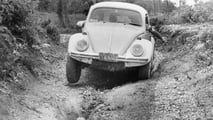
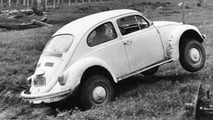
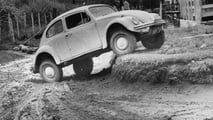
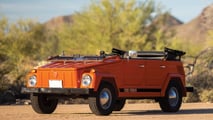
The Safari was to be sold to state institutions such as the National Institute for Colonisation and Agrarian Reform (Incra) and the National Roads Department (DNER) in order to reach regions where earthmoving machines did not yet exist.
One of the safaris led to the construction sites of the Transamazonica, a 4,000 km long trunk road across Brazil that was built between 1970 and 1973 - after all, the construction companies were also potential customers. At the behest of the military dictatorship at the time, thousands of settlers were sent from the south and north-east to the Amazon region.
Every giant Brazil nut tree felled was propagated as a victory in the fight against the jungle. The forest was the "Green Hell" and had to be conquered with chainsaws, tractors and (why not?) beetles. Volkswagen even made an advert for it.
The Jeep Kübelwagen (Type 82) and the Amphibious Schwimmwagen (Type 166)
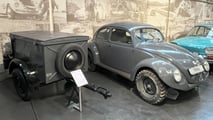
The idea of an off-road Beetle was not new: the Kübelwagen (Type 82), the Schwimmwagen (Type 166) and the Kommandeurswagen (Type 87), which were used by German troops both in the North African desert and on the icy Eastern Front, already existed in the days of the KdF-Wagen during the Second World War.
But back to Brazil in the 1970s: the three prototypes of the so-called Fuscão Safari were built almost exclusively with "off-the-shelf parts" that were already available for other models from the Group.
With front suspension from the Kombi 1500 (aka VW Bus T1), the car had a ground clearance of 21.5 centimetres - 6 cm more than the normal Fuscão. The rear suspension came from the old Kombi 1200 (pre-1967), with the gearboxes mounted on the wheel hubs. There was also a cable-controlled differential lock (and a lever on the centre tunnel, just behind the handbrake). A red light in the centre of the dashboard indicated to the driver when the lock was engaged.
The smooth floor helped to overcome bogs. Even if something went wrong, it was easy to bail out a car weighing just 885 kilos.
The engine was the same boxer engine with 1,493 cc and 52 PS (DIN) as the normal Fuscão, but the differential had a shorter ratio. Together with the gearboxes, this gave the car plenty of power to get out of the bog, but limited its top speed to around 110 km/h (68 mph). The wheels were combination wheels (14 inch) fitted with 7.00-14 off-road tyres. There was also a steel undercarriage guard at the front and reinforcements for the jack mounts.
Inside, the biggest difference was that the rear seat could be converted into a load bed. Although the Safari was equipped with the engine, rear bonnet and lights of the Fuscão, the finish was simplified like the standard VW 1300, with painted details instead of chrome.
The prototypes travelled around Brazil for tests and demonstrations. In Minas Gerais, for example, they spent a week in the municipality of Santa Luzia in the Belo Horizonte metropolitan region, where they were tested in the yard of a local VW dealer.
Test driver João Soares showed what the car can do at the wheel: He climbed up ravines, jumped five metres into the air and let the car roll in the middle of the forest. The onlookers were amazed at how easily the Fuscão overcame steep hills and obstacles, and all this with more comfort and economy than a Jeep CJ-5 (manufactured by Ford in Brazil at the time).
Long before there was talk of "crossovers" and "adventure versions", the VW Safari occupied an intermediate position between normal cars and jeeps. Its price was to be around Cr$ 2,000 above the Cr$ 18,000 that was charged for a conventional Fusca at the time.
What do you think?
View
Comments
However, the time of market launch was uncertain. At the time of the tests, it was rumoured that this version would come onto the market if the research results showed a minimum demand of one thousand units per year. This apparently did not materialise, as the Safari did not make it past the design phase.
The unknown VW models from Brazil:
Italy vs Brazil: The two faces of Fiat
Abarth Pulse is brand's first hot crossover but it's only for Brazil
Some time later, Volkswagen even tested its Type 181 "Thing" in Brazil (which was produced in Mexico, where it was called ... Safari!), but this model also failed to reach market maturity in Brazil. Those who owned a regular VW Beetle or Kombi felt that their cars were more than enough to tackle mud, dirt, sand and scrub without having to pay extra for off-road preparation.
We want your opinion!
What would you like to see on Motor1.com?
Take our 3 minute survey.
- The Motor1.com Team
Share this Story
- (https://twitter.com/intent/tweet?url=https%3A%2F%2Fwww.motor1.com%2Fnews%2F711792%2Fvolkswagen-fusca-safari-1972-beetle%2F&text=Volkswagen%20Fusca%20Safari%20%281972%29%3A%20The%20Beetle%20granddaddy%20of%20the%20Polo%20Robust&via=motor1com)
- copy
GO TO COMMENTS
(
)
Got a tip for us? Email: tips@motor1.com
View all comments ( )
Popular
The Rotary Engine Should Be Everywhere. Why Isn't It?
The 2027 BMW X5 Is Hugely Improved Where It Matters Most: Driven
Honda's Mitsubishi-Based Truck Is Official, Coming In 2028
The BMW iX5 Makes A Strong Case Against The Gas X5: Driven
Volkswagen Wanted An Electric Bugatti Tourbillon, But Mate Rimac Pushed For A V16 Engine
latest articles
- Why Do Some Semi Truck Tires Look Like They're Not Touching The Ground? Oct 22 - Motor101 -
- ‘This Should Be On The Dealership’: Woman Buys VW at Hyundai Dealership. Then Her Mechanic Finds A Shocking Problem No One Caught Oct 22 - Trending -
- The New Lexus LFA Inches Closer To Production With Fresh Spy Photos Oct 22 - Spy Shots -
- Remember Aston Martin's Weird Little City Car? There's A Reason It Existed Oct 22 - Motor101 -
- The BMW iX5 Makes A Strong Case Against The Gas X5: Driven Oct 22 - First Drives -
- The 2027 BMW X5 Is Hugely Improved Where It Matters Most: Driven Oct 22 - First Drives -
- Ford Explains Why Naming Cars Is So Hard: 'Everyone Has An Opinion' Oct 22 - Official -
RECOMMENDED FOR YOU
Volkswagen Wanted An Electric Bugatti Tourbillon, But Mate Rimac Pushed For A V16 Engine
The New Lexus LFA Inches Closer To Production With Fresh Spy Photos
The Strange Reason The Golf GTI Had A Golf Ball Shifter
Remember Aston Martin's Weird Little City Car? There's A Reason It Existed
12 Cars With Names That Make Absolutely No Sense
The BMW iX5 Makes A Strong Case Against The Gas X5: Driven
This German City Exists Because Of Volkswagen