Home
News
Trending
'Don't Waste Money:' Expert Shares Which Fuel Additive to Use Based on Your Car's Problem. Then He Shares How to Use It
'They have different value for different drivers.'
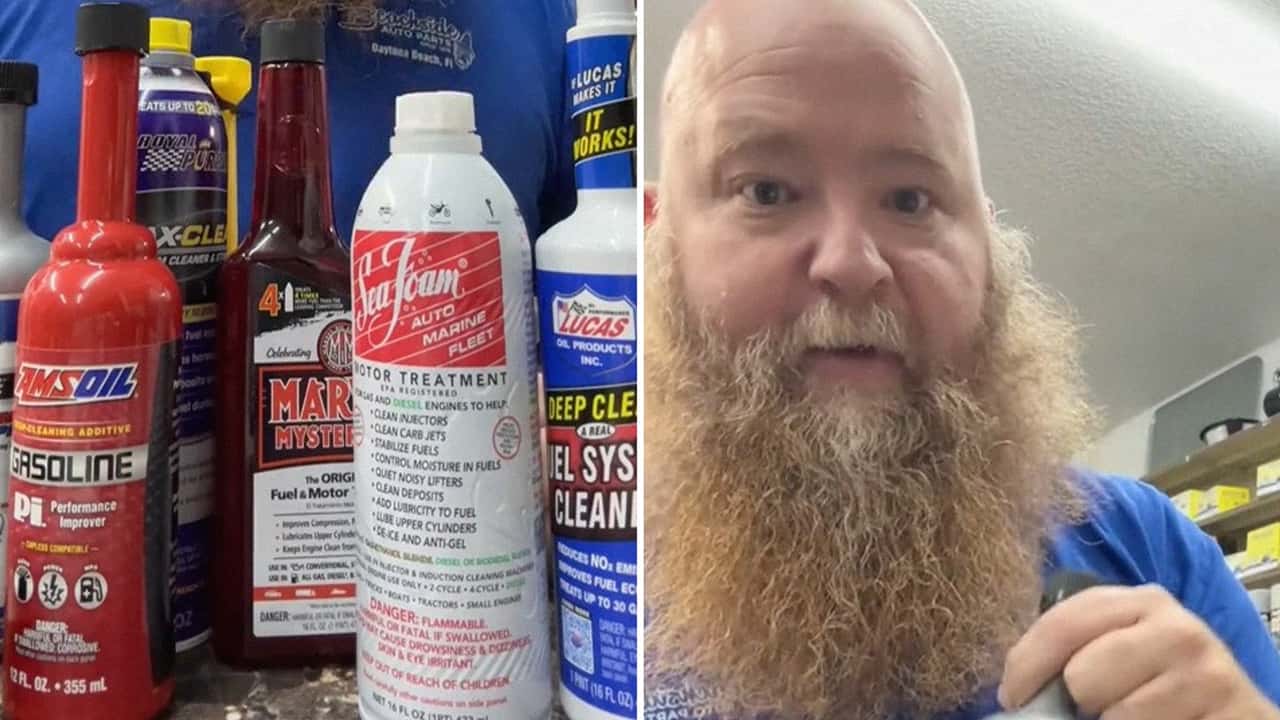
Photo by: @chrisfrombeachside
Chad Swiatecki 
By: Chad Swiatecki
Jun 20, 2025 at 9:00pm ET
Add Motor1.com as a preferred source in Google
- (https://twitter.com/intent/tweet?url=https%3A%2F%2Fwww.motor1.com%2Fnews%2F763268%2Fexperts-reveals-right-fuel-additive%2F&text=%27Don%27t%20Waste%20Money%3A%27%20Expert%20Shares%20Which%20Fuel%20Additive%20to%20Use%20Based%20on%20Your%20Car%27s%20Problem.%20Then%20He%20Shares%20How%20to%20Use%20It&via=motor1com)
- copy
Share
Comment
Fuel additive fatigue is real.
With dozens of brightly labeled bottles lining the aisles of AutoZone and Pep Boys stores everywhere—promising smoother rides, better mileage, or cleaner engines—picking the right one can feel like a guessing game. A viral TikTok video cuts through the noise, offering a symptom-based guide to choosing the right additive without the hype.
Chris Stone (@chrisfrombeachside), vice president of Beachside Auto Parts in Daytona, Florida, says he recorded the video to help unfamiliar motorists make the best choice when selecting from the dizzying array of products promising to turn their vehicle into a fine-tuned machine.
Stone's advice resonated with his audience. Hundreds shared their preferred additives, asked for additional information, and wrote comments thanking him.
As of this writing, his post has been viewed 1.2 million times.
How Do You Choose and Use the Right Additive?
Between bold claims, cryptic acronyms, and engine diagrams that look like they belong in a textbook, it’s easy to feel like you're flying blind. Instead of hype, Stone offers plain-language advice: Choose the product based on your symptoms, like hesitation, rough idle, ticking, or knocking, and you’ll have a better shot at actually solving the issue.
Trending Now
If your car is sluggish off the line, Stone advises trying AMSOIL P.I. Burning oil at startup? Marvel Mystery Oil still has a place in the modern garage, according to Stone. And for engines showing signs of knock or ping — especially in turbocharged vehicles — he recommends Royal Purple Max Clean to smooth out combustion.
He doesn’t stop at recommending products. Stone shares a useful technique for effectively using a fuel additive.
He says that for most fuel system cleaners, you should wait until your tank is under a quarter full, pour the additive in, and then drive aggressively (within legal limits) to circulate the treatment effectively before refueling. This helps the cleaner come into more direct contact with injectors and combustion surfaces, increasing its effectiveness.
Of course, fuel additives aren’t a magic fix. If you’ve got a check engine light or ongoing performance issues, it’s best to get a professional diagnostic. But for routine maintenance, especially with older or high-mileage vehicles, the right additive can play a useful role in keeping your engine running smoothly.
When Should You Use an Additive?
Most mechanics and product manufacturers recommend using a treatment every 3,000 to 5,000 miles. However, that interval can vary depending on fuel quality, engine design, and driving habits. High-mileage vehicles, cars frequently driven in stop-and-go traffic, or those using lower-quality fuel may benefit from more frequent use.
Drivers who use high-grade gasoline may find they need additives less often.
This doesn’t necessarily mean you shouldn’t use a fuel additive if you always buy premium.
While many premium fuels contain detergents to keep injectors clean, dedicated fuel system cleaners tend to offer higher concentrations of active ingredients like PEA (polyetheramine), which can clean deeper into the intake valves and combustion chamber.
This can be especially helpful for older engines or cars with unknown maintenance histories, where carbon buildup may already affect performance.
It’s also important to note that compatibility matters.
Not every fuel additive is designed for every engine type. Some are explicitly formulated for gasoline engines, while others are safe for diesels or compatible with ethanol-blended fuels. Hybrids and direct injection engines may also have different needs or tolerances. Always check the label for your engine type, and avoid assuming that any additive is one-size-fits-all. The wrong product can reduce effectiveness at best and cause damage at worst.
Another point of confusion for many DIY car owners is whether it’s okay to mix multiple additives in the same tank. The short answer is no, unless the manufacturer explicitly allows it.
Most companies advise using just one additive per treatment cycle to avoid unintended chemical interactions or dilution of key ingredients. It’s best to wait until your tank is nearly empty, add the recommended dose, and then refill, following label instructions closely to ensure safe and effective results.
What do you think?
View
Comments
“There's a lot of marketing out there, but nobody knows exactly what's good for what,” Stone told Motor1 over the phone.
“They all claim the same things, but they're all made differently and they have different values for different drivers.”
More From Motor1
 Here's Why Your Fuel Mixture Is Just as Important as Your Oil Mixture
It's Incredible How Badly Low-Quality Fuel Can Damage Your Engine
‘That’s Obviously a Villain Car:' Man Spots Honda Fit in Parking Lot. Then He Notices the Back
We want your opinion!
What would you like to see on Motor1.com?
Take our 3 minute survey.
- The Motor1.com Team
Share this Story
- (https://twitter.com/intent/tweet?url=https%3A%2F%2Fwww.motor1.com%2Fnews%2F763268%2Fexperts-reveals-right-fuel-additive%2F&text=%27Don%27t%20Waste%20Money%3A%27%20Expert%20Shares%20Which%20Fuel%20Additive%20to%20Use%20Based%20on%20Your%20Car%27s%20Problem.%20Then%20He%20Shares%20How%20to%20Use%20It&via=motor1com)
- copy
GO TO COMMENTS
(
)
Got a tip for us? Email: tips@motor1.com
View all comments ( )
Popular
12 Cars With Names That Make Absolutely No Sense
BMW Kept This Hatchback A Secret For Decades
Bugatti Restores One-Off Veyron With A Mirror-Like Aluminum Body
The Gas BMW M3 Isn't Dead: Next-Gen Prototype Roars
latest articles
- Driver Goes Through Car Wash With Full Truck Bed—Then He Learns The Hard Way Why You Shouldn't Do That Oct 20 - Trending -
- Every Rolls-Royce Has A Hidden Feature Most People Don't Know About Oct 20 - Motor101 -
- Subaru Built A 510-HP Electric Wagon Without Toyota's Help Oct 20 - Official -
- The Strange Reason The Golf GTI Had A Golf Ball Shifter Oct 20 - Motor101 -
- Photos: Porsche's Mission S Concept Takes Over New York City Oct 20 - Design -
- The 2027 Honda Passport TrailSport Looks Noticeably Taller Next To Last Year's Model Oct 20 - Off-Road -
- 12 Cars With Names That Make Absolutely No Sense Oct 20 - Lists -
RECOMMENDED FOR YOU
Driver Goes Through Car Wash With Full Truck Bed—Then He Learns The Hard Way Why You Shouldn't Do That
Every Rolls-Royce Has A Hidden Feature Most People Don't Know About
Cadillac Driver Is Fed Up With Auto Stop. Then She Buys A $9 Item On Amazon To Disable It
Subaru Built A 510-HP Electric Wagon Without Toyota's Help
Woman Buys A Tahoe. Then Her Chevrolet Dealer Calls Her A Week Later And Says She Owes $4,200
The Strange Reason The Golf GTI Had A Golf Ball Shifter
Man Gets Into New Car. Then He Tries To Shift Into Drive—And Crashes Out: 'Who Is Telling Car Manufacturers That?'