Home
News
Lifestyle
Holidays with a roof tent: What drivers should look out for
Overloading can be expensive and dangerous
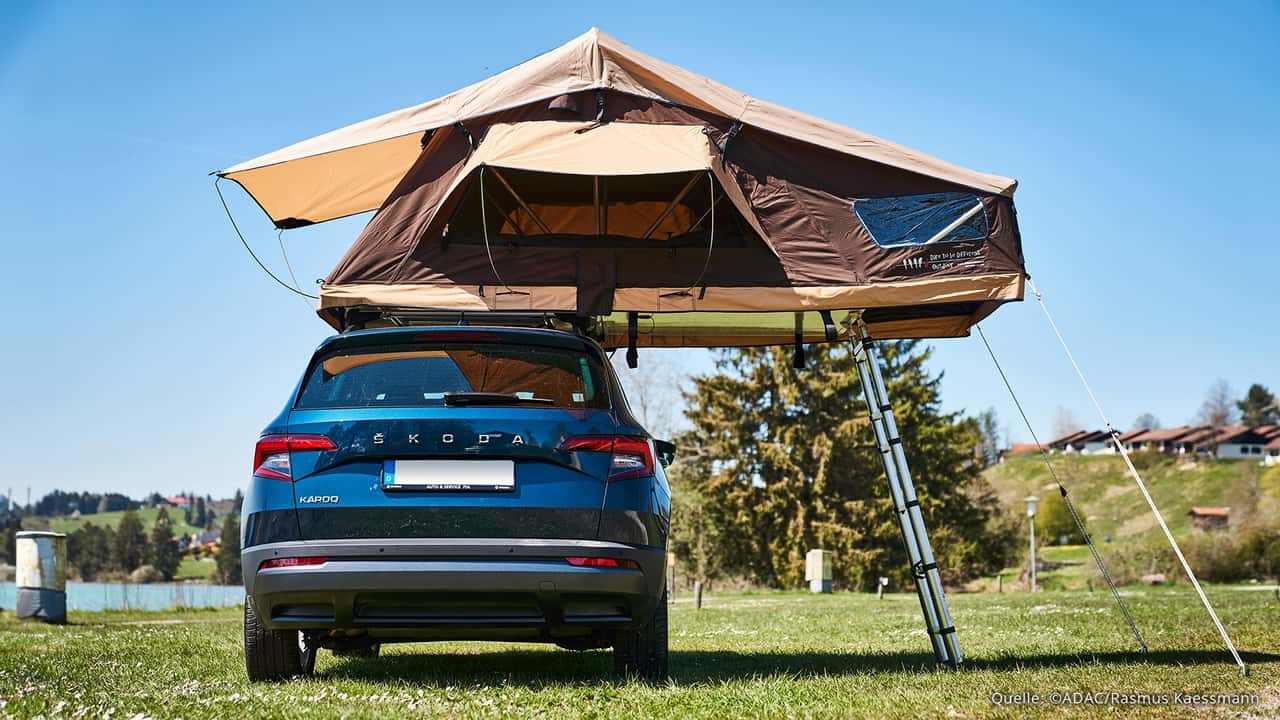
Photo by: ADAC e. V.

By: Roland Hildebrandt
Published by: Brian Potter
Jul 25, 2024 at 7:16am ET
Add Motor1.com as a preferred source in Google
- (https://twitter.com/intent/tweet?url=https%3A%2F%2Fwww.motor1.com%2Fnews%2F727868%2Fcar-rooftop-tent-guide-tips%2F&text=Holidays%20with%20a%20roof%20tent%3A%20What%20drivers%20should%20look%20out%20for&via=motor1com)
- copy
Share
Comment
Camping in a roof tent on your own vehicle is becoming increasingly popular. However, a tent that is too heavy on the roof jeopardises driving safety. Europe's largest automobile association, ADAC, points out that the roof load specified by the vehicle manufacturer must not be exceeded while driving. A roof load that is too high has a negative effect on the vehicle's centre of gravity and can increase the risk of skidding and tipping.
The permissible roof load varies depending on the vehicle type and is generally between 50 kilograms for small cars and up to 200 kilograms for buses and vans. This information can be found in the vehicle's operating instructions, but not in the vehicle registration document.
Gallery: Kia Sportage with roof tent in the test

15


As roof tents are not permanently attached to the vehicle and can be removed, they are regarded as cargo. The permissible total weight of the vehicle must therefore also be observed. This can be found in the vehicle registration certificate (registration certificate part I) under point F.2. In addition, the permissible axle loads of the front axle (8.1) and the rear axle (8.2) must not be exceeded.
In Germany, overloading is penalised with a fine of up to €235 (approx. £200). The fines can be even higher abroad. In addition, an overloaded vehicle is often not allowed to continue driving until the permissible total weight is no longer exceeded.
What do you think?
View
Comments
There is no legal regulation on the maximum speed with a roof load in Germany. Most manufacturers of roof tents recommend a maximum speed of 60 to 80 mph. The ADAC advises adhering to the manufacturer's specifications and adjusting the speed, as the roof load reduces driving stability and increases the braking distance. In addition, the higher air resistance increases fuel and power consumption. The roof tent should therefore only be mounted on the car roof during the holiday season.
When camping in a roof tent, the load can generally be higher than the maximum roof load specified for driving. Many roof tents also have additional supports or a load-bearing ladder to increase the floor space when camping overnight - they also reduce the load on the vehicle. However, the user bears the risk of any damage to the vehicle roof if the maximum roof load is exceeded.
More about the roof tent:
Porsche CEO camped in £4,635 roof tent on top of 911 Turbo S at Le Mans
UK: Skoda Enyaq one-off camper revealed with roof tent and extendable bed
Lifted Rolls-Royce Cullinan overlander has roof-top tent and a snorkel
Smart Car gets overlanding conversion with roof tent, stove, and sink
Source: ADAC
We want your opinion!
What would you like to see on Motor1.com?
Take our 3 minute survey.
- The Motor1.com Team
Share this Story
- (https://twitter.com/intent/tweet?url=https%3A%2F%2Fwww.motor1.com%2Fnews%2F727868%2Fcar-rooftop-tent-guide-tips%2F&text=Holidays%20with%20a%20roof%20tent%3A%20What%20drivers%20should%20look%20out%20for&via=motor1com)
- copy
GO TO COMMENTS
(
)
Got a tip for us? Email: tips@motor1.com
View all comments ( )
Popular
12 Cars With Names That Make Absolutely No Sense
BMW Kept This Hatchback A Secret For Decades
Bugatti Restores One-Off Veyron With A Mirror-Like Aluminum Body
The Gas BMW M3 Isn't Dead: Next-Gen Prototype Roars
latest articles
- Driver Goes Through Car Wash With Full Truck Bed—Then He Learns The Hard Way Why You Shouldn't Do That Oct 20 - Trending -
- Every Rolls-Royce Has A Hidden Feature Most People Don't Know About Oct 20 - Motor101 -
- Subaru Built A 510-HP Electric Wagon Without Toyota's Help Oct 20 - Official -
- The Strange Reason The Golf GTI Had A Golf Ball Shifter Oct 20 - Motor101 -
- Photos: Porsche's Mission S Concept Takes Over New York City Oct 20 - Design -
- The 2027 Honda Passport TrailSport Looks Noticeably Taller Next To Last Year's Model Oct 20 - Off-Road -
- 12 Cars With Names That Make Absolutely No Sense Oct 20 - Lists -
RECOMMENDED FOR YOU
Porsche Design Turns Car Storage Into A Members Only Country Club
Subaru Built A 510-HP Electric Wagon Without Toyota's Help
Bugatti Is Building A 60-Story Luxury Tower In Miami
The Strange Reason The Golf GTI Had A Golf Ball Shifter
Rolls-Royce's First Abalone Phantom Took Nine Months To Make
Photos: Porsche's Mission S Concept Takes Over New York City
This Porsche 911 GT3 RS Became A Color-Matched Carbon Bike