Home
Mazda
MX-5 Miata
News
Mazda PE-VPS, the refined 2.0 SKYACTIV-G engine for the MX-5
Fitted to several models, including the small Japanese roadster, this naturally aspirated petrol engine delivers smoothness and efficiency.


By: Filippo Einaudi
Published by: Brian Potter
Oct 28, 2023 at 1:00am ET
Add Motor1.com as a preferred source in Google
- (https://twitter.com/intent/tweet?url=https%3A%2F%2Fwww.motor1.com%2Fnews%2F693621%2Fmazda-skyactive-g-engine-mx5%2F&text=Mazda%20PE-VPS%2C%20the%20refined%202.0%20SKYACTIV-G%20engine%20for%20the%20MX-5&via=motor1com)
- copy
Share
Comment
In times of downsizing, Mazda did not follow the mainstream trend and, in fact, applied the opposite philosophy: increasing the displacement of its engines (right sizing). Such is the case of the MX-5, which began its career with a 1.6-litre engine, and now, in its fourth instalment, adopts a 2.0-litre block from the SKYACTIV family.
In this article we'll take a look at this powertrain range, which has always been characterised by a good dose of power (at high revs) and good efficiency. Mazda seems to have got it right, as it is still used in its current models after more than ten years of operation.
The SKYACTIV concept
The SKYACTIV engine story began around 2010. Mazda, having returned as an independent brand after leaving Ford's orbit, was in the midst of an ambitious relaunch to reassert its own identity, but at this delicate stage it could not invest heavily in the development of entirely new engines and platforms designed from the ground up.
For this reason, a complex technical programme called SKYACTIV was launched which, in the case of the engines, consisted of evolving and improving the previous L-series units, making them more efficient and compliant with emissions standards. The SKYACTIV-G petrol and SKYACTIV-D diesel engines were born.
.

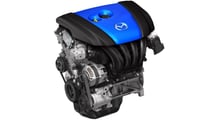
Mazda 2.0 SKYACTIV-G engine in transverse position.
The SKYACTIV petrol programme included, among other things, the adoption of direct injection (first introduced on the 2.3-litre engine), an upgraded exhaust system and an increased compression ratio from 11:1 to 14:1 to improve combustion and reduce harmful substances. For the turbodiesels, the opposite was true and the ratio was reduced from 16.5-17:1 to approximately 14:1.
There was also a redesign of the intake and exhaust systems, a new piston head design and multi-hole injectors. The blocks were all-aluminium, with twin overhead camshafts and VVT variable valve timing, but without turbocharging.
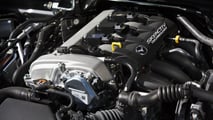
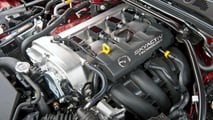
SKYACTIV-G 2.0 engine in the Mazda MX-5 RF.
Virtue in the middle ground
Between 2011 and 2012, when they debuted, there were three SKYACTIV-Gs, a 1.3-litre, a 2.0-litre and a 2.5-litre. The mid-displacement, labelled PE-VPS, had a bore and stroke of 83.5 x 91.2 mm, as well as a displacement of 1,998 cm3 and developed slightly less power than its predecessor, with 158 bhp versus more than 168 bhp, but with a better balance of efficiency and emissions.
It was the most widely available engine, powering compacts, saloons and SUVs, from the Mazda3, Mazda5 and Mazda6, to the CX-3 and CX-5, and then the CX-30, plus other models not sold in Europe.
SKYACTIV-G logo.
The fourth-generation MX-5 debuted in 2016, along with the 118 bhp 1.5 SKYACTIV-G powertrain. The 2.0-litre engine, which could be mated to either a six-speed manual or automatic gearbox, claimed 158 bhp at 6,800 rpm and 200 Nm at 4,600 revs.
These were figures that allowed the roadster to go from 0-100 km/h in 7.3 seconds, 7.5 for the RF retractable hardtop version, which weighed a little more but was still under 1,100 kg.
Two Other Historic Engines:
Mitsubishi 4N1: a good diesel engine with variable valve timing
BMW M500, the first aluminium V8s born 70 years ago
On the MX-5 alone, in 2019 the 2.0-litre engine underwent an upgrade focusing on intake and exhaust, injection pressure and cylinder treatment, which boosted power to 181 bhp at 7,500 rpm and torque to 205 Nm. As a result, the two-seater cut 0-60 to 6.5 seconds.
What do you think?
View
Comments
To top it off, the 2.0-litre SKYACTIV-G forms the basis of the sophisticated SKYACTIV-X, which introduced complex variable compression technology designed to further improve efficiency. It will be offered from 2019 in SUVs and saloons, starting with the new CX-30.
Undoubtedly, everyone who has tested these engines praises their smoothness and purity of drivability, as you need to maintain a rather high engine speed to get the most out of them, which means you need to be more focused behind the wheel. Good for Mazda!
Gallery: Mazda Skyactiv-G 2.0 PE-VPS engine
Mazda
- Make: Mazda
- Model:
- URL: Mazda
4
We want your opinion!
What would you like to see on Motor1.com?
Take our 3 minute survey.
- The Motor1.com Team
Share this Story
- (https://twitter.com/intent/tweet?url=https%3A%2F%2Fwww.motor1.com%2Fnews%2F693621%2Fmazda-skyactive-g-engine-mx5%2F&text=Mazda%20PE-VPS%2C%20the%20refined%202.0%20SKYACTIV-G%20engine%20for%20the%20MX-5&via=motor1com)
- copy
GO TO COMMENTS
(
)
Got a tip for us? Email: tips@motor1.com
View all comments ( )
Popular
Driven: The New Audi A2 Is Proof Small Cars Still Make Sense
Aston Martin Is Taking Its Call Of Duty Off-Roader To Dakar
Ford Will Sell The Dark Horse SC's V8 And DCT, Minus The Mustang
Ford Maverick Buyers Can Get The 300-HP SV300T Package Before Taking Delivery
Inspiring The Next Generation Of Mechanics
Latest Stories
- Ford Will Sell The Dark Horse SC's V8 And DCT, Minus The Mustang Nov 17 - Engines -
- Cupholders In Cars Weren't Always A Thing Nov 17 - Motor101 -
- Used Nissan GT-Rs Cost Less Than You Might Think Nov 17 - Why Buy? -
- Gas Prices Are Finally Dropping. Here's The Cheapest And Most Expensive Gas In Every State Nov 17 - Lists -
- The Ford Mustang Cobra Arrives 'Late 2027' (Update) Nov 17 - Teasers -
- Driven: The New Audi A2 Is Proof Small Cars Still Make Sense Nov 17 - First Drives -
- Toyota Thinks $22,000 Is 'Reasonable' For Its Scion Kei Truck Nov 17 - Pricing -
RECOMMENDED FOR YOU
12 Crossovers That Are Surprisingly Good At Off-Roading
Gas Prices Are Finally Dropping. Here's The Cheapest And Most Expensive Gas In Every State
The Mazdaspeed3 Isn't Coming Back. Mazda Says 'It's Rumors'
The Ford Mustang Cobra Arrives 'Late 2027' (Update)
October Winners And Losers: Mazda Surges As Mustang Sales Slide
Driven: The New Audi A2 Is Proof Small Cars Still Make Sense
Mazda Refuses To Let The Manual Mazda3 Die