Home
Features
From Track to Taycan: How Porsche Uses Formula E As Its EV Testbed
Formula E isn't just another racing series; it's a way for automakers like Porsche to develop better EVs.
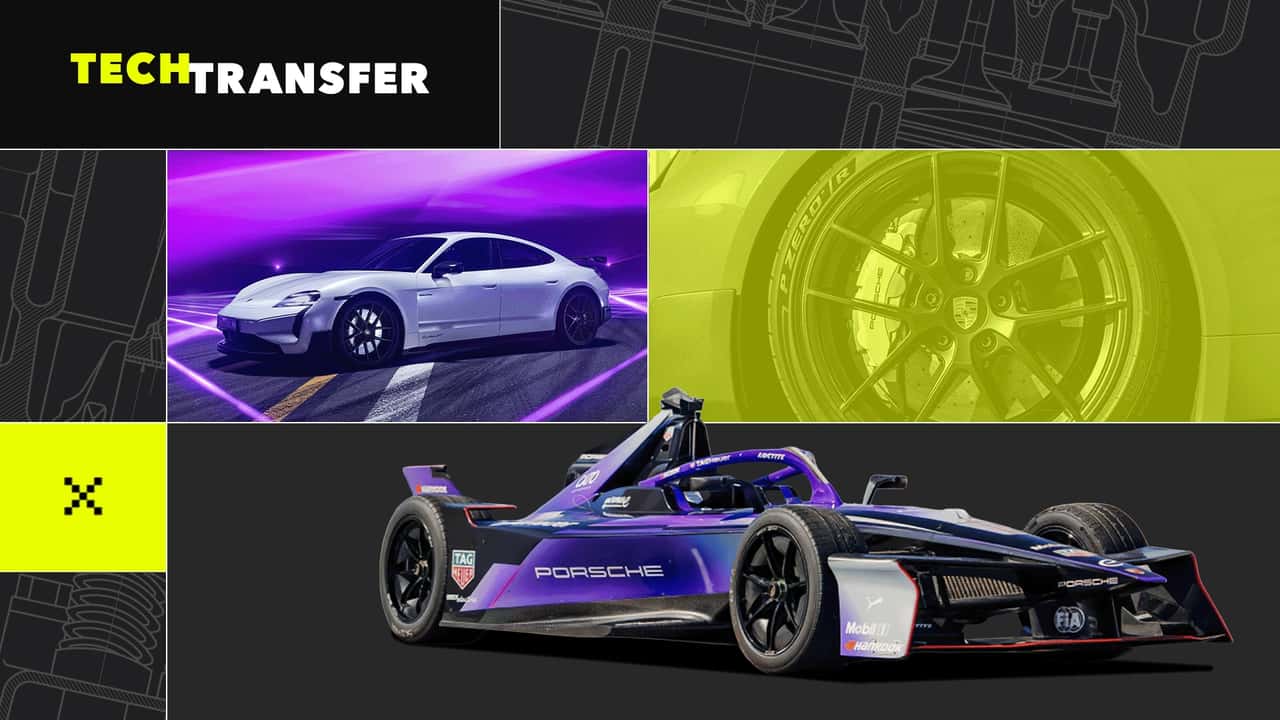
Photo by: Ralph Hermens | Motor1
Jeff Perez 
By: Jeff Perez
Feb 27, at 9:00am ET
Add Motor1.com as a preferred source in Google
- (https://twitter.com/intent/tweet?url=https%3A%2F%2Fwww.motor1.com%2Ffeatures%2F788453%2Fporsche-formula-e-ev-tech-transfer%2F&text=From%20Track%20to%20Taycan%3A%20How%20Porsche%20Uses%20Formula%20E%20As%20Its%20EV%20Testbed&via=motor1com)
- copy
Share
Comment
Since the dawn of the automobile, racing has served as the world’s fastest laboratory. Powertrains, chassis, and aerodynamics, all pushed to their limits in some of the most grueling conditions, with one overarching goal in mind: to go faster.
Formula 1 got its start more than 75 years ago, and the lessons learned in that time have not only spawned some of the world’s best sports cars—the McLaren F1, the Porsche Carrera GT, etc.—but also much of the engineering still used in modern road cars today.
Only recently has that same thinking been applied to electric vehicles.

Porsche Formula E At The 2026 Miami E-Prix
Photo by: Porsche
The rise of Formula E in 2014 and the uptick of high-performance EVs is no coincidence. Much like F1, the technology developed in the early days of Formula E helped shape many fledgling production EVs. Now, more than a decade later, Formula E technology is better than ever—and so is the technology making its way to road cars.
Take Porsche, for example. The German luxury marque took to the Formula E grid for the first time in the 2019-2020 season under the Tag Heuer outfit. Since then, it’s secured the Drivers' World Championship in 2024, as well as the Teams' and Manufacturers' World Championship just last year.
Much of that recent success comes at the hands of Team principal Florian Modlinger, who assumed the role in 2022. Modlinger’s racing management career spans brands like Abt Sportsline, Audi Sport, BMW Sport, and Maserati. This is his second stint at Formula E following a few years with Abt.
Porsche Formula E Team Principal Florian Modlinger
Photo by: Porsche
Modlinger knows a thing or two about building successful racing teams—as evidenced by his continued success. He also understands the importance of translating Porsche’s on-track success back into its road cars.
One of Porsche’s biggest breakthroughs in Formula E isn’t about battery size or aerodynamics, though—it’s energy recuperation. In the current Gen 3 race cars, regenerative braking can recover up to 600 kilowatts of energy, more than double the 265 kilowatts initially offered in the first Taycan EV, and more still than the latest Macan EV (240 kilowatts).
Depending on the track, the regenerative system handles up to 75 percent of deceleration. The hydraulic brakes on the front axle are mostly a backup.
Photos by: Porsche
Photos by: Porsche
"During normal driving, only the hydraulic brakes on the front axle are active, not on the rear," Modlinger tells me as we stand in the pits ahead of qualifying. "On the rear, you have no brake disc, no brake caliper. That's only an emergency brake."
This technology doesn’t just make Porsche faster on the track—it directly benefits road cars. Even though Porsche doesn’t currently offer one-pedal driving on its EVs (a sore spot for some enthusiasts), the upcoming 2026 Cayenne Electric will have the highest level of regenerative braking in a Porsche road car to date.
With technology borrowed from the brand’s Formula E race car, the Cayenne offers the same 600 kW regenerative braking capacity used on the track. That means it can capture more energy during braking and reduce wear on traditional brakes.
Photo by: Porsche
"600 kW is very impressive," Modlinger says. "A lot of braking situations [on the track] are only done by the recuperation. This is very road-relevant because the more recuperation you have, the smaller you can build your batteries with the same range."
Speaking of batteries—while Formula E cars have relatively small 38.5-kWh batteries for Gen 3 (increasing to about 55.0 kWh in Gen 4), the Cayenne’s battery is much larger at 108.0 kWh. The reason isn’t that the racing tech is inferior; on the track, it's all about efficiency and lightness.
Granted, that "lightness" strategy hasn't exactly translated to Porsche’s electric road cars—at least, not yet. The Cayenne tips the scales at a hefty 5,831 pounds. Still, Porsche understands the importance of weight, and it applies many of these lessons to its EVs, things like battery placement, cooling, and packaging.
'A lot of braking situations [on the track] are only done by the recuperation. This is very road-relevant because the more recuperation you have, the smaller you can build your batteries with the same range.'
"From the pure hardware technology, the e-motor we have here is direct liquid-cooled," Modlinger says. "Compared to the housing cooled, you want to make sure that if you want a high-power, long-lasting car, that the package and the weight can be significantly reduced. It gives you an advantage in weight, an advantage in the packaging."
But maybe the biggest key to Porsche’s success on the track comes down to what you can’t see: the software. While all Formula E cars share the same basic aerodynamics, bodywork, and even the front electric motor, as decided by the FIA, the secret sauce that makes each of these cars unique is the specific software developed in-house.
Without giving away any secrets, Modlinger says that the "software in Formula E is very complex." The proprietary technology controls everything from regenerative braking and the exact throttle output to energy recuperation. And a version of that software—adapted for road use—does the same in something like a Taycan or a Cayenne.
Photos by: Porsche
Photos by: Porsche
Now in its seventh season, Porsche has big goals for the Tag Heuer team—the biggest of which is another championship. But also important to Modlinger with the arrival of the Gen 4 cars next season is further narrowing the gap between Formula E and F1.
"In Monaco, we always race the same track," Modlinger says. "F1 is still significantly quicker from the lap time—about 18 percent quicker. But we closed the gap in the last year and saw how rapidly Formula E has evolved."
Of course, there’s still one big hurdle for Formula E that hasn't been much of an issue for F1: getting automakers to buy in.
What do you think?
View
Comments
Audi and Mercedes-EQ bowed out of the series after just a few years, while only a handful of brands remain alongside Porsche—Jaguar, Nissan, Renault, and a few others. The recent EV downturn, especially in the US, certainly isn’t helping, and the F1 push by rivals like Audi and Cadillac leaves the future of Formula E a bit murky.
Yet, Porsche believes in the merits of Formula E. In less than 15 years—far fewer than its counterparts at F1 have had—the series has grown exponentially. And with recent investments in the sport, it’s only bound to get better. As Modlinger puts it: "If you want to be active and shape electric motorsport, the place to be is here."
The Latest From Porsche
This Is The Porsche Panamera You Actually Want: Review
Porsche Celebrates 75 Years Of Racing With A Daytona Three-Peat
We want your opinion!
What would you like to see on Motor1.com?
Take our 3 minute survey.
- The Motor1.com Team
Share this Story
- (https://twitter.com/intent/tweet?url=https%3A%2F%2Fwww.motor1.com%2Ffeatures%2F788453%2Fporsche-formula-e-ev-tech-transfer%2F&text=From%20Track%20to%20Taycan%3A%20How%20Porsche%20Uses%20Formula%20E%20As%20Its%20EV%20Testbed&via=motor1com)
- copy
GO TO COMMENTS
(
)
Got a tip for us? Email: tips@motor1.com
View all comments ( )
Popular
Bugatti Restores One-Off Veyron With A Mirror-Like Aluminum Body
BMW Kept This Hatchback A Secret For Decades
Skoda Wants You To 3D Print Pieces Of Your Car At Home
The Gas BMW M3 Isn't Dead: Next-Gen Prototype Roars
latest articles
- The Ford Ranger Is Getting A Bigger V6 For 2027: Report Oct 20 - Rumors -
- BMW Already Has A Deal On The New i3. But It's Not Cheap Oct 20 - Pricing -
- Remember The Ford Flex? This Weird SUV Is Now A Great Used Buy Oct 20 - Why Buy? -
- Mercedes Isn't Sold On Extended-Range EVs: 'Would You Really Switch?' Oct 20 - Interview -
- Cadillac Driver Is Fed Up With Auto Stop. Then She Buys A $9 Item On Amazon To Disable It Oct 20 - Trending -
- Bugatti Restores One-Off Veyron With A Mirror-Like Aluminum Body Oct 20 - Supercars -
- Lexus NX Goes Hybrid Only For 2027 Oct 20 - Official -
RECOMMENDED FOR YOU
Woman Goes To Costco. Then She Gets Gas For Her Porsche Cayenne: ‘If You Can Afford A Porsche…’
The Ford Ranger Is Getting A Bigger V6 For 2027: Report
Porsche Won't Build An Electric Supercar Because 'There Is No Demand'
BMW Already Has A Deal On The New i3. But It's Not Cheap
Porsche Mission S Could Get A Manual If Customers Want One
Remember The Ford Flex? This Weird SUV Is Now A Great Used Buy
Listen To The Porsche Mission S Rev Its Mysterious Engine: Video