Home
BMW
Features
Remember When BMW Built a Mid-Engined Hatchback?
The ultimate driving machine for the city had a central driver's seat.
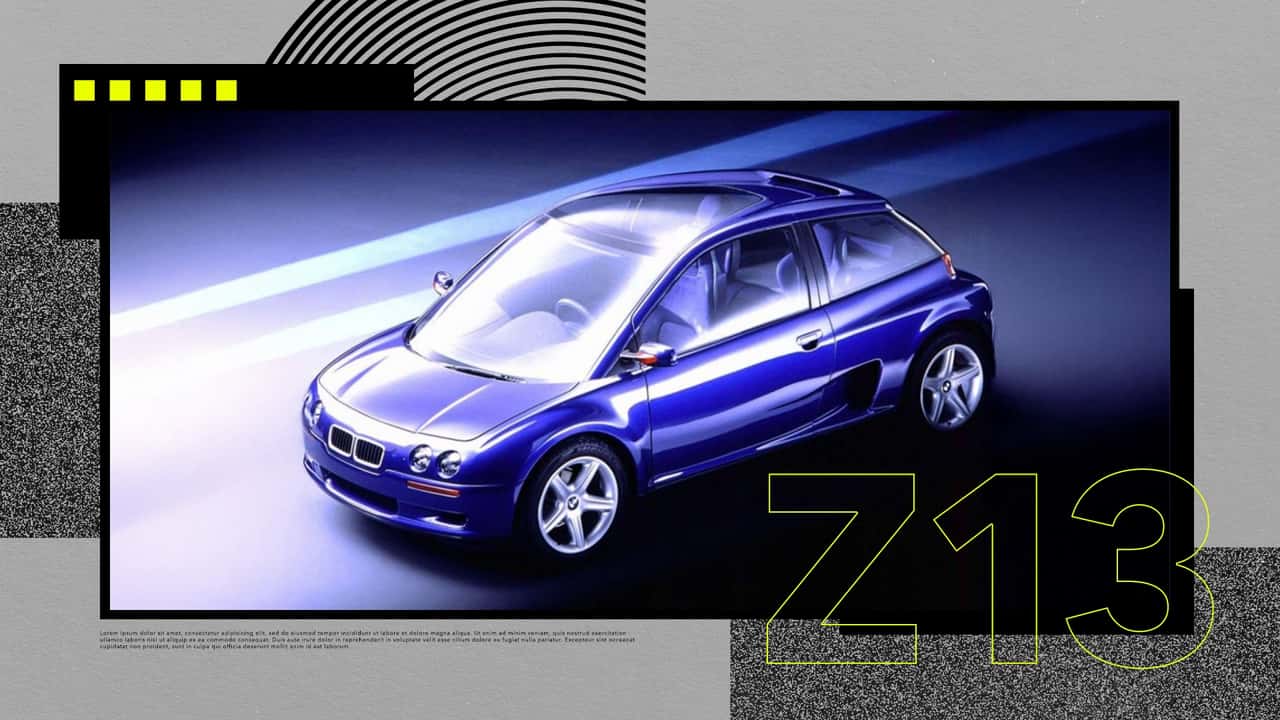
Photo by: BMW
Adrian Padeanu 
By: Adrian Padeanu
Updated: Jul 23, 2025 at 8:55am ET
Add Motor1.com as a preferred source in Google
- (https://twitter.com/intent/tweet?url=https%3A%2F%2Fwww.motor1.com%2Ffeatures%2F766691%2Fbmw-mid-engined-hatchback-concept-details%2F&text=Remember%20When%20BMW%20Built%20a%20Mid-Engined%20Hatchback%3F&via=motor1com)
- copy
Share
Comment
If you’ve been following Motor1 since the site's early days, you likely remember my long-running Concept We Forgot series. I’ve decided to bring it back and aim to improve it by taking a deeper dive into some of the most unusual concepts that have crossed my radar over the years. A good starting point is this: the 1993 BMW Z13. There’s more to this Bavarian city car than its quirky appearance, which alone is enough to warrant a closer look at the diminutive hatchback.
The Z13 tackled car bloat by shrinking the BMW formula down to just 135.4 inches in length. For context, the eccentric i3 electric hatchback was a full 22 inches longer. Despite its tiny footprint, the concept had enough room for three people in a McLaren F1-style layout, with a central driver’s seat and a pair of passenger seats mounted farther back on each side. This was all possible in a car that was only 64.5 inches wide.

Clever packaging included mounting the engine at the rear, just ahead of the axle. While the idea of a mid-engine hatchback might conjure thoughts of performance cars like the Renault Clio V6 or the more recent Toyota GR Yaris M concept, the Z13 was far from a hot hatch. It used a naturally aspirated inline-four derived from the BMW K1100 motorcycle.
With just 82 horsepower and 81 pound-feet of torque, it didn’t set your pulse racing. The fact that it featured a continuously variable transmission (CVT), believed to have been sourced from Ford, didn't help either. Although it wasn't your typical sporty Bimmer, it did stay true to BMW's rear-wheel-drive tradition.
The Z13 needed around 10 seconds to reach 62 miles per hour (100 km/h) and topped out at 112 miles per hour. But that was perfectly adequate for a car designed primarily for city use rather than chasing Nürburgring lap times. The idea wasn’t to create a performance car, but to offer a solution for people who typically drive alone and don’t need a 3 Series, let alone an even larger car. Here’s what prompted BMW to create what could’ve become an entry-level model had it reached production:
'To design a compact vehicle suitable for modern needs, with exemplary active and passive safety, a high level of comfort and convenience, convincing performance with acceptable economy and environmental acceptability, but also fun to drive and elegant but restrained in its appearance.'
To maximize interior space while keeping the car compact, BMW stretched the wheelbase to 90.5 inches, widened the tracks, and shortened the overhangs as much as possible. Weighing only 1,829 pounds, fuel economy must have been exceptional. The Z13 was built around a computer-optimized aluminum space frame and had a drag coefficient of 0.34, a remarkable figure for its time.
It rode on bespoke 16-inch alloys and featured air inlets ahead of the rear wheels to cool the engine and brakes. Despite its unconventional look, the Z13 remained instantly recognizable as a BMW, with a kidney grille flanked by twin headlights. Designers aimed to give it a mature appearance, even if it was thimble-sized.
While the exterior borrowed cues from traditional BMW models, the interior was nothing short of revolutionary. Beyond the central driving position, the cabin featured several innovations. The CVT was controlled via a rotary switch to the right of the steering wheel, while a navigation display and built-in phone were positioned to the left. It even had a telefax machine onboard, along with a subwoofer mounted between the rear seats.
Heat-insulating glass extended into the roof, making the cabin feel even more spacious. Rear passengers had individual armrests and reading lights mounted on the doors, designed to minimize disturbance to the driver. Folding the side seats made room for skis up to 6.5 feet (2 meters) long. With the rear seats upright and no front passenger seats, occupants could "stretch their legs out to an extent that cannot even be taken for granted in certain large luxury cars.”
BMW didn’t cut corners on safety either. The driver had an airbag, and the Z13’s frame with its large crossmembers and thick B-pillars provided solid side-impact protection. Without a front-mounted engine, engineers had more freedom to maximize the crumple zone. Computer simulations in the early 1990s showed the Z13 met “the world’s toughest automobile safety standards.”
What do you think?
View
Comments
The Z13 was the third vehicle (after the Z1 roadster and E1 electric hatchback) developed by BMW Technik GmbH, a wholly owned subsidiary founded in 1985. Essentially a skunkworks division, Technik produced numerous innovative concepts from the late 1980s to the early 2000s. It was renamed BMW Forschung und Technik GmbH in 2003 and continues to focus on research and development to this day.
At the time, BMW emphasized the Z13 was “not just a technical guinea-pig for experimental purposes, but a vision that could easily be turned into a reality.” A second prototype appeared in 1994, this time featuring a five-speed manual gearbox and a larger 1.2-liter engine sourced from the K1200 motorcycle. Even so, the city car never made it to production. Why? Later that same year, BMW acquired the rights to the Mini brand, and the rest is history.
1993 BMW Z13 concept
24




We want your opinion!
What would you like to see on Motor1.com?
Take our 3 minute survey.
- The Motor1.com Team
Share this Story
- (https://twitter.com/intent/tweet?url=https%3A%2F%2Fwww.motor1.com%2Ffeatures%2F766691%2Fbmw-mid-engined-hatchback-concept-details%2F&text=Remember%20When%20BMW%20Built%20a%20Mid-Engined%20Hatchback%3F&via=motor1com)
- copy
GO TO COMMENTS
(
)
Got a tip for us? Email: tips@motor1.com
View all comments ( )
Popular
The 15 Best Movie Cars of All Time, Ranked
KTM's Lightweight Supercar Is Finally Coming To America
You Might Finally Be Able To Afford An Aston Martin Vanquish
Audi's Full-Size SUV Was Worth The Wait: Driven
Turo Now Lets You Rent A Tesla With Full Self-Driving
latest articles
- Porsche Says No To US Factories While Audi Pours $4 Billion Into Georgia Oct 27 - Manufacturing / Production -
- Woman's Certified Pre-Owned Genesis GV70 Starts Pulling. Suddenly, There’s Fluid On The Floor Oct 27 - Trending -
- F1 Cars Have A Bunch Of Steering Wheel Buttons. What Do They All Do? Oct 27 - Motor101 -
- Koenigsegg Recalled Every CC850 In America. All Seven Of Them Oct 27 - Supercars -
- KTM's Lightweight Supercar Is Finally Coming To America Oct 27 - Supercars -
- How Porsche's US Headquarters Became Home To Marvel's Avengers Oct 27 - Motor101 -
- You Might Finally Be Able To Afford An Aston Martin Vanquish Oct 27 - Why Buy? -
RECOMMENDED FOR YOU
These Automakers Have The Strangest Headquarters
Toyota Put Snow Tracks On Five Of Its Trucks and SUVs. Because Why Not?
The BMW iX5 Makes A Strong Case Against The Gas X5: Driven
Mazda Drops The CX-70 For A Two-Row CX-90
The 2027 BMW X5 Is Hugely Improved Where It Matters Most: Driven
Police Recovered $54,000 Worth Of Hot Wheels After A Train Heist
For Around $40,000, You Can Buy BMW's Sports Car Of The Future